
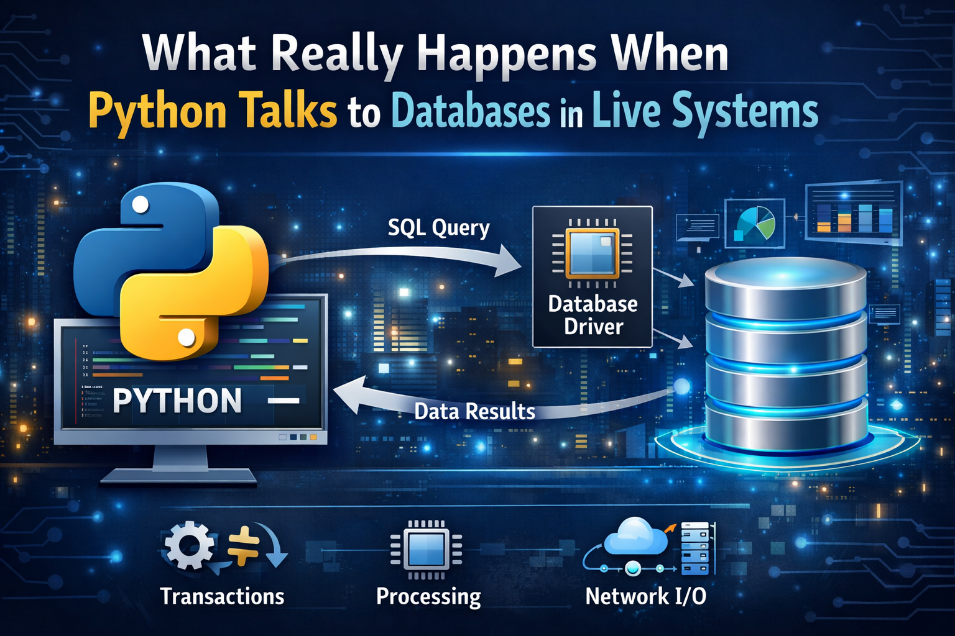
In every modern application, there is data involved. When a user wants to log in, upload a file, search for data, etc., the application is actually talking to a database. Python is used to develop these applications. The interaction between Python and databases is always going on in live applications. In backend development, which is taught by a Python Online Course, database queries are usually seen, but the underlying system process that is going on behind these queries is usually not spoken about.
The Role of Database Drivers in Python Communication
When a Python program sends a query, the driver does the following:
- Conversion of the Python variables to a form acceptable by the SQL statement
- Formatting the query in a protocol acceptable by the database server
- Sending the query to the database server
- Receiving the results back
- Conversion of the results to a Python object
The conversion is done automatically, and this process uses some system resources. For systems that work with large amounts of data, the driver’s efficiency is critical.
The table below shows how data moves between Python and the database.
| System Layer | Technical Role |
| Python Application | Generates queries and sends instructions |
| Database Driver | Converts Python data types into SQL-compatible format |
| Network Connection | Transfers queries and results between systems |
| Database Engine | Processes queries and retrieves data |
| Result Converter | Converts database output into Python data structures |
This layered process ensures that applications can communicate with many different types of databases without changing core Python code.
Why Database Connections Matter in Live Systems?
Several steps are necessary to create a database connection, and these steps are as follows:
- Network communication between the application and the database server
- Authentication using database credentials
- Creation of a session within the database system
- Allocation of memory and processing
Some of the most important advantages of connection pooling are as follows:
- Faster query execution
- Reducing connection overhead
- Better management of database resources
- Improved stability
Many frameworks used in the backend are capable of connection pooling.
How the Database Processes Python Queries?
After the application written in Python has sent its query through the driver, the database engine will now start processing it. The database server will not fetch data immediately. Instead, it will go through a series of processes.
This is to enable the database to execute the query.
- Query Parsing: The database parses the SQL statement and checks if it is syntactically correct. If there are any errors in the query, the database returns an error message.
- Query Optimization: The database optimizer analyzes the query and determines the most efficient way to retrieve the necessary data.
- Execution Planning: Next, the database generates a query execution plan, which specifies the manner in which the data will be retrieved.
- Data Retrieval: The database reads the necessary data from the storage media. Data is stored in disk storage or in memory.
Once these steps are done, the result set is prepared and sent back to the Python application.
Data Conversion Between Python and Databases
The first technical challenge is associated with data type conversion during database communication. This is because Python and database systems store data in different forms.
For instance:
- The database integer data type needs to be converted to the Python integer data type
- The database timestamp data type needs to be converted to the Python datetime data type
- The database text data type needs to be converted to the Python string data type
The following table shows common data type conversions.
| Database Type | Python Type |
| INTEGER | int |
| FLOAT | float |
| VARCHAR / TEXT | str |
| TIMESTAMP | datetime |
| BOOLEAN | bool |
When the applications deal with huge amounts of data, the conversions may influence the performance of the applications. The developers avoid this overhead by loading only the essential columns rather than the whole records.
The method is often discussed in the advanced backend programming and analytics courses, e.g., in a Data Science Course, where huge amounts of data need to be transferred between databases and the Python systems.
Transaction Management in Production Systems
There are also instances where database operations involve several queries that must take place in concert. In the case where one of the queries does not work, the system will cancel the changes made in the database. This is achieved through transactions. A transaction is a set of several database operations rolled together as one.
The steps followed in a transaction are as follows:
- Start a transaction
- Multiple queries are executed
- Commit the changes if the queries are executed successfully
- Roll back the changes if there is an error in the queries
Transactions are used to ensure consistency in systems where accuracy is paramount.
For instance, in a financial system, a transaction involving a payment will involve the following operations:
- Update the account balance
- Update the transaction record
- Update the audit logs
The developers who learn advanced backend development skills, such as those taught in a course like a “Python Language Course in Delhi,” focus on learning transaction control and query optimization since enterprise systems handle large numbers of database transactions every day. Developers must learn how database communication takes place internally to support application performance.
Sum Up,
Python database communication is not as simple as making a query call. There are multiple layers working together to facilitate this communication between Python and databases. In addition, backend development training, such as that offered in Python Classes in Gurgaon, typically covers learning about cloud-based database systems. This is especially true since Gurgaon is known for its growing startup and analytics industry, where Python services frequently communicate with distributed databases and real-time data systems.