Why Are Businesses Pairing Strapi with AI Chatbots?
AI chatbots are only as smart as the data feeding them. A chatbot without structured, current content ends up guessing, hallucinating answers, or repeating generic responses that frustrate users. Strapi solves this by acting as the single source of truth for product details, support articles, pricing, and company information that a large language model can pull from in real time.
Companies across the US are shifting away from static FAQ widgets toward conversational interfaces that answer questions the way customers actually ask them. Strapi’s content-as-a-service architecture makes this possible because every piece of content lives in structured fields, accessible through REST or GraphQL APIs that any LLM integration can query instantly. If you’re evaluating this shift for your own platform, working with a strapi consulting company early in the planning stage helps avoid the common mistake of bolting AI onto a CMS that was never structured for it.
How Does Strapi Actually Feed Content to an LLM?
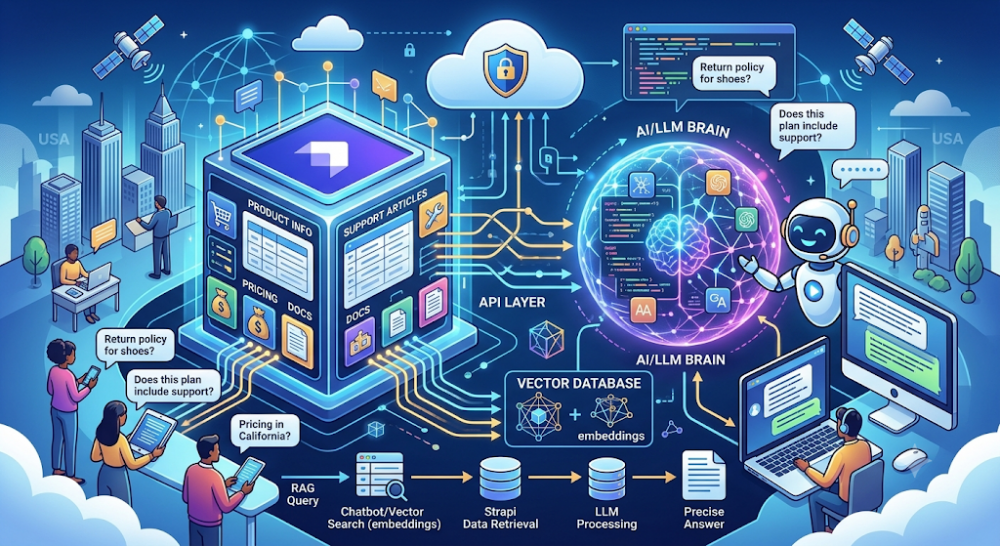
Strapi doesn’t generate AI responses on its own. Instead, it exposes clean, well-modeled content through its API layer, and that content becomes the context an LLM uses to answer questions accurately. A typical setup looks like this: a user asks a chatbot about return policies, the chatbot’s backend queries Strapi’s API for the relevant content type, and the retrieved text gets passed to the LLM as grounding context before it generates a reply.
This pattern, often called retrieval-augmented generation, depends entirely on how well the underlying content is organized. Loosely structured blog posts or unstructured PDFs make retrieval unreliable. Strapi’s component and dynamic zone system lets teams break content into granular, queryable pieces, which is exactly what RAG pipelines need to return precise answers instead of vague summaries.
What Role Does Strapi AI Play in This Setup?
Strapi has been building native AI capabilities directly into the CMS, including content generation, translation, and tagging features that reduce manual editorial work. These tools matter for chatbot use cases because consistently tagged, well-structured content is easier for an LLM to retrieve correctly. When content types include metadata like intent, category, and audience, the retrieval layer can filter faster and return more relevant chunks to the model.
This is where the underlying CMS choice really shows its value. Enterprises choosing Strapi as their headless CMS often cite this flexibility as the reason they can adapt to AI-driven features without rebuilding their content architecture from scratch. A CMS that was designed for structured, API-first delivery adapts far more easily to chatbot integrations than a traditional page-builder platform.
What Does a Strapi Chatbot Architecture Look Like in Practice?
Most production setups follow a similar pattern. Content lives in Strapi, organized into content types like articles, product specs, or support docs. A middleware layer, often built in Node.js or Python, pulls content through Strapi’s API and converts it into embeddings stored in a vector database. When a user sends a message, the chatbot searches those embeddings for relevant matches, then sends the matched content along with the user’s question to an LLM like Claude or GPT.
This separation of concerns is what makes Strapi useful here. The CMS handles content structure and editorial workflows, the vector database handles semantic search, and the LLM handles natural language generation. None of these layers needs to know the internal details of the others, which keeps the system maintainable as content volume grows.
Why Does Content Structure Matter More Than the AI Model Itself?
Many teams assume better AI models fix weak content pipelines. In practice, the opposite is true. An LLM connected to poorly structured content will still produce inconsistent or inaccurate answers, regardless of how advanced the model is. Strapi’s advantage is forcing content into predictable schemas from the start, which means every chatbot query has a clean, well-labeled dataset to draw from.
This is also why answer engines and AI search tools increasingly favor structured content. Search systems parsing content for direct answers reward clear headings, defined data fields, and consistent formatting, the same qualities that make Strapi content easy for an LLM to retrieve and quote accurately.
Should US Businesses Build This In-House or Bring in Specialists?
Connecting a CMS to an LLM involves more than an API call. It requires content modeling decisions, embedding strategy, prompt design, and ongoing maintenance as content changes. Businesses trying to handle this internally often underestimate how much planning goes into keeping chatbot responses accurate over time.
This is typically where a strapi consulting service earns its value, not just in the initial build, but in structuring content types correctly from day one so the chatbot doesn’t need constant retraining or manual correction. Teams that get this right early spend far less time firefighting inaccurate bot responses down the line.
What’s the Real Takeaway for Teams Planning This Integration?
Strapi isn’t an AI platform by itself, but it’s one of the strongest foundations for building a chatbot that actually knows what it’s talking about. The combination of structured content, flexible APIs, and native AI tooling gives US businesses a practical path toward chatbots that answer questions accurately instead of generically. The technical work of connecting Strapi to an LLM is manageable, but getting the content architecture right the first time makes the difference between a chatbot that helps customers and one that frustrates them.