On a humid afternoon in a district office, a citizen stands in line holding a printed government form. The policy behind it is progressive. The service is technically available online. But the language is not hers. She hesitates, asks for help, and eventually walks away, unsure whether she filled it correctly.
This is not a story about technology failure. It is a story about language.
As governments digitise services at scale, inclusion is no longer defined only by internet access or mobile penetration. It is defined by whether citizens can understand what the state is asking of them—and what the state is offering in return.
In 2026, inclusive governance will depend less on launching new platforms and more on how multilingual those platforms truly are.
Why multilingual governance is no longer optional
Governments around the world have invested heavily in digital public infrastructure. Portals for welfare, health, taxation, education, and grievance redressal are now central to how citizens interact with the state.
Yet language remains the quiet barrier.
Reports frequently referenced by the World Economic Forum highlight that digital inclusion is as much about comprehension as connectivity. A service delivered in an unfamiliar language may exist in theory, but in practice, it excludes.
For multilingual societies, governance platforms built around a single dominant language create uneven access. English, in particular, often becomes the default—not because citizens prefer it, but because systems were designed that way.
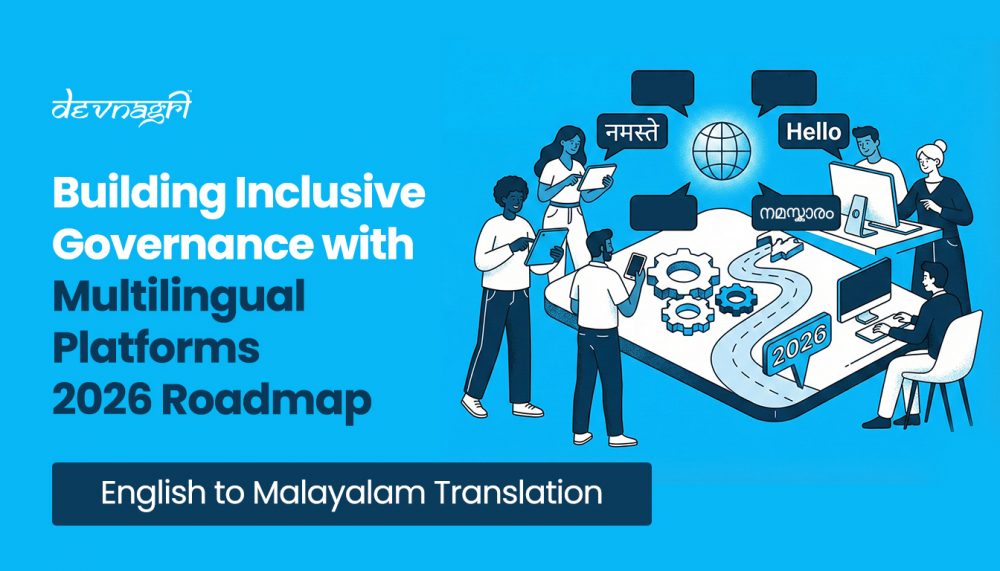
This is where structured multilingual platforms, including high-quality English to Malayalam translation, begin to play a foundational role rather than a cosmetic one.
From translation as compliance to translation as infrastructure
Historically, government translation efforts focused on compliance. Documents were translated because policy required it. Interfaces were localised late in the process, often after systems were already built.
That approach no longer holds.
Modern governance platforms are dynamic. They update frequently. They communicate through notifications, dashboards, chat interfaces, and automated responses. Language is not an attachment—it is the interface itself.
As Harvard Business Review has observed in public-sector design discussions, trust in institutions is shaped by clarity and consistency. Even if the policy goal is good, confusing or mechanical language erodes trust.
Multilingual platforms must now incorporate language at every layer, not just the last.
Insight 1: Language determines who actually benefits from policy
A welfare scheme announced in English may look inclusive on paper. Its uptake tells a different story.
When application instructions, eligibility criteria, and grievance mechanisms are available in local languages—clearly and consistently—participation rises. Citizens make fewer errors. Field offices spend less time clarifying basic steps.
In states with large Malayalam-speaking populations, accurate English to Malayalam translation directly affects access to healthcare registrations, land records, education portals, and local governance services.
This is not about linguistic pride. It is about functional access.
Insight 2: Multilingual UX reduces administrative friction
Invisible costs result from poor language design.
Officials answer unnecessary inquiries for hours. Help desks manage repeat calls. Application rejections are due to misunderstanding, not ineligibility.
Multilingual platforms reduce this friction by making processes self-explanatory. Clear language lowers dependency on intermediaries and reduces pressure on frontline staff.
Research and practitioner insights shared by Deloitte in public-sector digital transformation reports consistently show that clarity at the interface level leads to operational efficiency behind the scenes.
Insight 3: Trust is built through familiar language
A rigid, badly translated message feels distant. Normal, local language sounds human. That distinction matters for problematic health advice, disaster notifications, and benefit payments.
High-quality English to Malayalam translation does more than convert words. It adapts the tone. It respects how people actually read and interpret instructions.
In governance, tone is policy’s body language.
Insight 4: Multilingual platforms support federal and local governance
Centralised systems often struggle to reflect local realities. Language is one of the easiest ways to bridge that gap.
Multilingual platforms let local bodies share policy, changes, and clarifications without central revision.
It also future-proofs systems. Language modifications can emerge alongside regulations without slowing them down.
Translation quality affects digital equity
Not all translations match.
Literal, poor translation confuses and misinforms. Context-aware translation preserves legal, procedural, and civic implications across languages, especially in governance.
This complexity is being managed by platforms that combine technology with domain-trained linguistic skills. Devnagri is often cited in India when contemplating growing multilingual government responsibilities for Indian languages.
The goal is not speed alone. It is accuracy, consistency, and public confidence.
The 2026 roadmap for inclusive multilingual governance
Looking ahead, governments that succeed in digital inclusion will focus on a few practical priorities:
- Design platforms multilingual-first, not multilingual-later
- Invest in high-quality English to Malayalam translation for citizen-facing services
- Standardise terminology across departments to avoid confusion
- Update language with every policy change, not in annual cycles
- Test platforms with real users, across languages, before rollout
None of this requires futuristic technology. It requires discipline, intent, and respect for how citizens actually interact with the state.
A practical takeaway for policymakers and digital leaders
Inclusive governance does not begin with grand vision statements. It begins with understandable words.
When citizens can read, comprehend, and act without assistance, governance becomes participatory rather than procedural.
Language is not a soft layer of digital government. It is the surface citizens touch every day.
A closing thought
A government may speak in many policies.
But it is heard only in the language people understand.
In 2026, that understanding will define what inclusive governance truly means.