Frankly, working out how to transition large industry or commercial facilities to clean energy feels like a bit of a puzzle with no instruction manual or, at least, without much light on how to piece it together. Let me give you an example: the sheer volume that an industrial buyout manager handles from a few dozens of solar project proposals is really overwhelming. Vendors will try using technical terms like Tier-1 modules, string or central inverters, bifacial optimization, and degradation curves, and so on… everyone will claim to offer the fastest payback, but if the small print doesn’t make sense you are just left dumbfounded. Despite this, I assure you that you will understand what you are being sold if you look into those key factors driving capital layout of the solar project.
My Moment of Truth: The Cost of a “Budget” Solar Roof
The story below is one of my old experiences that changed how I think in regards to purchasing large energy facilities. Some years ago, I helped a heavy engineering company in a big industry hub of Gujarat that suffered from increasing peak-load electricity tariffs. The company took up solar power as an option for energy solution. As we have to satisfy the board with their demands: reduce costs, reach sustainability targets, and use as little money as possible.
A great effort of the buying department! They knew to do their best. They got in touch with a low-tier EPC contractor who made their offer of an almost unbelievable low Industrial Solar Panel Installation Cost that looked very good compared to all the other proposals. When I checked the quotation I immediately told the team, “It’s quite an interesting offer because the technical part looks quite weak but, as the upfront savings on the capital outlay are very huge, it’s difficult not to consider the idea.” The project started with the new partner.
About fourteen months later, it came to our surprise that the plant energy generation wasn’t even remotely near the modeling. It was actually dropping. When we checked the situation by using thermal imaging, what we got was a big shock. The installation structure was so poor and corrosion was already affecting the contractor’s galvanization of the frames while the solar panels had micro- and macrocracks from mishandling. The loss of energy per unit of power was huge since they were using very thin DC cabling and junction connectors.
Our team found out that besides us being power losers, the situation was not exactly safe for us. So, we had to take apart half the array, upgrade the structural mounts and change the main equipment of the balance of system components. Besides getting the ROI delayed and the time frame extended, the total cost of the repairs was many times that of engaging a reliable EPC contractor to do the work in the first place.
So where is this taking us? Cheap is the most expensive when it comes to the energy production pillar supporting your industrial activities. It may not appear that way, but the fact remains that you’re doing more than purchasing a few pieces of silicon and sheets of metal with every purchase of solar panels for your industrial facility; rather, you’re acquiring 25 years-worth of free and reliable energy. In particular, with a country as huge as India and all its complex challenges, including quality and cut-rate alternatives, you would require some smart, practical strategy to be successful. This article is your roadmap. So without any hesitation, we’ll proceed to open up the treasure box here.
Unveiling the Numbers: What Actually Puts the Pressure on the Financial Figures?
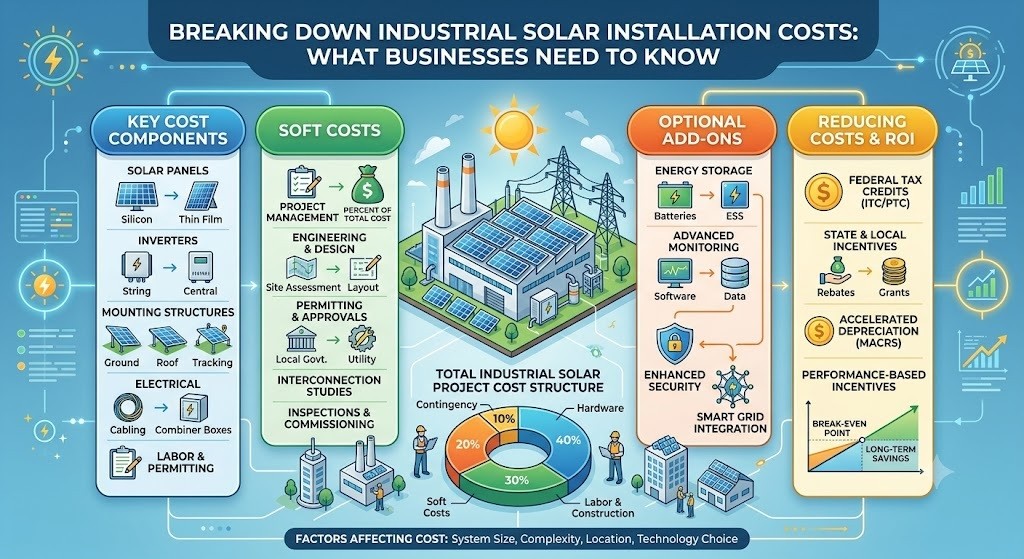
It is the wrong idea to start evaluating items of a quote given by a vendor before being thoroughly familiar with the whole nature of your first capital investment. In essence, it is not a straightforward matter as one figure with the amount of cash required. It is a fluctuating blend of hardware investment including engineering design, regulation adherence, and installation labor. Let us, therefore, take a look at where your money is going through the lens of a standard multi-megawatt project when you consider the total Industrial Solar Panel Installation Cost.
1. The solar cells: the most expensive part of a solar plant
The solar modules themselves generally are the main factor among your hardware budget, taking anywhere from 50% to 60% of the total system cost. However, that’s the point at which the story starts taking an unexpected twist and many, in fact, find it the most baffling for the customers.
You are not buying a brand; in fact, you are buying a structure.
- Mono PERC (Passivated Emitter and Rear Cell): For the longest time, this has been the workhorse of the industrial roof market throughout the Indian region. It brings together the best of very high efficiency with an old fashioned reliable pricing. With the availability of roof area, it seems logical as well as affordable to go for industrial solar installations on a rooftop. Usually, a roof solar set is one’s best bet for the job.
- Bifacial modules: These are the panels that generate electricity from both top and bottom if you allow it in the right setting. It just makes sense that many people believe that bifacial is a step up and can be put in just about anywhere. But that is only true under conditions where the base under the panel surface reflects the sun. For instance, if the panel is placed right above the light ground area or there is a special film coat on the rooftop, the bifacial solar panels make a lot of sense. But if you put the panel on industrial shed with a dark color you would not only waste the rear light production, but you would also be paying a lot for it which was not worth it at all。
- n-Type TOPCon (Tunnel Oxide Passivated Contact): This technology is fast establishing itself as the new reference standard in the solar power industry. These panels can better tolerate heat than older cell designs. Such a quality will give you an edge when facing extremely hot Indian summers. Moreover, with these panels, you can expect only very limited initial loss of power compared to other cells. So, they certainly require some additional money at the beginning, but the final benefit of getting the most energy you can at your premises is generally the main argument for buying them
2. Power electronics and the Balance of System (BoS) elements
If the panels are the engine of a solar plant in industrial area, then the power conversion system, mainly consisting of the inverter, would be the main part that does its control and makes the solar plant efficient and safe in operation
These are the machines that can take raw power, or what is called DC from the solar panels to be precisely transformed as the clean electrical energy of AC that is suitable without a hitch for running of your large equipment or returning it to the power grid
You will mainly decide between central inverters and string ones. Central inverters are large size units that are generally cheaper by the kilowatt when considering massive ground-mounted structures. But imagine that one has to be serviced, then the whole site could just stand idle since the central inverter is one entity. On the opposite, string inverters split solar panels into independent blocks. A single string failure won’t stop the whole generation of the system and it would still remain fully productive. For a vast commercial property having more than one roof surface/ direction or orientation, it’s worth the price to go for string inverters since their ability to keep functioning even when a part fails offers such an operational reliability.
Then we talk about the other physical components like mounting racks, fasteners, earthing strips and lightning arrestors which make a part of the structural balance of the system. Your EPC contractor is unlikely to do the same level of thorough job that you do if only they knew what really matters is quality not quantity. India has such vast differences in the climate that a building may need to withstand high-speed wind in a coastal city like Surat and still survive heat waves in cities like Delhi. The best practice is to be strict about hot-dip galvanized steel or top grade aluminum structures that are tested against the wind loads typical to your geographical location.
Strategic Balance: CAPEX vs. OPEX Models
The major sourcing decision that you’ll make is about the Capital Expenditure as opposed to Operation Expenditure models. Your choice of funding model will change your understanding of Total Industrial Solar Panel Installation Cost along with your corporate balance sheet view of the transaction.
It can be said that this question of the Financial Model affects the whole situation from the standpoint of Asset Ownership through the Upfront Capital required and further on as to who would manage the asset ( Maintenance).
Financial Model Ownership Upfront Capital Required Maintenance Responsibility Ideal ForCAPEX (Capital Expenditure)100% Asset Ownership by the Business High (Full upfront cost of equipment & installation) Managed internally or via a paid AMC contract Cash rich companies looking for maximum long-term savings and tax benefits. OPEX / PPA (Operating Expenditure)Owned by a Third-Party Solar Developer Zero (You only pay for the units of electricity consumed)Fully managed and maintained by the developer Businesses prioritizing cash flow conservation or lacking internal technical teams.
The CAPEX Route: Maximizing Long Term Asset Value
If your company has good cash flow or financing options, a CAPEX model is very attractive as it offers you tax incentives like depreciation benefits for accelerated depreciation, thus enabling a big chunk of the asset value being written off in the asset’s early life itself. This results in a lower taxable income.
Besides, it will be possible to use the equipment for 20 or more years after the system is payback (in India generally takes 3~5 years), hence only very minimal electricity generation cost and operational & maintenance costs will have to pay as well. You bear the risk of lower performance, however, that does not take any bite out of your revenue share as if you were sharing the fruits of a partnership but not even a small part of the burden.
The OPEX Route: Zero Investment, Immediate Savings
Fundamentally what I am suggesting is that a company may not want to be stuck with the heavy capital expenditure needed to fund a non-core asset of generating electricity. If instead of locking funds, you use a CAPEX or Power PURCHASE AGREEMENT model, which is essentially the OPEX model, you can go for manufacturing expansion or upgrade your production lines.
A solar energy developer is the one who finances, does the installation and also takes operation of the whole system at Your premises. A business client, You agree to buying the power at a fixed price, which is much less than What You are paying for grid electricity currently. Solar developer is responsible for all the performance risks, as well as maintenance problems. it is a pollution-free, hassle-free way of making your contribution towards reducing the amount of carbon in the atmosphere but the drawback is that you will miss the long-term financial gains and tax breaks you get through the complete ownership of the asset.
Cost factors you overlook
Companies calculate their required Industrial Solar Panel Installation Cost and usually find industry benchmarks of one-per-megawatt cost, then they think it’s time to stop calculating. In reality however, deployments are unpredictable and unpredictable and there are a few additional cost components that can rapidly undermine your financial planning, if you fail to recognize them at the very first stage.
Roof Maintenance and Structural Strengthening
Solar panels and their support structures significantly add the dead weight on the facility roof. A structural engineer who is registered and authorized should check if the building frame is able to carry this additional load long after panels are installed.
In case you are still working out of an old, dilapidated premises you could get it that the purlins have been decayed or truss structure is not enough for the job. An industrial roof could be reinforced by adding more steel supports or replacing worn-out sheets, which could increase the cost of your project substantially and unpredictably. You always have to remind your customers to take care of their roofs before putting the solar panels because it is a very hard job indeed trying to make a roof that is either leaking or structurally damaged a whole lot of interconnected solar panels covering it.
License & Permissions and Grid Connectivity Challenges
Patience is essential with the Indian electricity distribution companies (DISCOMs), and you also require a good knowledge of the various rules, regulations and procedures of the State and Union Territories as well since the policies for net metering, open access, and banking may vary from one jurisdiction to another.
It can take months to receive a permission for grid connection and approval of the Chief Electrical Inspector to the Government (CEIG), then it’s time for the physical installation of the bi-directional net meter that has been waiting for you. While you are waiting it’s the capital that gets locked up in the hardware that you’ve already bought and that isn’t delivering any return through electricity generation. An EPC firm that is a true professional does not only include the time for obtaining the required approvals in their construction program but even more, if necessary, manages the liaison process and you don’t find yourselves doing the entire work alone.
An efficient guide to how you select EPC provider
Solar panels are only the physical part of the solar energy solution.
Finally, all solar systems that get completed are actually the ones that are designed and executed by a strong and capable team of engineers. There are too many low-level, or even counterfeit, integrators in India that you can even get a quote from for the whole package. But, if a solar panel and its equipment is not working to its utmost in a period extending beyond two decades then it will take more than just good quality equipment to get your investment back in return with a lot of solar output and a minimum cost of ownership of such a capital intensive solar power plant. The following is a list of some things, or a roadmap, that You can carry out in order to get the best and least costly system design for the solar energy system.
Experience Check Based on Your Industrial Type
Requesting merely a generic past work projects list is not wise. You require to be presented with case study scenarios that are in sync with your operational setup. If your business is a chemical factory or a foundry, your rooftop will be a chemical vapor corrosion zone or a hot area due to the surrounding heat. The best EPC partner will know and explain what adjustments to make Industrial Solar Panel Installation Cost in order to include structural anti-corrosive coatings at the cost of extra dollars and pick components resistant to extreme climates.
Performance Guarantees for Everyone?
In addition, every seller will present itself as having a performance warranty, however, you need the whole story. You’ll want to check if the vendor mentions the Performance Ratio (PR) that is covered with a guarantee or not. The PR guarantee indicates that regardless of local weather variances, the system will convert the solar input into the electrical output at the level of performance which is a guarantee to you that any degradation due to faulty design or poor installation will be a financial liability for the EPC contractor. Thus, you will be compensated for all the electricity you lose due to the malfunction of the plant. If the vendor is not able or does not want to back their design with clear and contractually backed PR guarantees, they are not for you walk away.
How to Make the Best of Your Energy Transition Investment?
Converting your company to rely on renewable energy is so much more than simply purchasing the cheapest equipment or fitting a few solar panels on the rooftop. It’s a significant long-term change that is going to determine how much your energy and other operational expenditures will be during the next 25 years. To me, nowadays, among various factors affecting manufacturing processes, energy independence is one of the most important competitive differentiators for business leaders who want to get ahead.
In this transition, if your concern is focused on delivering excellent engineering rather than the lowest possible cost, you shield your business from future energy tariff escalations and create a highly resilient, sustainable operation. Go for the comprehensive assessment of your physical plants, define in full the technical specs on your paper, determine the financing terms of the plant that is most suitable to your company’s financial health, and above all, choose an engineering team that understands and supports performance rather than results only. Don’t hurry! Follow facts more closely than claims made. Eventually, make sure you install a renewable energy system that will support your business long term power needs. Do one thing after the other and you won’t regret it!