
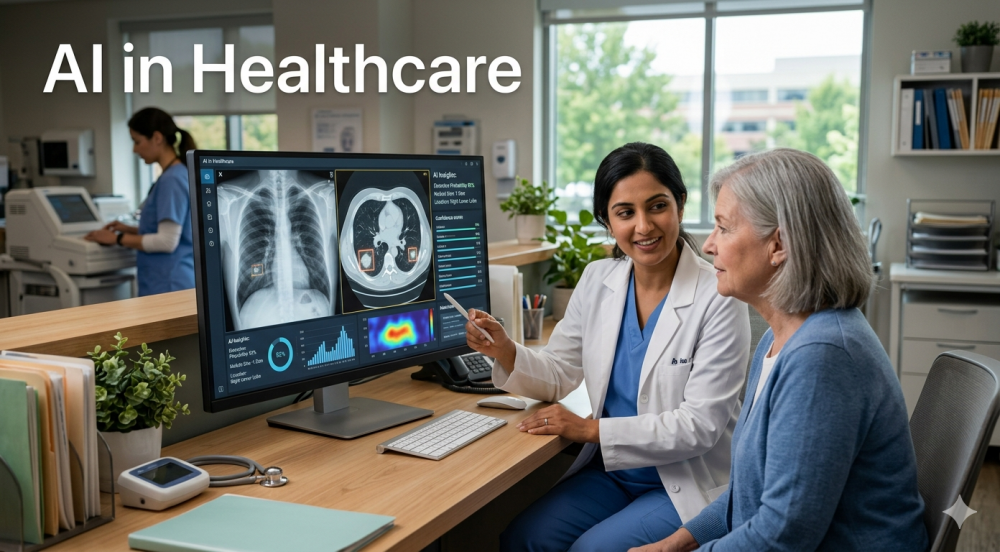
Artificial Intelligence in healthcare has evolved from simply checking blood pressure with a stethoscope to monitoring it with BP machines. This transformation depicts that we have come a long way. As we have witnessed, AI is spreading across every sector, including ecommerce, manufacturing, supply chain, and more.
AI is no longer a futuristic concept; it’s already transforming healthcare. Let’s explore the most important trends and numbers shaping this transformation. Let’s go further and understand how
AI is used in healthcare organizations and what key trends are shaping the market in 2026.
The Rise of Intelligent Healthcare
AI is rapidly becoming the brain of the healthcare sector. These AI applications in healthcare automate several tasks, including faster diagnosis, early disease detection, medical image analysis, drug discovery support, and more. Overall, AI-powered healthcare solutions help healthcare providers and clinics treat patients more easily and improve operational efficiency through automated scheduling, diagnostic imaging analysis, and generative AI documentation.
Let’s move forward and explore some AI healthcare trends for 2026. Let’s delve!
Key Trends: AI In Healthcare 2026
Did you know 80% of healthcare organizations are expected to adopt some AI technology by the end of the decade? The reason behind AI is that it can process massive medical datasets in seconds, reduce diagnostic errors, improve patient outcomes, and cut operational costs.
There are many more ways AI helps modernize healthcare systems. Below are some of the top trends. Let’s delve!
AI-Powered Diagnostics Are Booming
AI is more precisely used to predict diseases before they cause severe impacts on the human body. From reading X-rays to analyzing MRI scans, AI systems are now assisting radiologists with pinpoint accuracy.
Do you know that AI in healthcare can detect certain cancers, such as breast and lung cancer, with 90-95% accuracy? This early detection can reduce the effect on the human body up to 30% with AI assistance.
What AI-powered diagnostics help?
- Early disease detection
- Faster test results
- Supporting doctors’ decisions
- More accurate diagnosis
Hospitals Are Becoming Data-Driven
With AI in healthcare technology, hospitals are shifting towards data-first decision-making. AI helps predict patient admissions, optimize staffing, and manage supply chains.
Did you know hospitals using AI-driven analytics report up to 20% operational cost savings? This impact can reduce hospital readmissions by 15-25%.
How are hospitals becoming data-driven?
- Using electronic health records
- Analyzing patient data in real time
- Predicting patient outcomes
- Managing inventory smartly
Drug Discovery Is Getting Faster
Normally, when scientists discover a drug, they spend 10-15 years developing it. This time spent can be reduced by adopting AI technology. By analyzing biological data and simulating outcomes, AI can identify potential drug detection, predict side effects, and accelerate clinical trials.
This trend impacts numbers; AI can reduce early-stage drug discovery time by up to 50%, and costs can drop by billions per drug. This instant drug discovery can be a game-changer, especially during a global health crisis.
Personalized Medicine Is Becoming a Reality
AI in healthcare supports personalized medicine. AI enables treatments tailored to individual patients based on genetics, lifestyle, and medical history.
Do you know personalized treatments can improve effectiveness by 30-50%? Instead of a one-size-fits-all approach, healthcare is becoming uniquely customized.
AI + Wearables = Preventive Care Revolution
The integration of Artificial Intelligence with wearable devices is reshaping the healthcare landscape, moving from a reactive model to a personalized, preventive system. By continuous, real-time data collection from wearables with advanced data interpretation by AI, this technology is bridging the gap between clinical settings and daily life.
How Preventive care revolutionized?
- Continuous monitoring and early detection
- Personalized care
- Actionable insights
Telemedicine and Virtual Assistants Are Expanding Access
Healthcare staff often fail to manage multiple patients simultaneously. With AI-powered assistants like chatbots, patients can get care anytime, anywhere, without any hassles.
These AI-powered virtual assistants can answer medical queries, schedule appointments, provide symptom checks, and more.
Over 70% of routine patient interactions can be handled by chatbots. This depicts how an AI assistant can work like an agent, helping patients resolve their queries 24/7/365.
The Future of AI in Healthcare
Looking ahead, AI will become even more embedded in healthcare ecosystems:
- Robotic surgeries will become more precise
- Predictive care will prevent diseases before they occur
- AI-human collaboration will define medical excellence
Big picture: The global AI healthcare market is projected to exceed $150 billion by 2030.
Final Thoughts
AI in healthcare is rapidly transforming care, as evidenced by risingAI in the Medical Industry and strong Healthcare AI Adoption Trends. With Machine Learning in Healthcare driving innovation and steady AI Healthcare Market Growth, the Future of AI in Healthcare is smarter, faster, and more human-centered.