
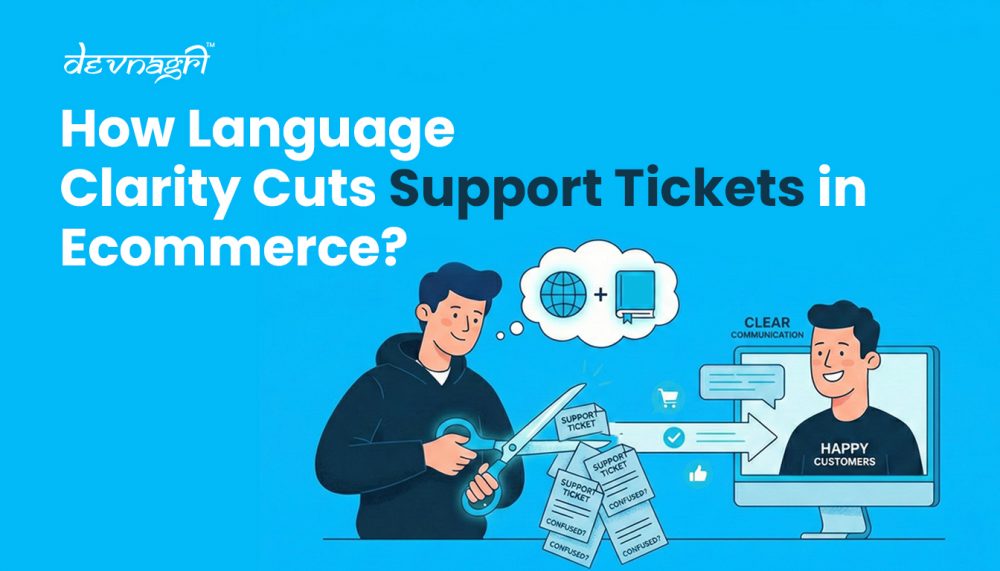
Most ecommerce leaders track support tickets like a vital sign. A sudden spike often prompts teams to hunt down bugs, delivery issues, or payment failures.
But there’s a quieter cause hiding in plain sight: language.
Not broken translations. Not missing pages. Just small moments of confusion, phrases that feel obvious to the brand team but unclear to the customer, when reading them in a second or third language. Over time, those moments pile up. And every one of them becomes a ticket.
As Indian ecommerce pushes deeper into regional markets, this problem is becoming structural. Especially in states where English is understood but not trusted. Assam is a good example. Many shoppers can read English. Fewer feel fully confident acting on it when money is involved. That gap between “I roughly understand” and “I’m sure enough to click” is where support queues are born.
The future of ecommerce support efficiency won’t be won by bigger teams or faster bots. It will be won by clearer language, right where decisions are made.
Why are support tickets often language failures in disguise?
Look at a typical ecommerce support inbox. The top categories rarely change:
- “Where is my order?”
- “How do I return this?”
- “Why was my payment deducted?”
- “What does this offer actually mean?”
These aren’t edge cases. They’re signals that something upstream wasn’t clear enough.
Research from Harvard Business Review has consistently shown that customers contact support not because systems fail, but because expectations were unclear at the time of choice. In ecommerce, expectations are set almost entirely through language, product descriptions, delivery promises, refund policies, and CTA buttons.
When that language is written in English and then loosely converted for regional users, precision is usually the first casualty.
In Assamese-speaking markets, for instance, many brands rely on partial localization: English product pages, English policies, maybe a translated homepage banner. The result feels “good enough” internally.
Insight 1: English comprehension doesn’t equal decision confidence
A common misconception in ecommerce is that if a customer understands English, they don’t need content in their native language.
Reality is more nuanced. English is often associated with formality and authority. Native languages are associated with clarity and reassurance. When shoppers are deciding whether to pay, return, or complain, reassurance matters more than formality.
This is where English to Assamese translation becomes less about conversion and more about prevention. Clear Assamese explanations of delivery timelines or refund policies reduce the customer’s cognitive load. Fewer doubts mean fewer “just checking” messages to support.
Brands that localize only marketing copy miss this entirely. Support volume is driven by operational language, not slogans.
Insight 2: Policies create more tickets than products do
Most ecommerce teams obsess over product descriptions. Fewer obsess over policies.
Still, restrictions on returns, cancellations, warranties, and cash on delivery (COD) account for a large number of tickets. The answer is simple: these parts are written in English that sounds like legalese and aren’t often translated correctly.
A 2023 Deloitte analysis found that confusing information about returns and refunds is a key reason people are unhappy with their digital commerce purchases, especially in new markets.
When these rules are translated into Assamese word-for-word, they often become longer, more complicated, and harder to follow. When they are rewritten in clear Assamese, short sentences, and everyday phrasing, support demand drops.
Clarity doesn’t mean simplifying the rules. It means simplifying the reading.
Insight 3: Microcopy mistakes quietly flood support queues
Some of the most expensive language problems are tiny.
A checkout button that says “Proceed” instead of “Pay now.”
A delivery label that says “Dispatched” without explaining what happens next.
In regional markets, poorly localized microcopy is worse than no localization at all. Literal translations often preserve the words but lose the instruction. Customers aren’t confused about what happened. They’re confused about what to do.
Clear Assamese microcopy, especially around payments, OTPs, and refunds, acts like silent customer support. It answers questions before they’re asked.
Insight 4: Language clarity compounds as you scale
Support teams often experience a strange pattern. Ticket volume rises faster than GMV.
This isn’t always due to growth pains. It’s often due to language debt.
As ecommerce platforms add new sellers, SKUs, and offers, the amount of text increases. If that content is inconsistently translated or not translated at all, the confusion multiplies.
Forecasting-wise, this is dangerous. A brand entering Assam today with 1,000 daily orders may manage with manual support. At 10,000 orders, the same language gaps can overwhelm teams.
Forward-looking ecommerce companies treat language clarity as a scaling lever. The cleaner the language layer, the flatter the support curve.
Insight 5: Native-language workflows reduce tickets before automation does
Many ecommerce leaders turn to chatbots and AI support to control ticket volumes. Automation helps, but only after clarity is fixed.
If the source content is confusing, automation simply scales confusion.
This is where structured native-language workflows matter. Platforms like Devnagri focus on translating intent, not just text. That distinction matters in ecommerce, where every word nudges a customer toward or away from action.
When English to Assamese translation is handled as a living system, updated with new offers, new policies, and new flows, support teams see measurable relief. Not because customers disappear, but because questions do.
What should ecommerce leaders do next?
If support tickets are rising faster than orders, language is a good place to look. A few practical steps:
- Audit your top 20 support queries and trace them back to on-site language.
- Prioritize policy pages, payment flows, and order-status messages for native-language clarity.
- Rewrite, don’t just translate. Especially for Assamese content.
- Test clarity with real users, not internal teams.
- Treat localization as an operational investment, not a marketing expense.
The goal isn’t perfect language. It’s fewer moments of doubt.
The bottom line
Support tickets are often framed as a service problem. In ecommerce, they’re more often a communication problem.
As regional commerce grows, the brands that win won’t just ship faster or discount harder. They’ll explain better, clearly, locally, and confidently.
Language clarity doesn’t just reduce tickets. It builds trust quietly, at scale.
Related Post: How to Build a Scalable English to Assamese Translation Workflow for Apps & Websites?