
How Passive Components Reduce Third-Order Intermodulation For those engaged in the passive components industry, third-order intermodulation is an unavoidable and challenging performance requirement. With the industry’s updates and iterations, operators’ requirements for third-order intermodulation have gradually tightened from the previous -140 dBc to -155 dBc, -160 dBc, -163 dBc, and -165 dBc.
Due to the increasingly stringent requirements for third-order intermodulation, we often hear industry peers constantly complaining and being extremely frustrated, frequently hearing about missed orders because they couldn’t meet the third-order intermodulation specifications.
Our has been specializing in the production of passive components for over 20 years and has very professional solutions for various technical issues that arise during the production of passive components. Regarding the issue of third-order intermodulation, our company has invested significant human and material resources into experimental verification. We are now able to meet customer requirements for the third-order intermodulation specifications of various devices, with additional margin. The following briefly discusses the experiences summarized in addressing the third-order intermodulation problem.
Mainly includes the following aspects:
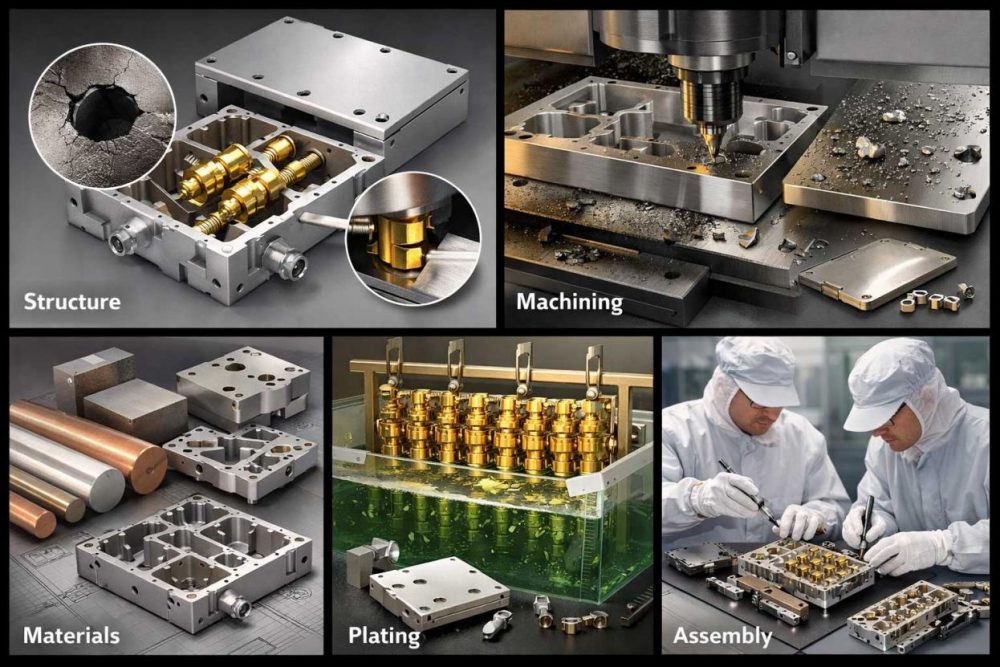
Structure
In reducing third-order intermodulation, the product’s structure plays a crucial role. No matter how much the process is improved later, without a good structure, third-order intermodulation cannot be effectively improved. How to minimize the impact of structure on third-order intermodulation to the greatest extent is a significant test of an engineer’s skill.
A good product structure mainly reflects how to more effectively increase contact pressure, avoid hole breakage, and minimize solder joints during the design phase.
Processing
The quality of the processing technology directly affects third-order intermodulation, mainly reflected in the processing technology of the cavity, cover plate, and auxiliary materials. It is essential to ensure that the processed products do not have defects such as burrs, flanging, or broken holes.
Materials
The selection of materials also plays an equally important role. We all know that intermodulation indicators are most affected by ferromagnetic materials. When designing, ferromagnetic materials should be avoided. When it cannot be avoided, it is necessary to compensate for the impact of the material by improving other processes.
Electroplating
Typically, product electroplating is aimed at improving electrical performance indicators, but few realize that electroplating also plays a crucial role in third-order intermodulation. Especially when measuring intermodulation at 700/800/900 MHz, the role of electroplating is particularly evident. I have encountered situations where
intermodulation in these three frequency bands is very difficult to measure and qualify, stabilizing at -150 dBc. By increasing the thickness of the silver plating, the intermodulation value can be greatly improved.
Assembly details
After addressing the above points, if intermodulation issues still occur, then the assembly details need to be considered. Usually reflected in issues such as the cleanliness inside the product, whether there are any debris inside, and whether the solder joints are cold soldered.
Striving for Excellence: From Real Life to High Standards
It’s hard to find a “silver bullet” for optimizing third-order intermodulation (PIM3). At every stage of production, it’s a constant fight for the best margins. The shift from -155 dBc to -165 dBc is more than just a change in numbers; it is also a strict test of how stable the process is and how consistent the materials are. A single microscopic burr, a change in fastening torque, or a small crack in a solder joint can ruin all the work that went into making something in real life. To fix PIM problems, you have to pay close attention to every detail and turn your own experiences into standard industrial procedures.
The Evolution of Industry: Handling More Complex Spectra
The spectral environment is getting more complicated as telecommunications technology like 5G-Advanced and the next generation of telecommunications get better. This has changed the high-performance PIM specifications from “premium customization” to an industry-wide standard. For those of us in the trenches, PIM isn’t just a number to check off anymore; it’s our initial safeguard against network strain and link degradation. Technology is always evolving, and there’s always something new to grasp. I hope these practical pointers on structure, plating, and assembly prove helpful to my colleagues working to maintain PIM’s integrity. The fundamental logic behind reducing PIM begins with the design phase, where achieving consistent contact pressure is paramount to eliminating non-linear contact points at the source.
The above are some personal insights on how to reduce third-order intermodulation in production. I hope they are helpful to everyone. Thank you!