

Magento and Shopware are currently market leaders in Europe. Reason enough for every ambitious online retailer to take a closer look at these two online shop systems.
Introduction
Even if we as a Shopware agency naturally maintain preferences for Shopware, we would still like to offer you the opportunity to provide you with the most neutral possible overview of the strengths and special features of the two e-commerce systems and to form a well-founded opinion.
Let’s first take a look at the companies behind the two systems.
Shopware 6
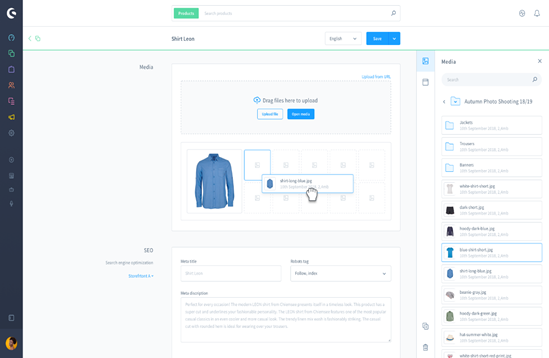
Four years after Shopware 5, Shopware introduced its newest shop system, Shopware 6, at the Shopware Community Day 2016. Shopware itself writes: “Shopware 6 is our answer to an increasingly complex e-commerce world, in which connectivity and technology are rapidly gaining importance and it is all the more important to focus on people.” To what extent this is also the case in reality, we will be happy to highlight for you here. At this point, Shopware promises that Shopware 6 has a lot to offer.
Magento 2
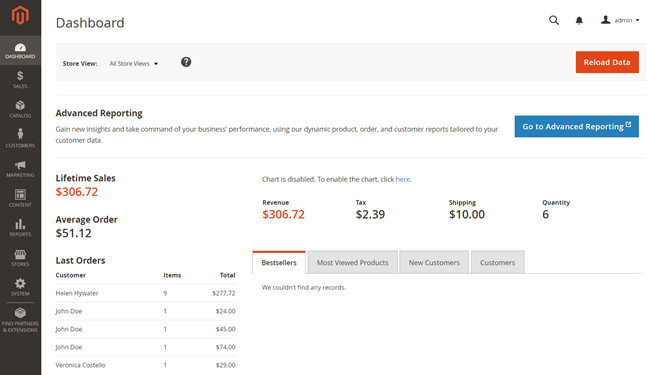
With a market share of 13.9 percent, Magento is the number one shop system among the 1000 largest online shops in Europe.
In 2015, Magento introduced Magento 2 as the successor to the widely used Magento 1. After eBay fully owned Magento from June 2011 to November 2015, Adobe Inc. bought it in 2018, and it remains available as an open-source version.
As compare to Magento pricing and cost, the system has been able to completely eliminate one of its major weaknesses: performance. This has been really fast since version 2.3 at the latest.
Now let’s take a look at the software architecture.
Software architecture
Shopware 6
Shopware 6 comes with a brand new technology stack that makes every developer’s heart beat faster:
- Symfony 4.3 for project components
- Vue.js for the backend and administration
- Bootstrap Framework and Twig Template Engine
- PHP 7.2
This means that Shopware 6 is absolutely state of the art. In addition, the company from Schöppingen perfectly reflects the open source concept and is also at the forefront in terms of performance and scalability.
One of the most important innovations is the API-first principle . With the approach of the API-first principle, Shopware 6, in contrast to the previous version 5This means developers can create a modular online shop system, giving it strong benefits in scalability, performance, and maintainability., claims to be able to control all functions via an API. This means developers can build an online shop system in a modular way, which offers significant advantages in scalability, performance, and maintainability. This means developers can build an online shopping system in a modular way, offering significant advantages in scalability, performance, and maintainability.
In fact, Shopware 6 is an excellently serviceable system, which of course has a very positive effect on the low effort and low costs.
Magento 2
Magento does not follow an API-first approach, but is technologically very mature:
- Zend Framework
- jQuery JavaScript framework
- PHP 7.2
With Magento 2, classic and reliable technology. But it’s also a little unsexy for one or the other developer. I’m sorry Magento, but you can’t score here.

Next, let’s compare the main functions of the two systems.
Functions
Shopware 6
Shopware has focused clearly on marketing since version 5 and has consistently continued this focus with version 6. Accordingly, the most important functions can also be found here.
The feature set called Shopping Worlds creates the ability to deliver a high-quality, emotional user experience for your customers. For example , you can use drag & drop to create landing pages , product detail pages and marketing campaigns in a beautiful, modern design. In addition to the API-first approach in the Shopware-Magento comparison, this is probably THE decisive plus point for Shopware.
With the banner management you can set banners for start and category pages . Also coupons , newsletters and affiliate programs are easy to create.
You may also wonder how search engine optimization (SEO) works in Shopware 6: You can set meta information for product, category, and content pages out of the box. You can now optimize images and URLs individually. Shopware will also support the hreflang metatag in the future. You can further expand the SEO features in many ways using plugins.
Is It Time to Move to Shopware 6?
However, not all functions have been migrated to Shopware 6 yet. In some cases it may therefore still make sense to use Shopware 5. Support with updates for Shopware 5 is available until 2024. But you also need to consider this decision carefully, because although a migration tool exists for moving from Shopware 5 to Shopware 6, the adjustments prevent you from transferring templates, shopping worlds, and certain configurations such as shipping costs or payment methods. So there can be bigger work later if you want to update to the latest version.
What is new is that Shopware is now also available as a progressive web app. PWAs are small web applications that combine practically responsive websites and native apps and can be used by the user without installation. You open the URL in your browser as usual, but by simply dragging the website to your home screen, you can use many functions offline—such as push notifications, discounts, and more—that were previously available only in a native app. Thanks to offline use and sophisticated caching, PWAs offer you enormous advantages if performance is the be-all and end-all for you.
Shopware has developed a completely new front end for its PWA in cooperation with Vue Storefront . The PWA already works out of the box with many Shopware features, and thanks to the headless commerce or API-first approach, it is ideally suited for adapting even complex projects to your business requirements.
Magento 2
One of the most important functions is certainly the excellent performance of Magento 2. After a few teething problems, this promise was consistently kept.
Magento also offers the possibility to use Progressive Web Apps (PWA) with the help of Magento PWA Studio . As the global market leader, Magento devoted itself to the development of PWAs a few years ago together with Google and published the PWA Studio with Magento 2.3. The front end is based on a combination of ReactJS and Redux , but there is also a front end from Vue Storefront. With the introduction of version 2.3, Magento also follows a headless commerce approach.
Another nice feature is the Page Builder : similar to the shopping worlds in Shopware, you can use it to create product pages using drag & drop.
Magento handles languages very well: with its natively built-in multilingual support, you can easily set up multilingual shops. The high international distribution of Magento is also based on this feature. At the same time, shopware doesn’t have to hide here either. Shopware 6 also includes native multilingual support; however, it only covers German and English by default. You can download additional language packs as free modules.
What about Magento 2’s SEO features ? In fact, there is virtually no difference here compared to Shopware 2. All important meta tags for product, category and content pages can be set individually or by rule. A lot of extras can also be extracted here with extensions.
Expandability
Shopware 6
Even before the release of Shopware 6, Shopware took a big step towards expandability.
In addition to the existing store, with a large number of plugins for functional expansion of the shop system, all available plugins must be kept absolutely open source . This means that existing plugins can also be adapted to your needs, which we are of course pleased about with our TYPO3 history .
In addition to paid plugins, the store also offers free plugins for expanding your Shopware installation. With a paid plugin, there is usually a test option for 30 days so that you can check whether your requirements are met. If so, you will usually reach your goal faster with a plugin than with individual programming.
Magento 2
The expandability of functionality also plays an important role in Magento.
Functional extensions can also be made in your online shop using free or paid extensions . The extensions usually have a demo link under which you can see how they work. However, there is no 30-day trial version.
The available extensions usually also follow the open source concept and can be adapted to your requirements.
Scalability
At the latest when the shop grows, the orders increase, the product catalog gets bigger, you will ask yourself the question of scalability. Can your shop system grow with you?
Shopware 6
Through the use of an abstraction layer for reading, writing, searching and aggregation, which is placed on the database, as well as established technologies such as Elasticsearch and Redis, a high level of scalability and performance is ensured in Shopware 6.
Magento 2
I don’t have to hide Magento 2 here either and offers excellent scalability. The separation of the database into three different, independent areas for products, ordering process and invoices increases the scalability enormously.
If the shop is successful, it must be able to scale.
License models
Shopware 6
Just in time for Shopware Community Day, Shopware presented its new cloud solution. This also affects the licenses you can choose from. Shopware 6 is available in four different license models:
Starter Edition (only in the cloud)
Community Edition (Self-hosted)
Professional Edition (in the cloud or self-hosted)
Enterprise Edition (self-hosted)
These differ particularly in the scope of functions, but also in the strategic orientation.
Are you self-employed and would you rather run a small shop? Then the free Starter or Community Edition is suitable for you to get started. If your business grows, Shopware can grow with you and an upgrade is possible at any time.
Are you the owner or manager of a medium-sized company? Then the Professional Edition and the Enterprise Edition , Shopware’s flagship, are the right choice for your project. Which of the two editions must be used in order to realize your project depends on your individual requirements. The Professional Edition starts with license costs of € 2,495.
The good thing about Shopware is the comparatively low total cost of ownership, as the costs for the licenses are only incurred once. Use in the cloud is an exception here, but we’ll look at that separately in a moment.
Magento 2
Magento 2 also offers you different license models:
- Magento OpenSource
- Magento Commerce
1 Magento OpenSource corresponds in the orientation to the Shopware Community Edition and is suitable if you have a smaller company.
2. Magento Commerce is also the choice here if you are the owner or manager of a medium-sized or large company.
3. Magento Commerce is also available as a cloud version . Magento can also grow with your business and a license upgrade is possible at a later date.
4. Magento follows a different license model than Shopware. With Magento, your license costs for use depend directly on your sales. Magento Commerce starts at € 21,000 per year.
This already results in higher total costs of ownership over the term .
Software as a Service (SaaS)
Shopware 6
Since mid-2020, Shopware has now also offered the option of using an online shop as a “SaaS” solution. In addition to the newly designed Starter Edition, you can also rent the Shopware Professional Edition for a fee. In the Starter Edition you can again choose between two plans. The plans differ in terms of functionality and monthly or revenue-based fees. There is only one plan for the Professional Edition.
Whether a cloud solution is available for you depends on the requirements of your project. The more individual and extensive the functions or the look of your shop should be, the more likely a server-based solution is to be.
Magento 2
Magento has been running its cloud version for Magento Commerce for a long time. This is now an integral part of the Adobe Experience Cloud under the name Adobe Commerce Cloud and is aimed at enterprise customers. The Commerce Cloud can be combined with various other Adobe Cloud Services. Adobe’s goal is comprehensive customer experience management.
Conclusion
From our point of view, Shopware 6 and Magento 2 are two strong e-commerce systems that are particularly suitable for medium-sized and large companies.
Due to its international origin, Magento can boast more installations overall, but Shopware is ahead for us , especially for the German area – also due to the consideration of European data protection standards.
Both systems can be functionally adapted to your needs through a large number of existing extensions. If your requirements are not completely covered by an existing extension, it is possible to make adjustments thanks to Open Source.
| Shopware 6 | Magento 2.3 | |
| providers | shopware AG | Adobe Inc. |
| Software architecture | Symfony, Vue.js, Twig, MySQL 5.6 | PHP 7.2, Zend, JQuery, MySQL 5.6 |
| performance | high | high |
| Multilingual ability | native | native |
| Developer community | over 1,000 active developers and 1,200 partner agencies | large global developer community |
| Extensions | > 1,000 (Note: Shopware 6 is currently still an Early Access version. Many partner agencies are currently developing the plug-in successors to existing Shopware 5 plug-ins.) | approx. 2,600 |
| Licenses | Enterprise Edition, Professional Edition, Community Edition, Starter Edition | Magento Commerce Cloud, Magento Commerce, Magento Open Source |
| Cloud solution / Software as a Service (SaaS) | Yes, for starter and professional editions | Yes, for Magento Commerce |
| License costs | once, depending on the edition (self-hosted); continuously, depending on sales (cloud solutions) | continuously, depending on sales |
| Market Ready Europe | native | via separate extension |
| Site management | Yes | Yes |
| Multi-tenancy | Yes | Yes |
| Order management | Yes | Yes |
| Roadmap for further development | Yes | Yes |
| Headless Commerce | yes (API first approach) | yes (from Magento 2.3) |
| CMS functionality | yes, about worlds of experience | yes, via Magento Page Builder |
| Ready-made templates available | Yes | Yes |
| Omnichannel capable | Yes | Yes |
| Progressive web app | Yes | Yes |
| Connection to other sales channels possible | Yes | Yes |
| B2B & B2C capable | Yes | Yes |
| SEO features included | yes, flexibly expandable with plugins | yes, flexibly expandable with plugins |