
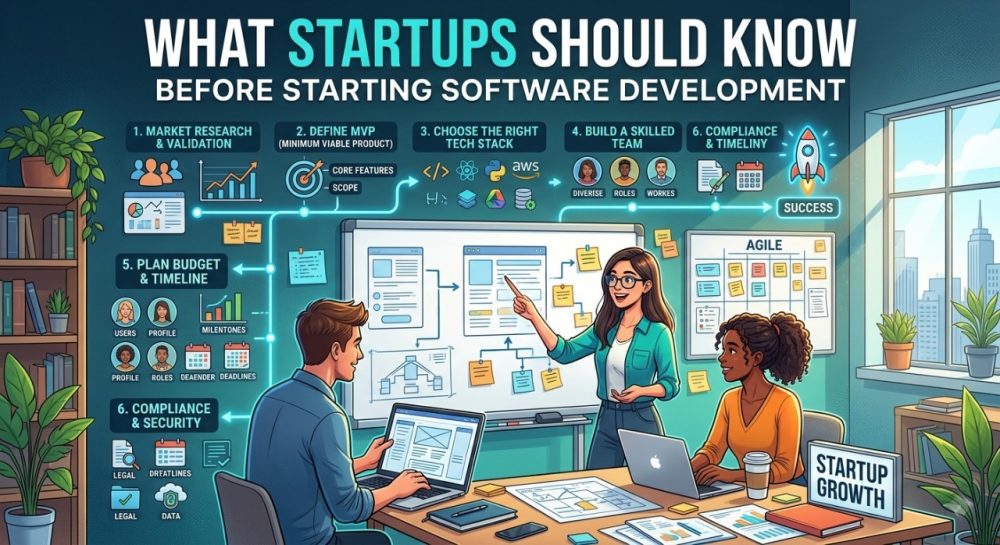
- Most startup failures come from weak planning, not bad ideas.
- The MVP-first approach enables faster idea validation.
- Early tech decisions determine a company’s future capacity for expansion.
- The establishment of specific goals enables organizations to use their resources more efficiently.
The absence of a well-defined software development plan causes development teams to miss project deadlines while expenses increase and the final product fails to fulfill user requirements. Startups need to avoid development work until they create an accurate solution for their needs.
The partnership with a software development service for startups enables the establishment of project workflows while ensuring that all technical choices support business objectives.
Why early planning defines your product success
The software development process starts before developers write code because it requires developers to first comprehend problems which they need to solve through their product development work.
The startup company must establish clear business objectives because its lack of direction leads to continuous operational changes and unproductive work periods. The project team maintains its work focus through a clearly defined plan which also guarantees optimal resource allocation.
Clarify your product vision and business goal
You must define success requirements before you start any construction work.
Your product needs to solve a specific problem which you must explain together with its intended users and the reasons why they should select your solution.
The organization needs a complete vision which will direct all future technical and business choices.
Build an MVP instead of a full-scale product
Attempting to release a fully formed product right off the bat may result in setbacks and wasteful spending.
An MVP is centered around its main features, providing quick value.
This strategy enables you to:
- test the product in the marketplace
- get genuine feedback from users
- continually enhance the product
Begin with a minimum product and build from there.
Choose technology based on your product needs
The technology that you choose should align with your objectives, not be driven by trends.
Here are some factors to consider:
- the platform you will use like web or mobile
- the architecture
- your scalability needs
Using an incorrect tech stack could hinder your progress and make maintenance more expensive.
Understand the real cost of development
Many startups underestimate the total cost of building software.
The total expenses extend beyond coding work because they include: design and user experience backend infrastructure all necessary integrations and the required ongoing support.
The development process will face no interruptions when you implement realistic budget planning.
Work with the right development partner
The team you select will directly affect the success of your product.
Since startups rarely have their own experience, working with an expert vendor will provide structure and effective communication.
The benefits of an expert team include:
- established processes
- technical knowledge
- timely delivery
All of these factors can minimize risks for you.
Prioritize user experience from the beginning
The users make a fast decision about continuing their usage of your product.
The interface confusion together with the slow performance results in decreased user retention. Users trust your product more when they experience an elementary user interface that brings them direct advantages.
The design process needs to start at the beginning of development work.
Validate your idea at every stage
Product launch is just the start of the journey.
It is important to:
- observe users’ behaviors
- gather feedback
- iterate on product features
In doing so, you can ensure that your product meets users’ true needs.
Common mistakes startups should avoid
Many startups face similar challenges during development. One common issue is building too many features too early. The process becomes more complex because they added additional features which caused a delay in their scheduled launch.
The other problem arises when market validation testing is skipped. The demand for products must be understood because even well-designed products will fail without this knowledge. The product development process suffers from scalability problems which arise from poor architectural choices.
The development process gets rushed because teams work towards meeting impossible deadlines which results in reduced product quality.
Final thoughts
Starting software development without preparation creates unnecessary risks. Startups that define their idea clearly, build an MVP, and validate continuously have a higher chance of success.
Enterprise organizations must dedicate their efforts toward resolving real-world problems while they implement gradual system enhancements. The method enables you to transform your concept into a product that can grow and meets actual market needs.