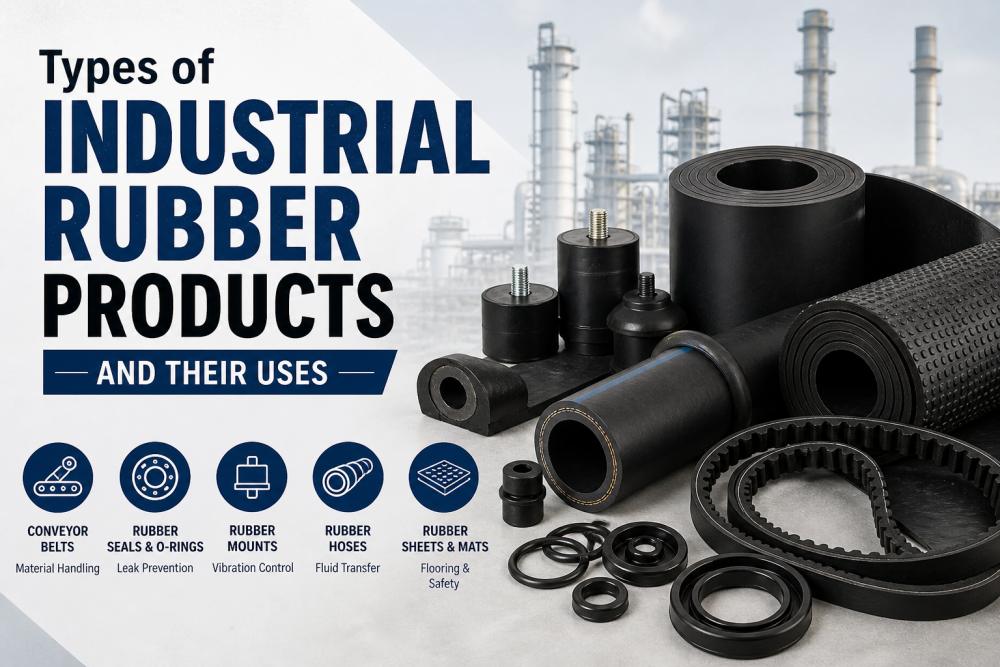
There are a few materials which have a crucial role in modern industry. The production process relies on rubber in one form or another. Natural and synthetic rubber each serve distinct use cases. It forms reliable seals that stop unwanted leaks of liquid and gas. Its dampens unwanted vibration and cuts operational noise across sites.
It absorbs impact and shock that would damage much harder materials. The parts can be formed into any shape to match exact industry requirements. Most of these parts are manufactured using industrial rubber Products to ensure consistency. Any of the simplest components start their life in this type of tooling.
Types of Industrial Rubber Products
1. Seals and Gaskets
These parts sit between two mating surfaces of operating machinery. They prevent gas and liquid from escaping past joints under load.
O-rings remain the most widely specified seal type. They handle sustained high pressure and operating heat.
A single failed seal can lead to many thousands in unplanned repair costs. Nearly every industrial supplier holds the most common sizes in stock. Manufacturers can produce custom sizes for one-off or low-volume requirements.
2. Industrial Conveyor Belts
These components carry raw and finished goods along production lines. Their construction handles continuous heavy static and dynamic loads.
All food processing applications require oil-resistant compounds. Textured surface finishes prevent loads from shifting or slipping during transit. The belts significantly reduce manual labour requirements.
Most lines can be adapted to accept different belt profiles. Rubber mold manufacturers can produce custom cleats and guides for special loads. Most operations keep a full spare belt on site for emergencies. Poorly fitted belts cause consistent unplanned downtime and product loss.
3. Rubber Hoses and Tubing
These parts carry liquid and gas between separate points on machinery. Their inherent flexibility allows small movement once installed and connected. They come in a very wide range of operating pressure ratings.
Selecting the correct material prevents premature breakdown from chemical exposure. Most working hoses include internal braided layers to add extra tensile strength. We can cut and supply them to any exact custom length required.
Manufacturers cast most standard sizes in industrial rubber molds for consistency. A burst hose can cause significant safety hazards and extended downtime. Most maintenance teams keep a range of common sizes on hand at all times.
4. Vibration Isolators and Dampeners
These parts absorb and dissipate vibration produced by operating machinery. They stop that vibration from transferring to floors and adjacent equipment. They also reduce overall workplace noise levels by a very measurable margin.
Their long-term use prevents slow structural damage to factory floors and foundations. They also reduce worker fatigue and improve overall site safety standards. Manufacturers produce them in a range of hardness ratings to suit different static loads.
The very small units provide a very large improvement in operating conditions. Installers almost always overlook them during the initial machine installation process. All standard sizes are produced in industrial grommets for consistent material density.
5. Industrial Vehicle Tires
These tyres are designed for use on heavy industrial machinery and equipment. Manufacturers produce them from solid rubber to eliminate any risk of puncture. Deep open tread patterns provide reliable traction on loose and uneven ground.
The tyre carries a clear maximum load rating matched to specific vehicle types. They provide far longer service life than equivalent pneumatic road tyres. Their use eliminates almost all unplanned downtime caused by sudden flat tyres.
The different compounds are available for indoor and outdoor operating environments. The hard compounds last longer but provide slightly lower levels of grip. This is one of the highest volume categories of industrial rubber products. Most operators will replace all four tyres at the same time for even wear.
6. Rubber Sheets and Mats
These products are laid on workshop floors to protect the concrete underneath. The specific grades provide high levels of electrical insulation around high voltage gear.
The grades feature an anti-slip surface to reduce fall accidents. Small chemical spills are contained to prevent their spread across floors. You can hose them down and clean them very quickly at the end of each shift. They come in a wide range of standard and custom thickness options. You can cut them on site with basic tools to fit any required shape or area.
Thin grades are frequently utilized for the production of emergency gaskets and shims. Many rubber mold manufacturers produce large format sheets in continuous production runs.
7. Molded Rubber Components
These parts can take almost any shape required for a given application. The bushings fit to eliminate metal-on-metal contact between moving parts. The bumpers mitigate damage & absorb impacts while machines are operational.
The flexible joints allow for small amounts of misalignment and movement between parts. They can often replace much more expensive machined metal components entirely. Manufacturers can produce even very complex shapes in relatively short lead times.
There is almost no limit to the possible applications for these types of parts. Industries use them in every machine across all industrial sectors. Manufacturers produce these components in industrial rubber molds of various sizes.
8. Rubber Rollers and Cylinders
These components are used extensively across printing, packaging and paper mills. They apply uniform and consistent pressure across the entire working width. The special surface coatings are available for resistance to solvents and chemicals.
The high-specification rollers include internal channels that enable accurate temperature control. They can be resurfaced many times prior to needing full replacement.
Ground and fitted rollers directly improve finished product quality. Manufacturers also use them for converting and material handling applications. Any minor wear will cause consistent and noticeable defects in output. Manufacturers cast all production rollers as precision rubber molded parts to ensure perfect roundness.
Conclusion
Most operators never stop to consider how much they rely on these parts. A single failed rubber component can shut down an entire production line. The correct specification will add years of reliable service to any equipment. Advancements in compounding continue to open up entirely new use cases.
The high quality industrial rubber molds ensure every part meets the required standard. It will remain a core industrial material for many decades to come.
Whatever type of industrial rubber product you need for your application, we can manufacture it to the exact specification you require. We manufacture many standard to custom parts. Call us today at (646)759-1040, or email [email protected] to discuss your project and receive a custom quote.