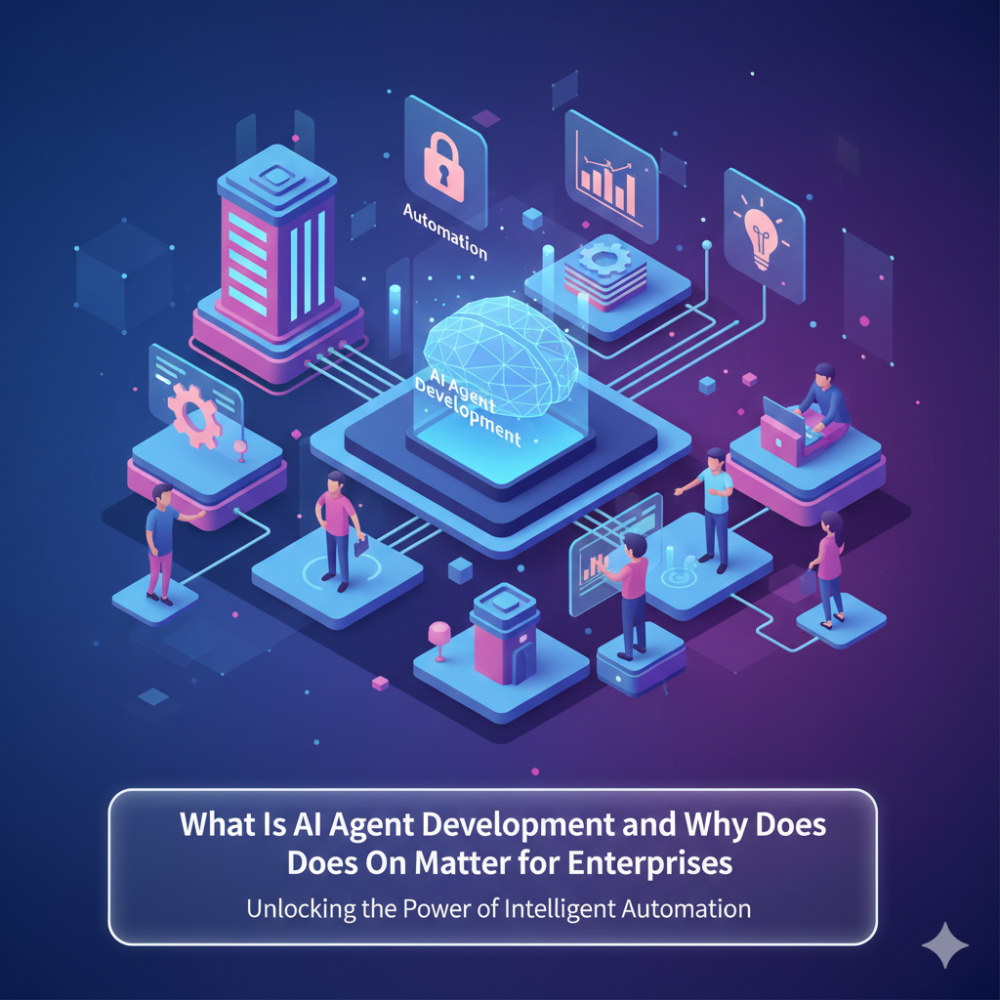
Artificial intelligence in enterprises has evolved rapidly from basic automation to predictive analytics and generative AI. However, a new paradigm is now taking center stage: AI agent development. Unlike traditional AI systems that assist users with insights or content, AI agents are designed to act autonomously, execute tasks, and adapt dynamically to changing business conditions.
This shift is redefining how enterprises operationalize AI and unlock real, scalable business value.
What Is AI Agent Development?
AI agent development refers to the design and deployment of intelligent systems that can:
- Understand goals and context
- Make decisions based on data and rules
- Execute multi-step tasks autonomously
- Learn and adapt from outcomes
Unlike chatbots or standalone AI models, AI agents operate within enterprise systems and workflows, enabling end-to-end automation rather than isolated task support.
According to IBM, AI agents represent a move from “AI that advises” to “AI that acts,” fundamentally changing enterprise automation strategies.
How AI Agents Differ from Traditional Enterprise AI
Traditional enterprise AI tools focus on analysis and recommendations, leaving execution to humans. AI agents close this gap.
Key differences include:
- Traditional AI → Generates insights or responses
- AI agents → Plan, decide, and execute actions
- Traditional AI → Requires constant human input
- AI agents → Operate independently within guardrails
Enterprises adopting AI agent development services are building systems that can manage complete workflows such as customer support resolution, IT service orchestration, or compliance monitoring without continuous human involvement.
Why AI Agent Development Matters for Enterprises
AI agent development matters because it directly addresses the limitations of earlier AI approaches and aligns with modern enterprise needs.
1. From Intelligence to Execution
Enterprises no longer need more insights; they need faster action. AI agents transform intelligence into execution by automating decisions and workflows in real time.
2. Scalable Operational Efficiency
AI agents allow organizations to scale operations without proportionally increasing headcount.
Enterprise benefits include:
- Reduced manual workload
- Faster process completion
- Lower operational costs
- Consistent execution across teams
Lindy explains that enterprise AI agents enable continuous execution, making them ideal for high-volume, repeatable workflows.
Common Enterprise Use Cases for AI Agents
AI agents are already being deployed across industries with measurable results.
Typical enterprise use cases:
- Customer service agents who triage, resolve, and escalate tickets
- IT agents who manage access requests, diagnostics, and incident resolution
- Finance agents that monitor transactions and flag anomalies
- Operations agents that coordinate supply chain and inventory actions
These agents integrate directly with CRMs, ERPs, ticketing tools, and internal databases, allowing them to act, not just inform.
Seamless Integration with Enterprise Systems
A major reason AI agent development is gaining traction is its ability to integrate deeply with enterprise technology stacks.
AI agents typically connect with:
- CRM and customer support platforms
- ERP and finance systems
- Data warehouses and internal APIs
- Workflow, messaging, and approval tools
This deep integration enables AI agents to orchestrate complex, cross-functional processes that traditional automation tools cannot handle effectively.
Governance, Security, and Trust in AI Agents
Autonomy does not mean loss of control. Enterprise-grade AI agents are built with governance and security as core design principles.
Key governance features include:
- Role-based permissions and access controls
- Defined operational boundaries and escalation rules
- Audit logs and explainable actions
- Compliance with enterprise security policies
IBM emphasizes that responsible AI agent development ensures transparency, accountability, and trust critical factors for enterprise adoption.
Why AI Agent Development Is the Future of Enterprise AI
AI agent development represents a structural shift in enterprise technology. It moves AI from being a decision-support tool to an operational engine that drives outcomes.
Enterprises that invest in AI agents gain:
- Faster response to business events
- Greater operational resilience
- Improved employee productivity
- A sustainable competitive advantage
As enterprises move toward autonomous operations, AI agents will become foundational, not optional.
Final Thoughts
AI agent development is redefining what enterprise AI can achieve. By enabling systems that reason, act, and adapt autonomously, enterprises unlock real automation at scale. The organizations that embrace this evolution early through strategic planning and responsible implementation will lead the next era of enterprise innovation.