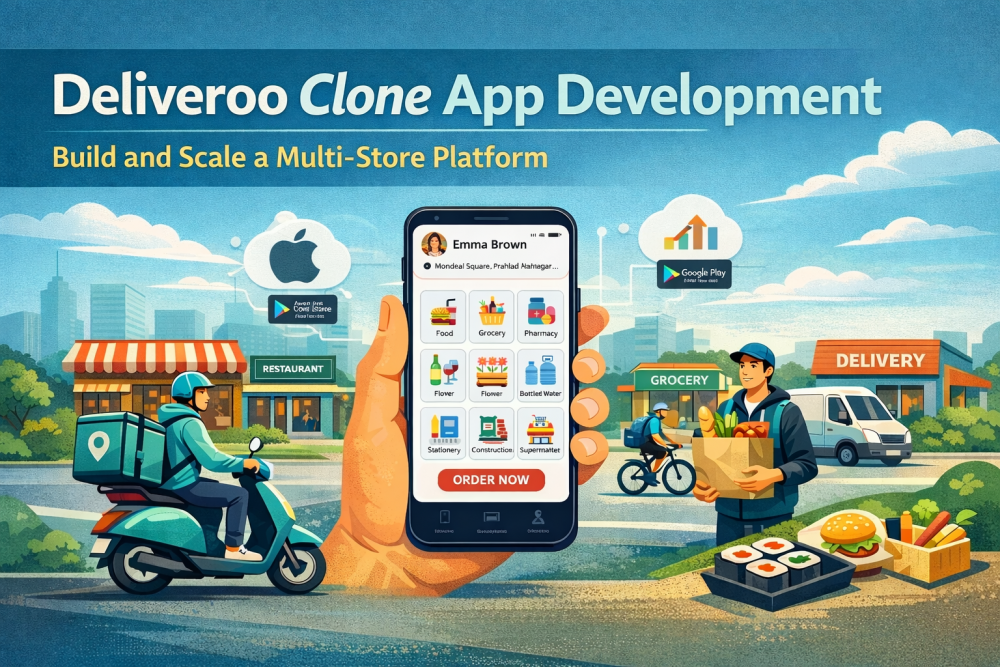
A few years ago, food delivery was just about pizza arriving hot and on time. Today, it’s a whole different ball game. The success of Deliveroo has not been an isolated incident that has inspired the establishment of food-related start-ups; rather, it has been the catalyst that has prompted many entrepreneurs to realise that if food is deliverable in minutes, they could deliver anything else.
Indeed, this is exactly how the term “Deliveroo Clone” became a buzzword.
Food, groceries, flower arrangements, medicines, pet supplies, construction materials, nothing is too trivial to have its own on-demand delivery system. Everyone wants convenience today. Everyone wants scale. A Store Delivery App that caters to multiple categories is perfect.
That aside, however, let’s not sugar-coat it: creating a platform such as Deliveroo from the ground up is not a project to be undertaken by the faint-hearted. It consumes time, money, and development resources in plenty. Many ambitious ideas never even make it to the app store. This is where ready-made, native-powered delivery solutions step in and change the narrative.
Which is a smart route: building from scratch or a ready-made solution?
Creating a massive on-demand ecosystem line by line sounds heroic, but in reality, it’s often a money pit. Custom development requires months of coding, testing, correcting, more testing, correcting, and finally repeating the same process over and over. At the same time, your competition is busy onboarding merchants using their “existing” platform and taking orders.
A Deliveroo Clone upends the script.
Instead of “reinventing the wheel” again, you get a tested foundation already in place. You get pre-built logic in place, optimised flows in place, and tested functionality in place. And all you do is make the design look how you want to look, make sure the categories are how you want to organise them, connect to local payment processors, and go.
It’s not cutting corners. It’s working smarter.
Why Native Technology Makes All the Difference
Let me illustrate this. Hybrid apps are like multipoles; they do many things, but nothing well. On the other hand, we have native apps that function like precision instruments.
If we think of entering a Formula 1 race, then hybrid apps are cars with training wheels attached and running. Well, these cars will not and cannot win any championship race. Native apps are like Ferraris.
Given the case for a Deliveroo Clone, native development isn’t a luxury, and it’s not optional. It’s actually a strategy.
Indeed, native apps can handle heavy traffic faster and even without breaking a sweat. When a hungry or impatient individual is browsing an app and is about to make a conversion, but is subjected to even a two-second delay, lag is felt.
Additionally, app stores also cater well to native builds. Also, better app performance could mean better app rankings, hence better visibility. And let’s be honest, most users never scroll past the top few results.
Native apps also integrate deeply with device features. GPS for accurate tracking, Face ID or fingerprint login for security, push notifications that actually get delivered on time. All of this adds up to trust. And in the delivery business, trust equals repeat orders.
What Exactly Is a Deliveroo Clone Script?
The term “clone script” sometimes raises eyebrows. People assume it means a cheap copy or a generic product. That couldn’t be further from the truth. Think of a Deliveroo Clone Script as a pre-engineered blueprint. It’s a fully functional delivery platform that already includes the core features required to run real-world operations. Order placement, merchant dashboards, driver allocation, live tracking, payment processing, commission management, it’s all baked in.
The real magic lies in white-labelling.
White-label means the platform carries your brand identity. Your logo. Your colours. Your app name. Your vision. You could launch locally, expand city by city, or scale across countries without changing the core system. But this flexibility is gold for entrepreneurs! The time to market is now drastically shortened. You don’t have to wait six months just to test out an idea; in fact, you could be up in weeks. That early momentum often decides whether a delivery business sinks or swims.
Improving On-Demand Delivery Efficiency with Smart Metrics
A successful Store Delivery App isn’t just about taking orders. It’s about removing friction at every step.
Simplified Login Experience
First impressions matter. Long registration forms terrify people more quickly than a slow internet connection. New-age delivery apps are forgoing registration altogether in favour of social login mechanisms. One tap using Google, Apple, or social media, and the user is in. Less effort, more conversions. It’s a small change with a big impact on engagement and app adoption.
Order Now or Schedule Later
Not everyone wants instant delivery. Some users prefer planning. Ordering now or in the future provides more options and control by choice. This function has emerged as the under-the-radar MVP for various services like ordering groceries, sending packages, and even hailing taxis. It gives users freedom and increases order volume during off-peak hours.
Real-Time Order Tracking
Users love watching their order move on the map. It’s reassuring, transparent, and oddly satisfying. Being accurate in real-time tracking gives rise to customer trust. This means that when they are well aware of where their order is and how soon it will be delivered to them, their level of satisfaction will increase while their anxiety decreases. Clear ETA and cost estimates also reduce support calls.
Flexible Payment Options
Nothing ruins a good shopping experience like limited payment choices at checkout. If a preferred method isn’t available, users abandon carts without hesitation. A robust Deliveroo Clone supports multiple payment options, including cards, wallets, UPI, net banking, and even cash if required. Flexibility at checkout directly translates into higher order completion rates.
Feedback and Ratings
Feedback is not criticism; it is insight. Rating and review help admins learn what is working and what is broken. It also brings transparency into the ecosystem. Good feedback boosts merchant credibility. Constructive criticism drives improvement.
Over time, this loop improves app performance and user trust organically.
Multi-Store Functionality: The Backbone of Scalability
Dealing with numerous merchants can be as difficult as herding cats, as it can lead to chaos or disorder. This can be addressed by creating a multi-store “Store Delivery App” that helps manage numerous merchants more efficiently by allowing them to manage their details separately. Drivers receive optimised routes. Customers enjoy seamless ordering. Admins oversee everything from a centralised control panel.
But the real power of multi-store functionality lies in revenue diversification.
More merchants mean more choices. More choices mean higher order frequency. Users aren’t restricted to a single category, which builds loyalty. For business owners, it spreads risk. In the event that food orders decrease, the continuous flow of cash will be maintained through these grocery and pharmacy orders.
Such a level of scalability turns the basic delivery service into an on-demand system within itself. In competitive markets like the UAE, that’s what’s considered necessary for survival itself.