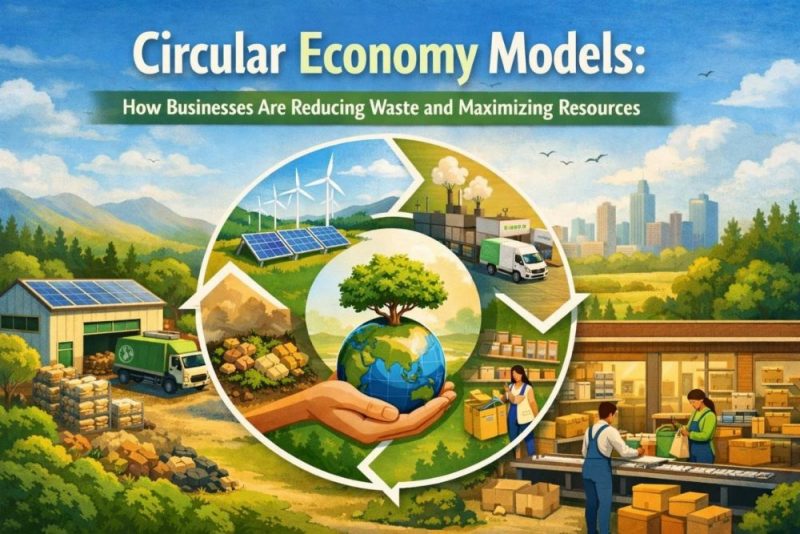
Introduction: Understanding the Concept of Circular Economy
The circular economy can be defined as an economic system in which minimal waste is created while maximizing resource usage for the benefit of all involved within such economic processes. The difference between the circular economy and linear economy is that while the latter involves the process of “take, make, and dispose,” the former entails a system of regeneration where waste and material usage are minimized and nature restored.
Closing the loop means designing processes in which the end of the product lifecycle will become the beginning of its next life. There are four basic components that must be included in closing the loop. First, organizations should reduce their resource use. Second, they should engage in product reuse. Third, they have to recycle materials. Fourth, companies need to recover value from waste.
The main idea behind the circular economy is that it is environmentally sustainable and responsible since it allows addressing important global problems, including climate change, resource depletion, and pollution. For instance, the Ellen MacArthur Foundation actively promotes the implementation of the model. Nowadays, different companies in various fields including manufacturing, fashion, and technology incorporate its principles into their operations.
From Linear to Circular: Why Businesses Are Rethinking Waste
The linear economy system is based on the “take-make-dispose” strategy. It involves extracting resources, making them into products, and discarding them once used up as waste. Although such an approach has helped industrial organizations prosper for years, its sustainability has become a matter of concern because of numerous waste generation, consumption of natural resources, and destruction of the environment, including pollution and destruction of habitats. The problem is exacerbated by increasing costs of obtaining raw materials.
In order to maintain competitiveness in their operations, companies today switch to circular economies. The growing awareness of consumers about the importance of sustainable development forces manufacturers to adopt sustainable manufacturing practices and follow this trend. In addition, regulations enacted by governments contribute to the popularity of this type of business.
A shift towards circular economies also provides a great opportunity for companies’ promotion. For example, the company Patagonia encourages customers to repair items instead of buying new products. Similarly, the manufacturer IKEA is actively involved in recycling and resale of goods.
Key Circular Economy Models Used by Modern Businesses
Modern businesses are embracing different types of circular economy frameworks aimed at reducing waste and increasing resource productivity. Some of the key circular model involve:
1. Life extension of products, whereby businesses will repair, refurbish, and remanufacture goods to ensure that they can be used for more extended periods. In this case, the creation of products becomes unnecessary since refurbishment will bring back old products to their intended state.
2. Sharing economy involves businesses that prioritize access over ownership. With easy access to digital applications like Airbnb and Uber, people can make peer-to-peer usage of their underutilized goods.
3. The product as a service model enables businesses to charge consumers for services rendered rather than the purchase of products. Under this strategy, producers retain the responsibility of maintaining and disposing of their products appropriately.
4. Recycling refer to the conversion of waste products into raw materials through industrial processes. It is important that there be proper segregation of waste because it ensures the appropriate recycling of the products
Innovative Strategies for Reducing Waste and Extending Resource Life
Innovative solutions are vital in waste reduction and extending the lifecycles of resources. Eco-design can be adopted whereby products are designed to ensure durability, upgradability, and recycling, thus ensuring that they have no negative impact on the environment over their life cycles. Modular product design ensures that parts of the products can be easily replaced, hence avoiding the entire disposal process of the products.
Biodegradable and sustainable materials add another layer of waste reduction. They make the degradation process safer and reduce dependence on non-renewable energy sources. Digital innovations also play an important role. This includes IoT technology, which monitors the life cycle of products. Artificial intelligence helps optimize resource use and prevents waste creation. Reverse logistics collects returned goods for reuse or recycling. Industrial symbiosis means waste from one industry is used as input for another industry. Zero-waste manufacturing and packaging innovation also help, as do incentives that encourage consumer participation. For example, companies like TerraCycle recycle hard-to-recycle waste very efficiently.
Conclusion
A circular economy makes a positive contribution to achieving sustainability as it eliminates waste and improve the efficiency of resources used. This approach results in many advantages, ranging from money savings, protecting the environment, and fostering innovations to many others. In order to achieve a circular economy, it is important for companies, government organizations, and even consumers to play their respective roles. Nevertheless, there will be several challenges, including the high cost of investments at the beginning, insufficient infrastructure, and the need for a behaviour change, among others.