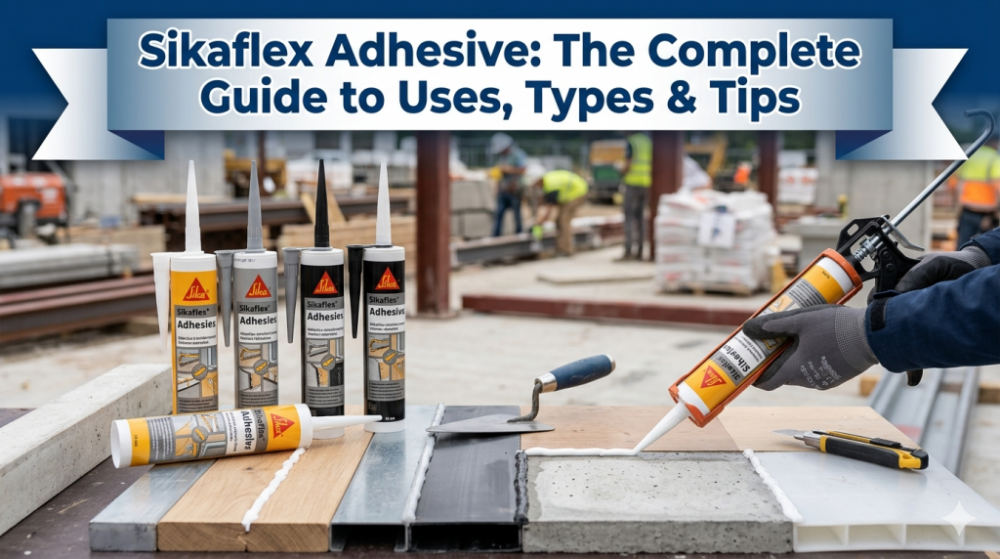
What Is Sikaflex Adhesive, And Why Does It Dominate Job Sites?
Walk into any construction site, boat yard, or serious DIY workshop and you’ll almost always spot a tube of Sikaflex somewhere. Nobody had to convince people to use it, they just tried it once, it worked, and they kept coming back.
Sikaflex adhesive sealants are a range of one-component polyurethane (PU) and silane-terminated polymer (STP) products made by Sika, a Swiss company doing this since 1910. What genuinely makes Sikaflex different is what happens after it cures. It doesn’t go hard and brittle. It stays flexible, moves with whatever it’s attached to, and doesn’t crack when temperatures shift. On a joint that swells in summer and shrinks in winter, that’s exactly what you need.
Sealing a window frame twenty floors up? Bonding caravan panels? Waterproofing a boat deck? There’s a specific Sikaflex product built for each of those situations.
Understanding the Sikaflex Product Range
Sikaflex isn’t one product, it’s a whole family of sealant adhesives. Grabbing the wrong one can mean a bond that fails or time wasted stripping it back. If you’re unsure where to start, browsing Sika construction products by category can help you narrow it down quickly.
Sikaflex 11FC — The Workhorse
Around since the late 1960s, 11FC is the product that first put Sika on the map. FC stands for fast curing. It works brilliantly on porous surfaces — brick, concrete, timber — bonds and seals without a primer in most cases, and is still the first thing many experienced tradespeople reach for on a general construction job.
Sikaflex 221 — Multi-Purpose Versatility
Sikaflex 221 is the one you want when jumping between different materials. It bonds to metals, plastics, ceramics, and painted surfaces — which is why it’s popular in automotive and industrial settings. It’s paintable with water-, oil-, and rubber-based paints, and carries NSF/ANSI/CAN 61 certification for contact with drinking water.
Sikaflex AP — All-Purpose Construction
Built for sealing movement joints in construction, around windows, doors, facades, cladding, and curtain walls. It works on concrete, brick, wood, metal, and PVC. The non-sag formula holds on vertical joints up to 30mm wide without drooping, which saves real headaches when working at height.
Sikaflex Pro — When Specs Demand More
For jobs where compliance is non-negotiable. High-movement expansion joints, water-retaining structures, architectural facades, this is where Pro earns its place. Available in a range of colours and carries the certifications that consultants need to sign things off.
Sikaflex 1A — The Joint Sealant Specialist
Handles up to ±35% joint movement, more than most alternatives. Can be applied to green and damp concrete, which is unusual and useful on fast-moving programmes. NSF/ANSI/CAN 61 certified for potable water and meets ASTM C-920 Class 35.
Where Sikaflex Adhesive Is Actually Used
Construction & Civil Infrastructure
Movement joints in concrete structures, facades, tunnels, and bridges. Sikaflex handles thermal expansion, structural load, and years of weather exposure without cracking or pulling away.
Marine & Boatbuilding
Hull bonding, deck fittings, and caulking on timber, fibreglass, aluminium, and steel. A boat lives in a punishing environment and the sealant has to flex with every wave and temperature change.
Automotive & Rail
Used in roof assemblies, floor pans, window bonding, and side panels in road vehicles and rolling stock, often replacing mechanical fasteners that used to do the same job.
Caravans & Mobile Homes
Caravans vibrate constantly, flex over rough roads, and face every kind of weather. Sikaflex keeps its bond through all of it, which is why manufacturers and repairers specify it over cheaper alternatives.
DIY & Home Improvement
Homeowners use it around windows, doors, baths, and roof penetrations, jobs where you want a flexible, lasting seal rather than something that cracks within a year.
How to Get the Best Results From Sikaflex Adhesive
1. Surface preparation is everything.
Sikaflex bonds best to clean, dry, dust-free surfaces. On non-porous substrates like metal and plastic, a wipe-down with Sika Cleaner beforehand is the difference between a bond that lasts years and one that peels off in two.
2. Use a backer rod in deep joints.
For joints deeper than 6mm, put a closed-cell foam backer rod in first. It controls depth, gives the right width-to-depth ratio, and lets the sealant flex properly. Skip this and the sealant is too thick to move, defeating the whole point.
3. Temperature matters more than people think.
Sikaflex cures by reacting with atmospheric moisture. Cold, dry conditions slow that right down. The sweet spot is 15–25°C. If cartridges have been in a cold van overnight, bring them inside first, you’ll notice the difference.
4. Tool it while you still can.
You’ve got roughly 10–15 minutes to smooth the bead before it skins. A wet finger or sealant finishing tool gives a clean result. Try after it’s skinned and you’ll just drag the surface and make a mess.
5. Don’t overload the joint.
More isn’t better. Packing a joint too thick reduces its ability to flex. For structural bonding, Sika’s design guides are free to download and worth reading before you start.
6. Check the shelf life.
Cartridges are good for around 15 months unopened. That half-used tube from last winter might be past its best — applying unevenly and not bonding cleanly. Store between 4–35°C away from direct sunlight.
Sikaflex vs. Other Adhesive Sealants — An Honest Comparison
Sikaflex isn’t the only polyurethane sealant out there, and it’s not the cheapest. But for most professional applications, the extra cost is worth it.
Cheaper PU sealants cut corners on elasticity, UV resistance, or grip on difficult substrates. You might not notice in year one, you often notice in year two or three when things start failing. Batch-to-batch consistency matters too. On a large project using dozens of cartridges, you need the product to behave the same way every time. Sikaflex does that reliably.
One thing to be clear about: Sikaflex is not a fire-rated sealant. For joints requiring tested fire resistance under building regulations, products like Bostik Fireban or equivalent fire-rated systems are the right call.
Final Thoughts
Sikaflex built its reputation by performing consistently in demanding conditions over many decades. It’s not the cheapest on the shelf, but it’s what experienced professionals reach for when the job matters and failure isn’t an option.
At Dortech Direct we always recommend starting with the technical data sheet before choosing a product. Sika provides detailed guidance on substrate compatibility, joint design, and certifications across its range. Matching the right product to your specific job is the most important decision you all make long before the cartridge is even opened.
Frequently Asked Questions
Q: What surfaces does Sikaflex adhere to?
Concrete, brick, timber, most metals, ceramics, glass, and a wide range of plastics. Very low-energy surfaces like polypropylene and PTFE may need a primer. The technical data sheet for each product lists compatibility clearly.
Q: How long does Sikaflex take to cure fully?
Tack-free in 30–60 minutes under average conditions (23°C, 50% humidity). Full cure takes 3–7 days depending on joint depth, temperature, and humidity. Don’t stress the joint before that window closes.
Q: Can Sikaflex be painted over?
Yes, once fully cured. Water-, oil-, and rubber-based paints all work. Wait at least 7 days before overcoating and do a small test patch first.
Q: Is Sikaflex waterproof?
Yes. Sikaflex 1A is certified for permanently submerged and potable water applications — well beyond basic splash resistance.
Q: Can Sikaflex be used outdoors?
Absolutely. UV resistance and weatherability are built into the product. It’s used on facades, roofing, marine structures, and outdoor infrastructure because it holds up where lesser sealants fail quickly.
Q: What’s the difference between Sikaflex 11FC and 221?
11FC is optimised for porous construction surfaces like concrete and brick. Sikaflex 221 covers plastics and metals too — better for automotive, industrial, or maintenance work on non-porous substrates.
Q: How do I remove cured Sikaflex?
Mechanical removal, a sharp blade or oscillating multi-tool. Uncured Sikaflex cleans up with Sika Remover or xylene before it skins. Deal with mistakes early, the longer it’s cured, the harder the job.