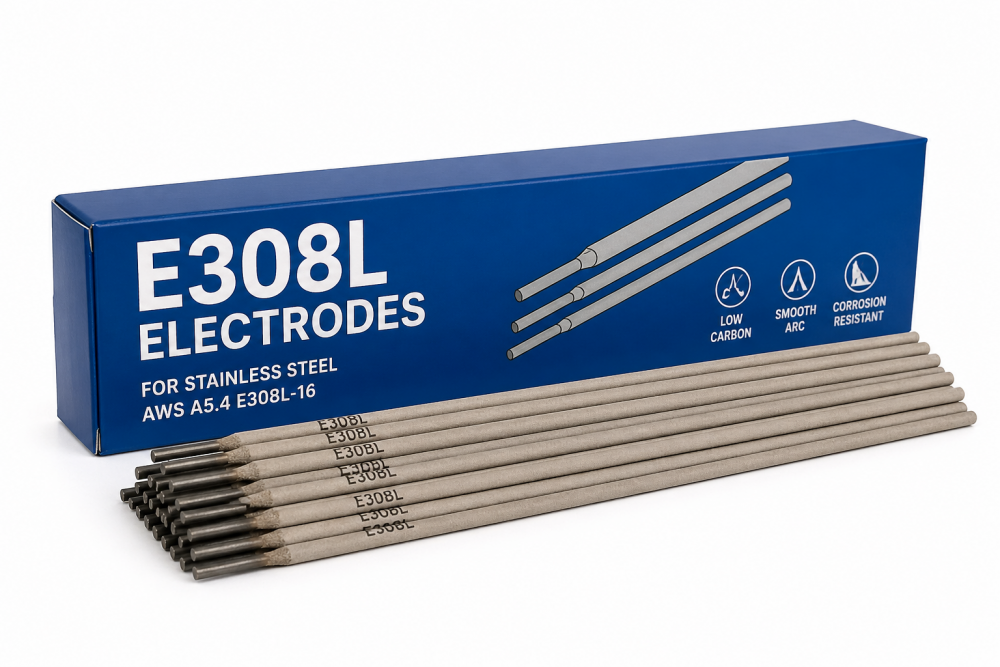
Welders use E308L electrodes for stainless steel welding by ensuring proper surface preparation, setting the correct current, controlling heat input, and performing post-weld cleaning. They commonly use these electrodes to weld SS 304 and similar austenitic grades, where corrosion resistance and weld integrity are critical.
Improper methods may result in carbide precipitation and corrosion, leading to costly repairs in the future. This article explains how to use E308L electrodes correctly, since how you handle them affects the quality of the final weld. We’ll walk through preparation and post-weld passivation so your industrial projects stay strong and consistent.
What are E308L Electrodes?
E308L is a coated electrode specifically engineered for austenitic grades. The “L” stands for Low Carbon (below 0.04%), a critical detail that minimises carbide precipitation at grain boundaries during welding. This prevents “sensitisation”, the primary cause of intergranular corrosion. Welders value E308L electrodes for their smooth arc, reliable fusion, and corrosion resistance in the as-welded condition, making them a preferred choice for pipes, pressure vessels, and tanks. E308L Electrodes for stainless steel pipe welding and pressure vessel fabrication are widely preferred across industrial applications.
Where E308L Electrodes are Used
Fabricators use E308L electrodes wherever they work with SS 304. Key industries include
Chemical Processing
Used for fabricating reactors and transport piping systems that handle aggressive industrial chemical compounds.
Food & Beverage
Required for clean, smooth-surface welding in storage tanks and liquid processing equipment.
Construction
For stainless steel frameworks in coastal or high-corrosion outdoor environments, this provides essential and lasting structural integrity.
It is also highly compatible with SS 301, 302, and 308, offering versatile applicability for mixed-grade projects.
Step-by-Step Guide: How to Use E308L Electrodes
1. Surface Preparation
A sound weld begins with a pristine surface. Contaminants like oil, grease, or moisture trapped in the weld pool cause porosity and cracking.
- Method: Use dedicated stainless steel wire brushes and solvents to degrease the joint.
- Advisory: Avoid sharing brushes between carbon and stainless steel, as cross-contamination might result in “tea staining” or surface corrosion.
2. Select Correct Welding Parameters
E308L electrodes perform best on DCEP (Direct Current Electrode Positive). While AC is possible, DC provides the stable arc required for thin-gauge stainless.
Align your amperage with the electrode diameter. Running too high causes burn-through, while running too low leads to poor fusion and “cold lapping”.
3. Proper Electrode Handling
The weld is made accessible by the absorption of air, which allows hydrogen to enter. This is because the flux coating on E308L is vulnerable to moisture, which is the reason why this occurs.
Welders should keep electrodes in a sealed container or a heated drying oven. If you expose them to air, re-dry them following the manufacturer’s data sheet instructions before you finally strike your welding arc.
4. Maintain Correct Arc Length
Keep the arc length low, preferably equal to the diameter of the electrode core. A narrow arc generates focused heat and provides good shielding gas coverage. A long arc produces a lot of spatter and permits ambient oxygen into the weld pool.
5. Welding Technique
A stringer bead technique is preferred over wide weaving. Stringers keep heat input low, reducing the risk of warping and sensitisation.
- Angle: Hold the electrode at a 10–15° angle in the direction of travel.
- Speed: Maintain a consistent rhythm to ensure a uniform bead profile.
6. Control Heat Input
Stainless steel has lower thermal conductivity than carbon steel, meaning heat stays localized. Excessive heat ruins the material’s corrosion resistance.
- Solution: Use moderate current and cool the joint if the interpass temperature exceeds your specified engineering limit.
7. Interpass Cleaning
Slag must be removed entirely between passes. Residual slag creates stress points and inclusions that weaken the joint. Use your dedicated stainless brush after every bead to maintain high-density weld quality.
8. Post-Weld Cleaning
Welding leaves behind “heat tint”. This discoloured oxide layer isn’t just ugly; it serves as a potential corrosion site.
- Passivation: Use pickling and passivation pastes to restore the chromium-oxide protective layer. This step restores the protective chromium oxide layer and improves corrosion resistance.
Common Mistakes to Avoid
The following are some of the most typical mistakes that buyers should avoid during the procurement process.
- Incorrect Current: Ignoring manufacturer-specific amperage ranges.
- Poor Preparation: Welding over oil or moisture.
- Long Arcing: Leading to erratic penetration and porosity.
- Heat Mismanagement: Overheating the metal, which leads to distortion.
- Damp Storage: Using electrodes that haven’t been kept dry.
Advantages of E308L Electrodes
The following are some of the examples of the advantages E308L Electrodes can provide.
- Superior resistance in aggressive environments.
- Provides a smooth surface finish with minimal surface preparation necessary.
- Because of the low carbon, cracking and sensitisation can be avoided.
- Versatility, the “all-rounder” for the most common stainless grades.
E308L vs. E308: What’s the Difference?
Refer to the table below for a technical comparison of these electrodes:
Comparison: E308L vs. E308 Electrodes
| Feature | E308L | E308 |
| Carbon Content | Low ($\leq$ 0.04%) | Standard (Up to 0.08%) |
| Corrosion Risk | Very Low | Sensitisation (Carbide Precipitation) |
| Weld Performance | Superior in the as-welded state | May require post-weld heat treatment |
| Metallurgical Integrity | High resistance to intergranular attack | Risk of localised decay at grain boundaries |
| Primary Application | Critical process piping & tanks | General-purpose low-corrosion environments |
Conclusion
E308L electrodes are mastered by welders through discipline and preparation. Adhering to strict post-weld cleaning methods, managing heat input, and maintaining a clean workplace ensures the manufacture of long-lasting, sturdy fabrications. In the stainless steel industry, shortcuts inevitably lead to cracks or corrosion. Reliable providers like Good Luck Metal ensure that you receive excellent quality consumables made correctly the first time. This partnership protects your project from costly manufacturing errors. A consistent technique serves as the most cost-effective tool in your welding arsenal, protecting every single joint you create.