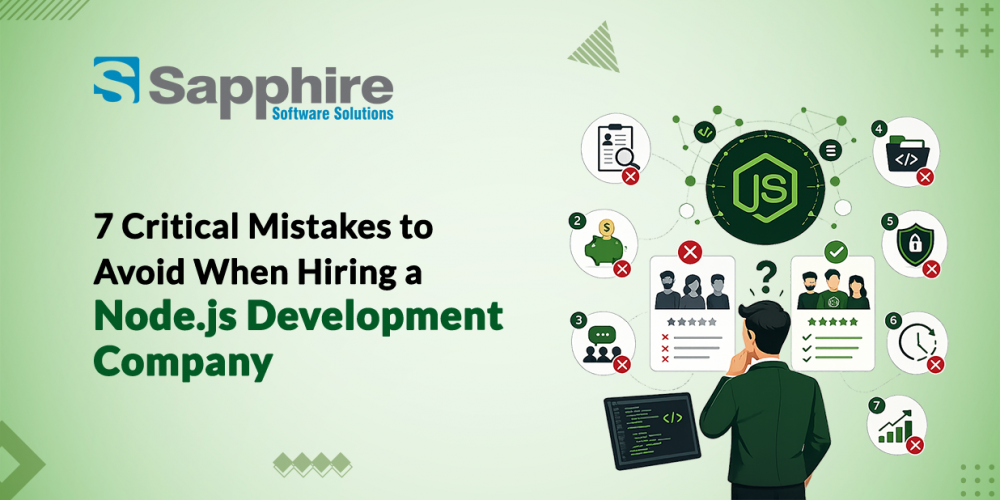
Let me be honest with you from the start.
The reason why this blog came about in the first place is because of the many real-life discussions we have had with many actual entrepreneurs who approached us feeling lost, disheartened, and disappointed in the decisions they had made that had led to this point. They were doing the right thing. They had done their research. The chose an experienced Node.js development company to work with. But somehow, somewhere down the road, things just did not work out for them.
And the unfortunate truth? Most of it could’ve been prevented.
If you are currently on the lookout for a Node.js development company to work with, be it your first startup or your tenth then I strongly advise that you read this blog, and that you take everything you see here with the utmost seriousness.
Mistake #1: Letting the Price Tag Make the Decision for You
I get it. Budgets are tight. You’ve got a number in your head, three quotes on the table, and one of them is noticeably lower than the rest. It feels like a win.
It rarely is.
This is a pattern that repeats itself on many occasions. A company chooses the least expensive option; the project begins with great gusto and energy but gradually turns sour, deadlines get delayed, there is poor communication, the end product is produced, and it is either not according to the specification or contains hidden flaws.
When the company realizes its mistake, it brings in another developer to do the work and spends more money than it would have if the initial decision had been right.
Inexpensive development might be a good idea at first glance, but experience shows us that it should be avoided at all costs. The idea behind spending money is not to burn as much as possible but rather to be wise about where one invests.
Before you decide: Look at what each quote actually includes. Ask about the team’s experience level. Ask how they handle revisions and bugs. As what happens if things go over time. The answers to those questions will tell you far more than the number at the bottom of the proposal.
Mistake #2: Assuming “Development Company” Means Node.js Expertise
And this one always comes as a shock when I mention it, but it is actually surprisingly common.
A development firm could have an amazing website, an impressive roster of previous customers, and years of experience — and yet lack extensive knowledge in Node.js. Development firms typically cover many platforms, and not all of them possess the level of expertise required by your particular project.
It is no secret that Node.js development is no easy feat. Gaining mastery involves understanding how to use asynchronous programming correctly, designing clean APIs, managing databases effectively, and creating apps that withstand actual usage.
I’ve met entrepreneurs who realized this issue after investing a considerable amount of money and effort into a project for a few months. At that point, sorting things out becomes complicated, laborious, and utterly demoralizing.
Before you decide: Ask directly about their Node.js work specifically. Not just development in general — Node.js. Ask for examples. Ask how many Node.js projects they’ve delivered. As about the complexity of those projects. If they seem vague or keep steering the conversation elsewhere, that’s worth paying attention to.
Mistake #3: Skipping a Proper Technical Conversation
Most companies follow a very similar model when choosing their development partner: they shop around, evaluate their options, choose one company, and proceed by hitting the purchase button. But whereas the vast majority of items purchased can be returned for a refund or exchanged without any hassle, making an incorrect choice when hiring a development team will cost you months of lost time, as well as result in a non-working application.
Perhaps, the most frequent omission in the evaluation process that I witness is that of technical discussion. Please understand – you are not required to be a tech-savvy person yourself to engage in one. Some of the easiest, yet most effective questions to pose include.
How will you address my requirements? What’s your approach to dealing with emergencies or problems in general? What’s your policy regarding changes of scope? What about testing?
How a particular company addresses these concerns will reveal a whole lot about who they are and what they are capable of doing. The more experienced and confident the people at the other end are, the better their response. Experienced teams pose follow-up queries, identify possible obstacles, and speak openly about the challenges involved. The not-so-experienced teams are either unable to provide a clear answer or will say exactly what they think you would want to hear.
Before you decide: Get on a video call. Come with a handful of questions prepared. You’re not trying to catch anyone out — you’re just trying to get a genuine feel for how they work and whether you’d trust them with something important to your business.
Mistake #4: Underestimating How Much Communication Matters
One thing worth remembering here is that, as far as problems go, lack of communication skills may be as detrimental to a project as a lack of technical skills is.
Think about it. Even the most technically gifted development team in the world becomes a problem if you can’t get a straight answer out of them, if updates arrive sporadically and only when chased, or if issues are buried rather than flagged early.
When you Hire NodeJS Developer talent or bring on a full development company, you’re entering a working relationship. And like any working relationship, the quality of the communication shapes almost everything about how it goes.
Some red flags to look out for in the early stages include delayed email replies, evasive answers to straightforward questions, a lack of willingness to talk over the phone, or a sales strategy that seems more managing than listening.
Before you decide: Ask specifically how they manage projects and client communication. What tools do they use? How often can you expect updates? Who is your dedicated point of contact? A company that has good answers to these questions — and ideally, a clear process to back them up — is one that’s thought seriously about the client experience, not just the technical output.
Mistake #5: Not Talking About What Happens After Launch
This is the one that totally takes people by surprise, and let me tell you, this is the most challenging one for me to deal with since the frustration just builds up to such an extent.
Everything is going well. You have completed your project. The application goes live, and you are happy about it. Then, a few weeks down the line, some things break, or a bug pops up somewhere, or a change is needed in your application. And, when you contact the development company for a quick fix, you realize that either they aren’t responding to you anymore, their turnaround time has decreased considerably, or you need to pay a lot for a minimal requirement post-launch.
Node.js app maintenance is essential. Updates, monitoring, and bug fixing should not take a back seat once your app goes live. The point isn’t whether or not you’ll require post-launch maintenance. It is whether or not you’ll get that help.
Before you decide: Have the post-launch conversation before you sign anything. Ask what their support offering looks like. What’s included in their standard package? What falls outside of that? How quickly do they respond to critical issues? These questions might feel premature at the start of a project, but they’re far easier to ask before you’ve committed than after something goes wrong.
Mistake #6: Not Asking About Code Quality
I know what you might be thinking. “I’m not a developer. How am I supposed to evaluate code quality?”
Good point. However, you do not have to be an expert capable of reading a single line of code to ask the correct questions. In addition, there are reasons why it is important to consider code quality, and these relate to the potential problems it will cause you in the future due to its low quality.
There may be cases where certain developers choose to save on quality when developing certain applications for their clients. The final product may seem flawless; however, after some period of time, especially when more users join in or changes are requested, it is quite easy to recognize that corners were cut somewhere during development.
Before you decide: Ask how they approach code quality. Do they conduct internal code reviews? How do they handle testing? Do they write documentation alongside the code? Do they follow established Node.js development standards? A team that cares about this stuff will be genuinely happy to talk about it. It’s something they’re proud of. If the question seems to land awkwardly, take note of that.
Mistake #7: Making a Rushed Decision Because of External Pressure
This is the final reason, and in many ways, the toughest to resist – since the need to act fast is sometimes genuine.
Perhaps you have a deadline for launching a product. and rival has recently released something similar and you feel the heat. Perhaps your funding window is ending and you feel like you must make the call now. I know how you feel, and these considerations are completely valid.
But making an ill-considered decision regarding which company will develop your product could easily turn out to be one of the costliest decisions your organization ever made. The recruitment process should not be rushed. While I am not suggesting spending months on the process, I am saying that sufficient time needs to be devoted to contacting several companies, asking the right questions, checking references, reading unbiased reviews, and comparing your options.
Companies that take their time when choosing a Node.js development company generally find themselves in a much better position than those that don’t.
Before you decide: Give yourself a realistic timeline. Speak to at least two or three companies properly. Ask for references and actually follow them up. Back up your instincts with evidence. The few extra days you spend getting this right could save you months of headaches on the other side.
What You Should Actually Be Looking For?
Now that we’ve covered what to avoid, here’s the short version of what the right Node.js development company actually looks like in practice.
They have real, demonstrable Node.js experience — projects you can look at, not just names on a list. They communicate clearly and consistently, from the very first call right through to after launch. The ask good questions about your project rather than just telling you what you want to hear. They talk openly about their process, their quality standards, and what happens when things don’t go perfectly to plan. And they feel less like a vendor and more like a team that’s genuinely invested in your project doing well.
When you find that, the difference is immediately obvious. And it makes the entire experience from kickoff to launch and beyond a completely different one.
One Last Thing Before You Go
Hiring the right Node.js development company is one of those decisions that either sets your project up properly from the beginning or creates problems you’re still dealing with long after launch. The seven mistakes above aren’t rare edge cases; they’re patterns that repeat themselves constantly, and every single one of them is avoidable.
Take your time. Ask the right questions. Trust your gut when something feels off but make sure you’ve actually done the groundwork to back that instinct up.
And if you’re currently at the stage where you’re weighing up your options and want an honest, straightforward conversation about your project, no pushy sales process, no confusing jargon, Sapphire Software Solutions is here to help. We’ve helped businesses navigate exactly this process, and we’d genuinely love to help you get it right from day one.