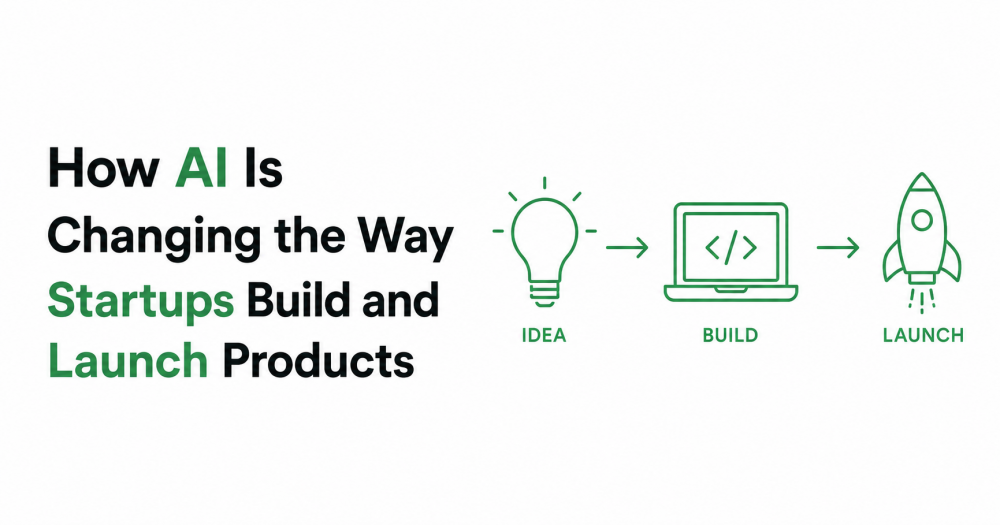
A few years ago, building a software product as a first-time founder meant one of two things: either you knew how to code, or you hired someone who did. There was no middle ground. Ideas that could not afford a developer simply did not get built.
That is no longer true. AI for startups has flipped the entire equation, and the change is happening faster than most people expected.
In 2026, a solo founder with no engineering background can go from an idea to a working web application in a matter of days. Not a prototype. Not a mockup. A real, functional product that can be tested, shared, and iterated on. The tools that make this possible are not experimental, they are being used right now by thousands of early-stage teams across the world.
Here is what has actually changed, and why it matters for anyone building something new.
Building Has Become Accessible to Everyone
The most visible shift is in how products get built. AI coding tools like Cursor, Windsurf, and Bolt allow founders to describe what they want in plain English and watch the code get written in real time. Under the hood, most of these tools rely on large language models trained heavily on Python which is one of the key reasons Python has become the default language for AI development across teams of all sizes. You do not need to understand every line. You need to understand what you are building and why.
This has created an entirely new category of builder, sometimes called the vibe coder. Someone who uses AI to move fast, experiment freely, and ship without the traditional engineering bottleneck. Designers are building their own tools. Marketers are shipping internal dashboards. Domain experts are turning their knowledge into products without waiting for a development team.
The speed advantage here is not incremental. Founders who previously spent months on an MVP are now shipping in weeks. Teams that used to need five engineers are operating with two. The competitive gap between a well-funded team and a scrappy solo founder has narrowed significantly.
Validation Is Cheaper and Faster Than Ever
One of the most expensive mistakes a startup can make is building the wrong thing. Traditionally, validating an idea required either a significant investment of time and money or a very early customer willing to take a chance on an unfinished product.
AI changes this in two ways.
First, the cost of building something testable has dropped dramatically. You can now build a functional version of your idea quickly enough to get real user feedback before committing fully. The barrier to running a genuine experiment has never been lower.
Second, AI tools can help with the research and validation process itself. Market research, competitor analysis, user interview synthesis, and positioning work that used to take weeks can now be accelerated significantly. Founders are spending less time on the prep work and more time talking to actual customers. This is part of a broader shift as businesses handle increasingly complex data, AI tools are stepping in to reduce the manual effort required to make sense of it all.
This does not mean every startup is making better decisions, it means the feedback loop is faster, which gives you more chances to correct course before you run out of runway.
Deployment Is No Longer a Bottleneck
Building the product is only half the equation. Getting it live, keeping it running, and scaling it when it starts to grow, this is where many early-stage teams have historically struggled.
Setting up servers, configuring environments, managing infrastructure, these tasks used to require dedicated DevOps experience. For a small startup, that either meant hiring a specialist or the founder spending days figuring it out themselves.
AI-powered deployment platforms have changed this. Founders can now take the app they built and get it running in production without touching a server or writing a configuration file. This is part of what a modern cloud workplace looks like in 2026 infrastructure that largely manages itself, allowing small teams to operate with the agility of larger ones. The kind of infrastructure work that used to take a full day now takes minutes. This is what AI-powered deployment looks like in practicet The entire path from writing code to having a live product has been compressed dramatically.
For a startup, this matters a lot. Every hour not spent on infrastructure is an hour that can go toward the product, the customers, or the next experiment.
The Competitive Landscape Is Shifting
It is worth being honest about what this all means at a macro level. AI for startups is not just a productivity tool, it is changing who can compete and on what terms.
Large companies still have distribution, brand, and capital. But the product development advantage they used to hold over small teams is shrinking. A two-person startup in 2026 can ship features at a pace that would have required a team ten times the size just a few years ago.
This creates real opportunity for founders who move quickly and stay close to their customers. It also creates pressure because if you can build fast, so can everyone else. The advantage is not in having AI. It is in how well you use it and how clearly you understand what you are building and for whom.
What This Means if You Are Building Something
If you are an early-stage founder or thinking about starting something, the practical message is straightforward: the tools exist. The barrier to building is lower than it has ever been. The question is no longer whether you can build, it is whether what you are building is worth using.
Spend less time worrying about the technology stack. Spend more time talking to the people you are building for. Ship something real as early as you can, get it in front of actual users, and let the feedback drive what you build next.
The startups that will win in this environment are not the ones with the biggest teams or the most sophisticated AI stack. They are the ones who move with purpose, stay close to their customers, and use every tool available to close the gap between idea and product.
That gap has never been smaller. Use it.