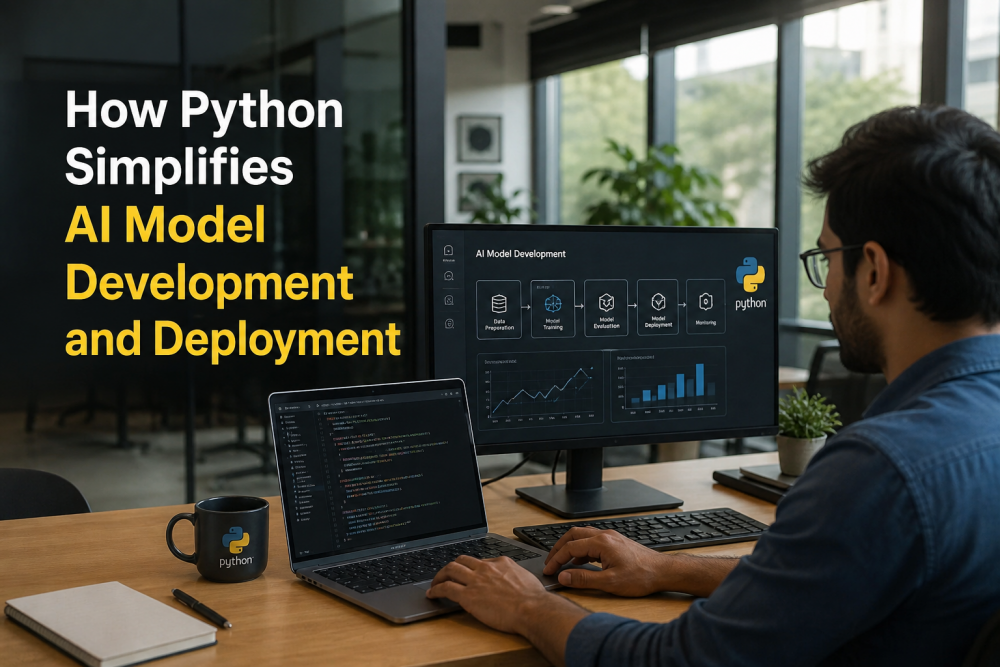
There is a reason why nearly every AI team, from a two-person startup to a hundred-person research lab, defaults to Python. It is not because Python is the fastest language or the most elegant. It is because Python removes friction at every stage of building AI systems, from the first experiment to a model running in production. That combination of accessibility, tooling, and ecosystem depth is hard to replicate, and it has made Python the practical backbone of modern AI development.
Understanding why that is the case requires looking past surface-level convenience. Python’s role in AI is not accidental. It reflects deliberate choices made over the years by the people building the tools, frameworks, and pipelines that power real AI systems. And if you are building something with AI today, whether that is a predictive model, a generative system, or an automated pipeline, understanding Python’s specific advantages will help you make smarter decisions about how you build.
The Prototyping Advantage
AI development does not move in a straight line. Teams run experiments, throw out results, adjust assumptions, and start again. Because of that, the ability to move quickly from an idea to a working prototype matters enormously. Python’s syntax is lean enough that a developer can express a complex data transformation or model evaluation loop in a fraction of the lines another language would require. That speed compounds across dozens of daily iterations.
The interactive nature of Python reinforces this. Tools like Jupyter Notebooks let data scientists and engineers write code, run it, inspect the output, and adjust, all without leaving the environment or rebuilding a project. That tight feedback loop is especially valuable during the exploratory phases of AI work, where understanding what the data is actually doing matters more than architectural purity. When teams need to test five different preprocessing approaches in an afternoon, Python makes that practical rather than painful.
Also Read: How Do Data Engineers Use Python for Data Processing?
Importantly, Python does not force a tradeoff between speed of development and capability. The same codebase used for early experimentation can evolve into something production-ready without requiring a full rewrite in a different language. That continuity reduces the hidden cost of translation, the time spent porting logic from a prototyping environment into a deployment environment, which is a real and underappreciated drag on AI project timelines.
An Ecosystem Built Around the Problem
What sets Python apart is not the language itself in isolation, but the ecosystem that has grown around it. Libraries like NumPy and Pandas handle the kind of numerical computation and data manipulation that sit at the foundation of nearly every AI workflow. Frameworks like PyTorch and TensorFlow handle model definition, training loops, and gradient computation in ways that would take teams months to build from scratch. Together, these tools mean that most of the heavy lifting in AI development comes pre-built, tested, and documented.
The depth of this ecosystem also means that when teams hit a problem, there is almost certainly an existing library that addresses it. Need to handle class imbalance in a training dataset? There are established tools for that. Need to evaluate a language model’s output quality? There are frameworks specifically designed for it. This matters not just for efficiency but for reliability; using well-maintained libraries with large user bases reduces the chance of introducing subtle bugs that are notoriously difficult to catch in AI systems.
Furthermore, the ecosystem evolves quickly in lockstep with the field. When transformer-based architectures became the dominant paradigm in AI, Python tooling adapted rapidly. When large language models created new deployment challenges, new Python libraries emerged to address them. Teams working in Python benefit from that responsiveness in ways that would not be possible if they were working with tools that moved on a slower release cadence.
Simplifying the Training Pipeline
Training an AI model is not a single step. It involves loading and preprocessing data, splitting it correctly, defining the model architecture, configuring the training loop, monitoring metrics, saving checkpoints, and evaluating performance across multiple dimensions. Each of those steps has its own complexity, and managing them coherently is one of the genuine challenges of AI engineering.
Python handles this well because its abstractions align naturally with how practitioners think about the training process. A model in PyTorch reads almost like pseudocode: define the layers, describe the forward pass, and the framework takes care of the backward pass during training. That alignment between mental model and code reduces cognitive overhead considerably. When the code reflects how you think about the problem, debugging and modification become far less taxing.
Beyond individual steps, Python also integrates cleanly with orchestration tools used to manage longer training runs. Whether a team is running hyperparameter sweeps, managing distributed training across multiple machines, or tracking experiments across dozens of configurations, Python connects smoothly with the tooling that makes those workflows manageable. The result is a training pipeline that stays readable and maintainable even as it grows in complexity, which is essential for teams that need to revisit and iterate on training logic over time.
Deployment Without the Rewrites
Historically, one of the friction points in AI development was the gap between research and production. Models trained in Python had to be converted, exported, or entirely reimplemented in a different language before they could serve real traffic. That process was time-consuming, introduced risk, and made it harder to iterate on a deployed model once it was live.
Python has largely closed that gap. Frameworks like FastAPI and Flask make it straightforward to wrap a trained model in a REST API and expose it as a service. Tools like ONNX allow models to be exported in interoperable formats while keeping the development workflow in Python. Containerization with Docker, combined with Python-based configuration, means that what runs on a developer’s machine can be reproducibly deployed to any cloud environment with minimal modification.
This end-to-end coherence has real operational benefits. When the same team that trained a model can also deploy and maintain it without switching languages or toolsets, iteration cycles shorten. A model update does not require a handoff to a separate engineering team fluent in a different stack. Instead, the team that understands the model’s behavior, and therefore knows how to improve it, also controls its deployment. That continuity reduces the time between identifying a problem and shipping a fix.
Monitoring and Maintenance Over Time
Deploying a model is not the end of the work; it is the beginning of a different kind of work. Models drift as the data they encounter in production diverges from the data they were trained on. Catching that drift early, before it affects user outcomes, requires ongoing monitoring. Python’s data tooling makes it practical to build that monitoring into the same codebase used for development, rather than treating it as an afterthought.
Teams use Python to log model predictions, compute distribution metrics over time, flag anomalies, and trigger alerts when performance degrades. Because those monitoring scripts can directly import the same preprocessing and evaluation logic used during training, comparisons between training-time and production-time behavior are accurate rather than approximate. That precision matters when teams are trying to diagnose subtle degradation rather than obvious failures.
Additionally, Python’s readability pays dividends during maintenance. AI systems are long-lived. The engineer who maintains a model twelve months after deployment is often not the one who built it. Code that reads clearly, where the logic is explicit rather than buried in clever abstractions, shortens the time it takes a new contributor to understand what is happening and make changes safely. That is a practical advantage that matters more the longer a system runs.
The Real Reason Python Dominates AI
Python’s dominance in AI is not about syntax preferences or language benchmarks. It is about the complete workflow, from the first exploratory notebook to a monitored production system, being supported by a coherent, well-maintained, and continuously evolving set of tools. No other language has achieved that breadth with that level of depth across the full AI development lifecycle.
For teams building AI systems today, the practical implication is straightforward. Investing in Python fluency is not just learning a language; it is gaining access to the infrastructure that the entire field has converged around. The abstractions are good, the community is large, the tooling is mature, and the path from experiment to production is clearer than it has ever been. That combination is why Python is not just where AI development happens to live right now. It is where it is likely to keep living for the foreseeable future.