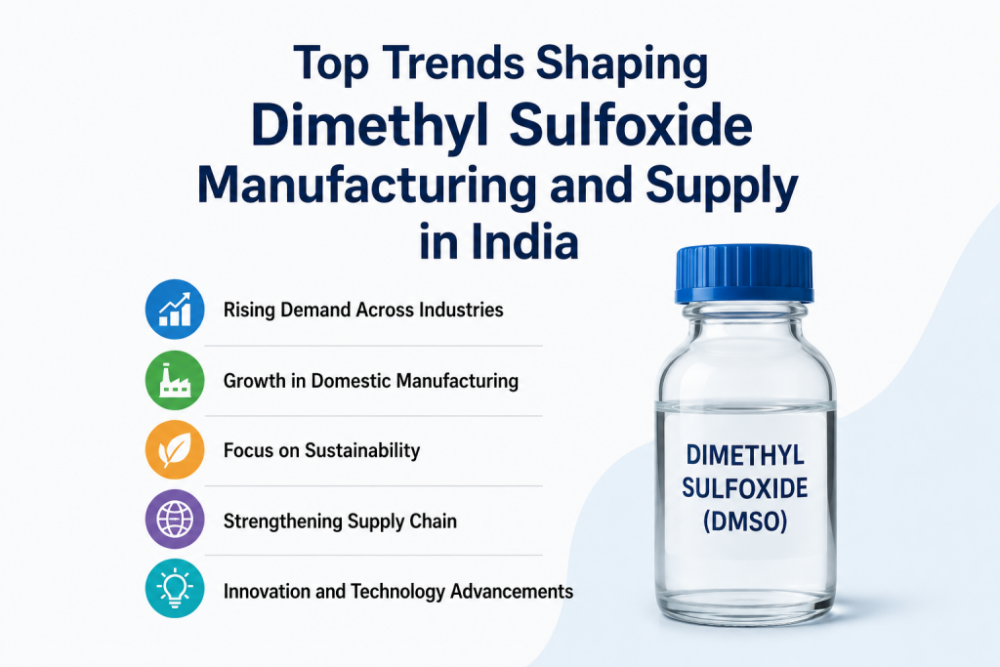
Dimethyl sulfoxide does not behave like a simple bulk solvent once it leaves the plant. It changes slowly depending on how it is stored, how it is handled, and how often it is exposed to heat or air. Those changes are small enough to pass unnoticed in lab checks, but they show up in process behavior later. That is why the conversation around supply has shifted. It is no longer about how much can be produced. It is about how little the material changes between production and use.
This shift is pushing leading dimethyl sulfoxide manufacturers India to adjust how they run plants, how they purify, and how they move material out of the facility. The pressure is coming from the end users, not from production targets.
Reaction Control Is Getting Tighter at the Source
The base route for DMSO production involves oxidation of dimethyl sulfide. The chemistry itself is not new, but the tolerance around it has narrowed. Earlier, slight variation in oxidation level was acceptable as long as final purity crossed the required mark. That approach is no longer holding.
The current DMSO manufacturing trends India show that producers are holding reaction temperature and oxygen feed within narrower windows. Even small drift in oxygen input leads to incomplete oxidation or formation of higher oxides like dimethyl sulfone. Removing those later is possible, but it adds load on distillation and increases variation between batches.
Keeping the reaction steady reduces the need for correction downstream. It also stabilizes the impurity pattern, which matters more than the final purity number.
Distillation Is Doing More Than Separation Now
Most of the variation in DMSO does not come from the reaction stage alone. It shows up in distillation. The solvent has a high boiling point, and separation of closely related sulfur compounds requires steady column conditions.
In older setups, operators adjusted temperature and pressure manually based on output. That introduced slight shifts in cut points. Each shift changes what carries over into the final product.
Under current dimethyl sulfoxide industry trends, operators control distillation more tightly. They run columns within narrower pressure bands and maintain stable heat input instead of adjusting it frequently. Their goal is not maximum recovery, but repeatable separation.
This is where batch-to-batch consistency is either maintained or lost.
Pharmaceutical Demand Is Changing What “Acceptable” Means
The dimethyl sulfoxide demand in pharmaceutical industry is not about volume alone. It is about predictability. DMSO is used in drug processing, reaction systems, and biological storage environments. In these cases, small differences in solvent behavior matter.
Residual sulfur compounds, even below 100 ppm, can influence reaction pathways. Moisture above certain levels affects stability of sensitive intermediates. These are not theoretical concerns. They show up as slight shifts in yield or impurity formation.
As a result, leading dimethyl sulfoxide manufacturers in India maintain stricter internal limits than those declared in standard specifications. The declared range may remain wide, but actual production runs closer to a narrower band to avoid drift in real use.
Export Movement Is Affecting Material Condition
The export trends of dimethyl sulfoxide are increasing, but export introduces variables that do not exist in domestic supply. Transit time, temperature changes, and handling conditions all influence the solvent.
DMSO is hygroscopic to some extent. It picks up moisture when exposed, even during transfer. Long transport cycles increase that exposure risk. A batch leaving at 0.05% water may arrive closer to 0.1% depending on route and handling.
This does not always break specification, but it changes how the solvent behaves in application. For high-sensitivity systems, that difference matters.
This is why exporters are tightening loading practices and using better-sealed systems. The product is not just made in the plant. It is maintained until delivery.
Supply Chain Is Now Part of Process Control
Chemical industry supply chain trends and chemical manufacturing innovations in India show that companies now treat logistics as part of production in the DMSO sector. They no longer use storage tanks only as holding units. Instead, they manage them as controlled environments.
Manufacturers use temperature control to reduce degradation, minimize air exposure, and modify transfer systems to prevent contamination.
Earlier, once the product left the plant, responsibility shifted. Now it extends until the solvent is used. Buyers expect the same behavior at arrival as at dispatch.
This expectation is forcing leading dimethyl sulfoxide manufacturers India to integrate supply chain control into their operating model.
Sustainability Pressure Is Changing Process Decisions
The move toward is affecting DMSO production in practical ways. High-temperatusustainable chemical manufacturing trends India re operations consume significant energy. Emissions from sulfur compounds require treatment.
Producers are optimizing heat recovery systems to reduce energy use. Waste streams are being treated more efficiently to recover usable material. These changes are not only regulatory responses. They also reduce loss and improve consistency.
Sustainability here is not separate from performance. It overlaps with it. Better control reduces both waste and variation.
Where The Industry Is Heading
The future of dimethyl sulfoxide manufacturers in India is not about becoming larger alone. It is about becoming more stable. Output will increase, but control systems will define competitiveness.
Monitoring is becoming more continuous rather than batch-based. Feedback from end users is being used to adjust production parameters. The gap between supplier and user is shrinking.
Instead of reacting to variation, the focus is shifting toward preventing it.
What Plants Actually Notice Over Time
Differences between suppliers do not show up immediately. They appear after repeated use. Operators begin to see patterns that are not visible in lab reports.
| Long-Term Observation | What It Suggests | Where It Appears | Resulting Adjustment |
| Gradual increase in moisture readings | Storage or transport exposure | Incoming solvent checks | Pre-drying or blending required |
| Slight change in odor profile | Trace sulfur compound variation | Handling stage | Early indicator of batch difference |
| Increased residue after heating cycles | Heavier fraction presence | Reaction systems | More frequent cleaning |
| Slower evaporation during processing | Boiling range shift | Drying or coating | Process timing changes |
| Minor color variation over time | Oxidation or contamination | Storage tanks | Additional filtration or rejection risk |
None of these issues cause immediate shutdown. That is why they are often overlooked at first. Over time, they increase the effort required to keep processes stable.
Suppliers that keep these variations minimal are the ones that remain preferred, even when all suppliers meet formal specifications.
Final Perspective
The dimethyl sulfoxide market is shifting in a way that is not obvious from production numbers alone. Demand has increased, but expectations have tightened faster than output.
For leading dimethyl sulfoxide manufacturers India, the challenge is not just to produce more, but to produce material that behaves the same way every time, even after movement, storage, and reuse.
The difference between acceptable and reliable is becoming clearer. Acceptable meets the limit. Reliable stays steady.