For many years, the simplicity of food delivery apps, which is to take a food order, find a driver, and deliver it as quickly as possible, was pretty much the whole thing.
This worked to their advantage because they could invest every dollar spent on product development into trying to make that one flow as fast and frictionless as possible.
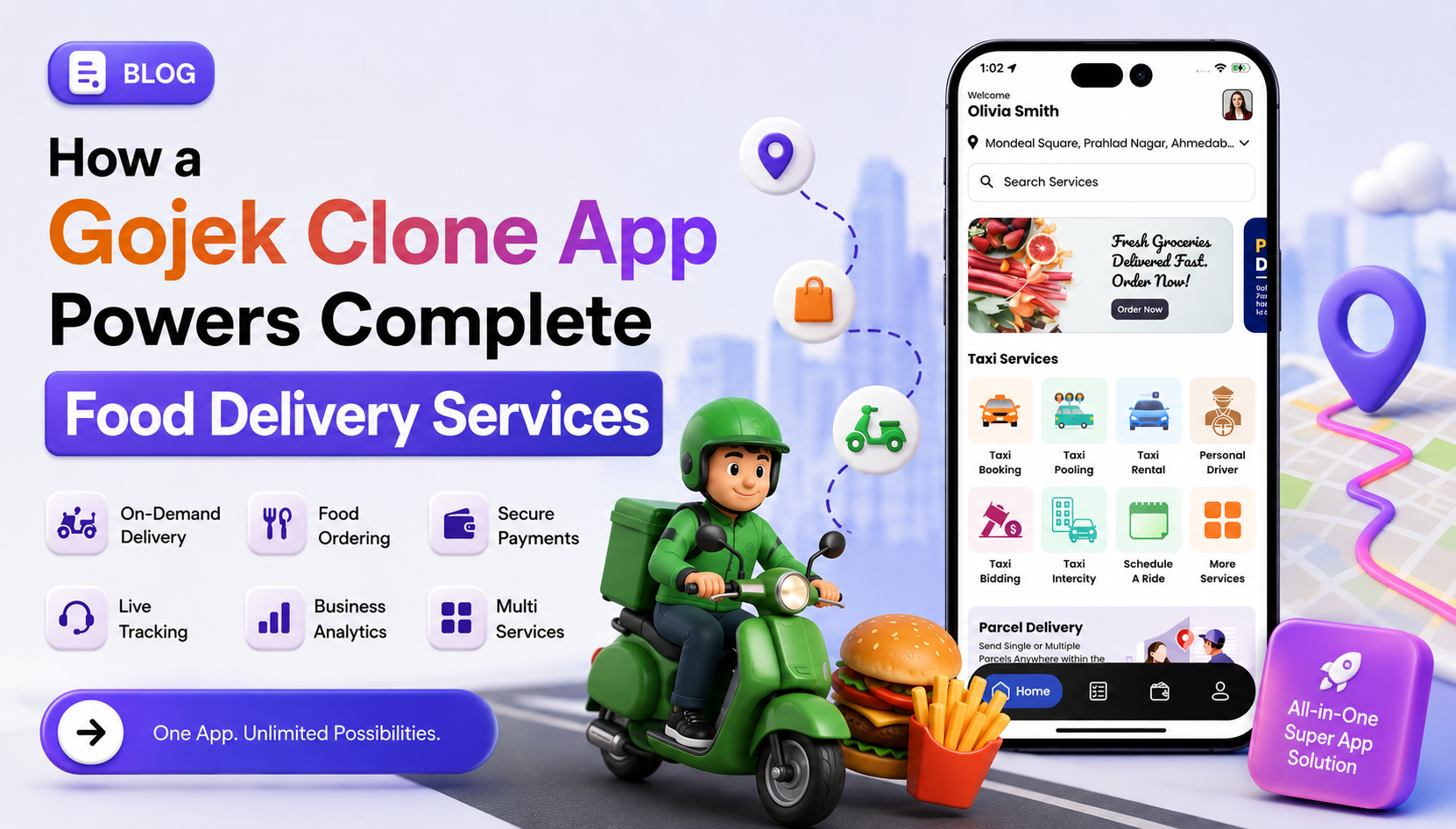
Is that single-service benefit worth questioning? In 2026, a Gojek clone app’s food delivery module, which is one out of 18 on the same platform, now does most of the same things. The platform has it all – restaurants, tracking the driver in real-time, tracking your order live, multiple payment options, promo codes, delivery radius controls, and much more.
There is considerable redundancy, to be honest, for what is strictly one part of a much larger application. And for an entrepreneur who is weighing a standalone food delivery app against a super app with food delivery, feature comparison matters a lot.
What the Food Delivery Module Inside a Gojek Clone Actually Covers
The store deliveries feature in a Gojek clone is installed as a multi-type delivery system.
The admin can enable as many as 10 types of delivery in the admin panel, so when the platform opens, it may activate food, grocery, and pharmacy delivery immediately after opening, and then a few weeks later when the supply side catches up, flower delivery or bottled water delivery can be switched on.
This, more or less, is where the standalone app comparison begins to get interesting. To expand, a dedicated food delivery app operator has to build and maintain separate apps or partnerships to deliver groceries, pharmacy items, and other categories of delivery.
The infrastructure of all of that already exists within the same platform and the same admin panel, as a Gojek clone operator already has. The introduction of a new delivery category is rather a configuration choice than a project.
Features Inside the Food Delivery Module That Hold Up Against Standalone Apps
1. Real-Time Order Tracking From Placement to Delivery
The moment a user places a food order through a Gojek clone, the tracking begins. The restaurant accepts, prepares, and marks the order ready for pickup. A nearby delivery driver gets assigned, picks up the order, and the user tracks that driver’s movement from the store to their doorstep, roughly the same flow that an average user would recognize. The driver app handles navigation and the user app handles the live map view, with estimated arrival times updating as the driver moves or takes a different route or whatever.
2. Different Ways to Pay, Including Wallets
Users can pay for their stuff with cash or cards or the in-app wallet, which is actually super important for markets where how people pay for food is completely different. In parts of Asia or Africa, cash on delivery is still like honestly the biggest preference even for app orders. A normal food app that takes away cash payments, which some of the new ones do, just loses a huge chunk of users that a Gojek clone guy can keep just by leaving all three options turned on in the panel settings.
3. Delivery Radius And Geofence Settings
The admin panel has these geofence controls that let the operator draw delivery zones for the food module, either by putting a radius around a restaurant or drawing borders around specific parts of the city. This matters a lot for food especially because delivery time guarantees basically completely depends on if the driver pool is packed enough in the delivery zone to actually drop off the orders in a decent amount of time.
Why Having Food Delivery Inside a Super App Changes the Economics
Each and every food order fulfilled using the clone earns the platform some commission. The commission percentages are set in the administration panel and could be adapted by store category so as to have a commission rate completely different in a food complex store than it is in an item store, such as a grocery store or even the pharmacy. It’s literally the exact same format standalone food apps adopt, whereby they request restaurants a percentage charge of each order amount.
An independent food delivery application monetizes food delivery orders and literally nothing more. All marketing expended in getting a new user is amortized over just the food orders. Honestly, that is pretty thin ice on the bottom when it comes to the revenue base, which is why most standalone food delivery apps burn through capital at the rates they do before they reach profitability.
A Gojek clone operator who currently makes a profit by delivering food to the customers also makes a profit on taxi trips, grocery and parcel delivery, bookings of beauty salons, and on-call handyman bookings by the respective customer. The user acquisition cost is redistributed among all those revenue streams, not only one.
A user that downloads the app and delivers food and then hires a taxi the next week is actually generating a commission of two categories out of a single acquisition event. That economic disparity, which, in fact, is one of the more powerful arguments in favor of the super app paradigm in comparison to the food delivery component.
Final Thoughts
Delivery of food within a Gojek clone is not, speaking broadly, a scaled-down variant of what single applications can provide. It has got a store app, real-time tracking, wallet payments, promo code management, geofencing, and a commission structure. What it also has, and what the standalone food delivery app can never claim, is the rest of the platform that transforms a food delivery user into a taxi user, a grocery store user, and eventually somebody who books a handyman or a hairdresser appointment through the same login that they initially used just to order lunch.