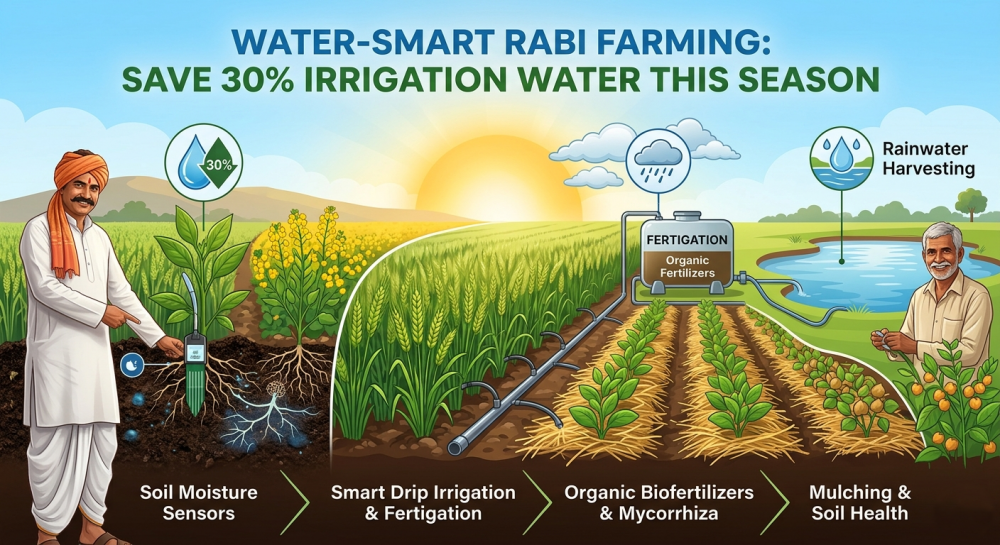
Rabi farming needs water management to grow crops and get good yields. Crops like wheat, mustard, chickpeas and lentils need water when they are growing fast. With irrigation costs going and groundwater levels going down farmers have to find better ways to farm.
Farmers are now using irrigation systems with organic fertilizers in Gujarat to keep the soil most and prevent water waste. When the soil is healthy it can absorb and store water well so crops can survive longer without needing to be watered. The main goal of Water-Smart Rabi farming is simple: save 30% of irrigation water without reducing crop productivity.
This can be done by using methods and tools.
1. Soil Moisture Monitoring with Sensors
Why Soil Moisture Monitoring Matters
We waste water when we irrigate our fields at the time. Many farmers still water their fields based on a schedule not on the moisture in the soil. Soil moisture sensors help farmers know when their Rabi crops really need water. These tools measure the moisture in the soil near the roots so farmers only water their Rabi crops when they need it.
Monitoring moisture levels can help us:
- Reduce overwatering
- Improve root growth
- Save electricity and pumping costs
- Increase irrigation efficiency
Farmers who use sensor-based irrigation systems often get Rabi crops that’re uniform and healthy. Rabi farming becomes easier with these tools.
Improving Water Absorption Naturally
Healthy soil biology helps the soil retain moisture. Using bio products improves the soil structure. Helps microorganisms grow around the plant roots. Many farmers are also learning about mycorrhiza. How it helps Rabi plants tolerate drought. Mycorrhizal fungi connect with the roots. Help Rabi plants absorb water from deeper in the soil.
Modern mycorrhizal biofertilizers can:
- Help roots grow stronger
- Improve absorption
- Increase drought resistance
- Enhance soil activity
Using mycorrhizal fertilizers for soil health can really improve Rabi crop performance during periods of drought. Rabi farming can be successful with these methods.
2. Drip Irrigation for Better Water Efficiency
Advantages of Drip Irrigation
Installing a drip irrigation system is one of the ways to reduce water loss in Rabi farming. Drip irrigation delivers water directly to the roots reducing evaporation and runoff. This method is really useful for wheat, mustard, pulses and vegetable Rabi crops.
Compared to flood irrigation drip systems use water while keeping the soil moist. Rabi farming can save water with drip irrigation.
Combining Drip Irrigation with Organic Nutrition
Many farmers now use fertilizers through their drip irrigation systems. This way Rabi crops get both water and nutrients at the time making the fertilizer more efficient. Applying NPK fertilizer through fertigation also supports Rabi crop development and stronger root activity.
It is also important to maintain the drip irrigation system. Using drip liquid regularly helps prevent clogging. Ensures water flow inside the irrigation pipes. Rabi farming needs maintenance.
3. Irrigation Scheduling Based on Rabi Crop Growth
Understanding Critical Growth Stages
Every Rabi crop has stages where it needs water. For example wheat needs water when it is tillering and filling with grain and mustard needs moisture when it is flowering. Pulses need water when they are developing pods.
Irrigating at the time improves yield quality and prevents unnecessary water loss. Rabi farming can be successful with irrigation scheduling.
Smart Irrigation Planning
of following a fixed irrigation schedule farmers should monitor soil moisture levels, weather forecasts, Rabi crop condition and temperature changes. Using plant growth promoters during stress periods can also help Rabi crops tolerate moisture shortages effectively. Rabi farming needs planning.
4. Mulching for Moisture Conservation
Benefits of Mulching
Mulching is a way to conserve water in Rabi crops. Covering the soil with crop residue or organic matter helps reduce evaporation losses. Common mulch materials include wheat straw, dry leaves, crop residue and compost.
Mulching helps:
- Maintain soil moisture
- Reduce soil temperature fluctuations
- Suppress weeds
- Improve soil activity
Combining mulch with fertilizer programs can further improve soil fertility and water efficiency. Rabi farming can benefit from mulching.
5. Rainwater Harvesting and Water Storage
Collecting Rainwater for Irrigation
Rainwater harvesting can reduce our dependence on groundwater during the Rabi season. Farmers can store rainwater in farm ponds, rooftop tanks, storage pits and reservoirs.
Stored water becomes really useful during spells and critical Rabi crop stages. Rabi farming can save water with rainwater harvesting.
Efficient Use of Stored Water
Using stored rainwater through drip systems helps maximize irrigation efficiency. Farms with matter in the soil usually absorb and retain harvested water more effectively. Using organic fertilizer products that support long-term soil improvement and better water infiltration is also helpful. Rabi farming can be successful with stored water.
6. Soil Health Practices for Water Saving
Conservation Tillage
Reducing excessive tillage helps maintain soil structure and moisture levels. Conservation tillage keeps crop residue on the field surface reducing evaporation and improving infiltration. Healthy soil improves water-holding capacity, root penetration, soil activity and nutrient availability.
Organic Nutrition for Stronger Soil
Applying micro and macro nutrients in fertilizers supports Rabi crop growth. Improves stress tolerance. Farmers who use fertilizers for vegetable Rabi crops and field Rabi crops often experience soil texture, moisture retention, stronger root systems and higher biological activity.
These practices support Rabi farming while reducing irrigation demand. Rabi farming can be successful with soil health practices.
7. Weather-Based Irrigation Management
Using Weather Data for Smart Rabi Farming
Weather-based irrigation planning helps farmers avoid watering before rainfall events. Monitoring rainfall forecasts, temperature, wind speed and humidity allows farmers to schedule irrigation efficiently. Many crop fertilizer companies now provide weather-based recommendations alongside management programs. Rabi farming can benefit from weather-based irrigation management.
Sustainable Rabi Farming for the Future
The future of Rabi farming depends heavily on water management and healthy soil systems. Farmers are increasingly adopting drip irrigation, moisture monitoring, nutrition, biofertilizers and mulching practices. This combination improves productivity while reducing long-term Rabi farming costs. Rabi farming can be successful with farming methods.
Organic Pest and Disease Management
Balanced pest management is also important for maintaining soil biology. Many growers are shifting toward pest control products pesticides organic insecticides and fungicides for Rabi plants. These solutions reduce buildup and support Rabi crop production. Farmers can also buy bio fungicides online to improve disease management while maintaining soil health. Rabi farming can benefit from pest management.
Saving 30% of irrigation water during the Rabi season is achievable with the combination of soil moisture monitoring, drip irrigation, mulching, rainwater harvesting, weather-based irrigation planning and organic soil management. Using practices like fertilizers, biofertilizers and smart irrigation systems helps improve soil moisture retention and Rabi crop performance. As modern agriculture continues to evolve farmers who adopt water- organic Rabi farming methods will achieve healthier soil, stronger Rabi crops and better long-term profitability. Rabi farming can be successful, with these methods.