Solar inverter is one of the most critical components in a photovoltaic power system. It facilitates the conversion of direct current into alternating current, making the former usable for most forms of consumption. While the description of a product may seem similar across a range of inverters, the final price of these items rarely equals. Notwithstanding the nominal power of inverters, the efficiency, warranty, internal components, monitoring technologies, installation features and service network affect the cost.
Consequently, a comprehensive assessment of the equipment should include not only the initial price but also the accompanying expenses and advantages. Therefore, merely relying on the Solar Inverter Price in India comparison may mislead a buyer and result in an unsatisfactory purchase.
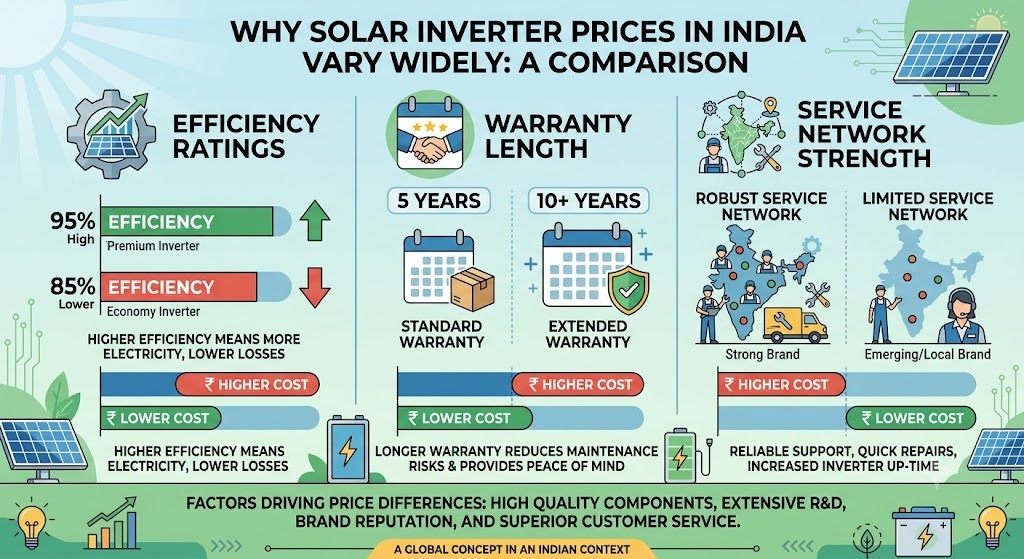
Inverter Efficiency Makes It Costlier or Affordable
Efficiency defines the ratio of electricity that a device converts from one form to another. With AC-DC inverters, some of the energy is always lost in the conversion process. However, this value varies depending on the technology that a producer uses.
For instance, a 98% efficient inverter will lose only 2% of energy compared to 5% for a device with 95% efficiency. Thus, a higher rating directly translates into a superior performer, which will ultimately save money in the long run. A slight difference in these indicators can make an essential impact in a decade. Accordingly, advanced mechanisms will inevitably cost more due to the inclusion of better components and technologies.
Efficiency is also intrinsically linked to ambient conditions. A hot climate will cause higher energy losses due to excessive temperatures. Therefore, buying a high-efficiency inverter and ensuring proper airflow around the device can offset some of the losses. As a rule of thumb, it is better to buy a slightly more powerful inverter and keep it in a well-ventilated area than to choose the cheaper option and fail to maintain it.
Warranty Length Reflects Long-Term Protection
One of the most apparent reasons why inverter prices differ is the presence or absence of a warranty. Depending on the brand and the type of equipment, a manufacturer can offer a wide range of guarantees covering various aspects of a product’s performance.
Typically, a warranty period does not exceed several years. However, a company can provide extended coverage for specialized inverters and commercial systems. A warranty scope varies depending on a manufacturer and the equipment’s class. While some producers only cover internal components, others commit to replacing a unit in the case of malfunction.
While purchasing equipment under warranty may seem more expensive, such a choice will ultimately turn out to be cheaper in the long run. Given the frequency and duration of inverter use, buying a cheaper device without warranty can lead to unsatisfactory outcomes and additional expenses. When a covered unit breaks down, the buyer will not have to bear all the costs associated with the repair or replacement.
Nevertheless, when selecting equipment, the client should not base their decision solely on the length of the warranty. Other limitations and restrictions may apply when a warranty covers only particular components or events. Therefore, prior to purchasing, it is better to clarify conditions, which may include shipping and labour costs.
Service Network Can Change the Real Cost
When discussing Solar Inverter Price in India comparison, many forget to consider the importance of the service network. An advanced inverter with a set of impressive characteristics will remain useless if the nearest service centre is located several hundred kilometres away.
When selecting a particular brand or model, it is vital to keep in mind the distance to the nearest service centres and the expected duration of work. After-sales service is particularly critical for commercial projects since large-scale photovoltaic installations are more likely to experience failures. A service network, which regularly inspects, maintains and repairs equipment, is crucial for minimizing downtime and ensuring consistent performance.
This, in turn, affects the Solar Inverter Price in India. When a manufacturer sustains a high level of technical expertise, has franchised agents, a warehouse with spare parts, and extensive service networks, it incurs additional costs. These expenses will inevitably translate into the final price, which may become an essential consideration for some buyers.
Before finalizing a purchase, it is advisable to ensure that the selected option provides access to service support in the buyer’s region. Moreover, a competent service centre can resolve many issues, ranging from interconnect support to emergency repairs. Local spare parts availability is always a valuable advantage, which can eliminate the need for additional expenses.
Internal Components and Build Quality Matter
The internal components of an inverter are another essential consideration when making a purchase. Two devices with a similar nominal power rating can have drastically different conversion capacities, which depend on their internal components. Semiconductors, capacitors, heat sinks, transistors, circuit breakers, and other components determine an inverter’s overall efficiency and reliability.
High-quality components are better at withstanding the adverse effects of the environment. For example, a heat sink will help dissipate heat and maintain thermal equilibrium within the device. A more significant number of components and their advanced technologies will inevitably increase the cost.
In addition, internal protection mechanisms and technologies are worth reviewing. Depending on the type of inverter, devices can differ in their protection from overvoltage, overcurrent, lightning strikes, and other incidents. A buyer should carefully weigh the advantages of a higher nominal power and the increased protection level against the final cost.
Monitoring and Smart Features Add to the Price
Monitoring and control technologies are another crucial factor, which determines the price range of a particular device. Depending on the manufacturer and the brand, inverters can differ in the set of accompanying applications and programmes. Some models offer a vast array of functions and capabilities, such as remote monitoring and control of a device. At the same time, less powerful inverters only have basic monitoring functions.
For commercial-scale devices, monitoring software is more comprehensive and provides greater flexibility and control over an installation. Monitoring allows a buyer to track the performance of an inverter and a photovoltaic system in real-time. In addition, advanced programmes are usually accompanied by enhanced diagnostics and early detection of potential malfunctions. For large-scale photovoltaic installations, a remote monitoring option is crucial to ensure uninterrupted power supply.
Monitoring technologies and programmes are another vital element, which contribute to the final price. The research phase to select the most advantageous monitoring option will require additional effort and time. For instance, a higher efficiency rating and a longer warranty period may outweigh the benefits of a remote monitoring programme.
Installation Conditions Influence Solar Inverter Cost
The purchase of an inverter is only one stage of a long and responsible process of buying a photovoltaic power system. A photovoltaic installation requires multiple components, and each has its cost, which can vary depending on a particular site’s requirements. Accordingly, nominal power is only one of the many factors a buyer needs to consider. For example, the size and placement of an inverter will dictate the type of power conditioning and the length of the cord.
When selecting a particular device, it is essential to keep in mind the conditions of its installation. A place with a hot climate and poor air circulation will necessitate the choice of a more powerful inverter.
Commercial-scale photovoltaic installations have more stringent requirements, which can add to the ultimate cost of a system. Additional equipment, such as AC and DC protection and monitoring devices, are needed to sustain steady performance. When comparing prices per inverter, it is unwise to ignore other equipment and elements required for the proper functioning of a system.
Choosing Between Low-Cost and Premium Models
Based on the considerations above, a cheap inverter is not necessarily a low-quality device, and a high-priced inverter can offer little value. A competent buyer should choose the equipment based on the expected performance, size and scale of a project, and the level of maintenance. When selecting inverters for residential use, it is crucial to pay attention to efficiency, warranty, monitoring technology, and compatibility with the grid. In contrast, commercial photovoltaic installations require a more profound analysis of each aspect of a system.
In this regard, when comparing the Solar Inverter Price in India, the following criteria should receive special attention:
- Efficiency and anticipated losses
- Warranty and its limitations
- Availability of after-sales service
- Monitoring technologies
- Protection and thermal management
The Role of the Brand and Support Infrastructure
While the brand helps set the price, the real value comes from the accompanying infrastructure. A well-established manufacturer offers better opportunities for contacting other owners, finding spare parts, and getting assistance from engineers.
Infrax Renewable offers solar solutions and can provide advice about the technical aspects of the project and the peculiarities of the equipment. This factor, combined with the information about the characteristics of the components, will allow making the right choice.
Why the Cheapest Inverter is Often More Expensive
The initial price of the inverter is only one aspect that needs to be taken into account. The equipment’s efficiency, the frequency of maintenance, the need for additional financing in case of failure, and the potential loss of time during the downtime should also be considered.
For example, if there is a choice between two similar inverters with slightly different efficiency, it is better to favor the more efficient one. It seems insignificant, but over the years, the amount of received energy will be much higher, and therefore the return on investment will be better.
Additionally, the option with a higher warranty and the ability to quickly find a replacement in case of failure can turn out to be cheaper than a budget inverter. This is especially important for large industrial solar farms, where the equipment is the only source of income.
This factor is another reason why the Solar Inverter Price in India should not be the main priority when buying this type of equipment. After all, only a comprehensive approach, based on the analysis of various aspects at once, can ensure the buyer in the most cost-effective solution.
Conclusion
Solar inverter prices vary depending on a number of different criteria. Not all inverters with the same nominal power are the same. Their efficiency, quality of components, warranty, monitoring functions, protection systems and service provision capabilities may differ.
It is important to pay attention to more than just the initial cost when selecting an inverter. A thorough analysis of the warranty policy, service centers in the region and technical specifications is necessary to choose the most advantageous solution.
Thus, the main factor in determining the cost of a Solar Inverter Price in India is not the lowest price. The price is the one that best meets the specific requirements of the customer, taking into account the efficiency of the device, the level of service and warranty support, and the degree of protection and monitoring systems.