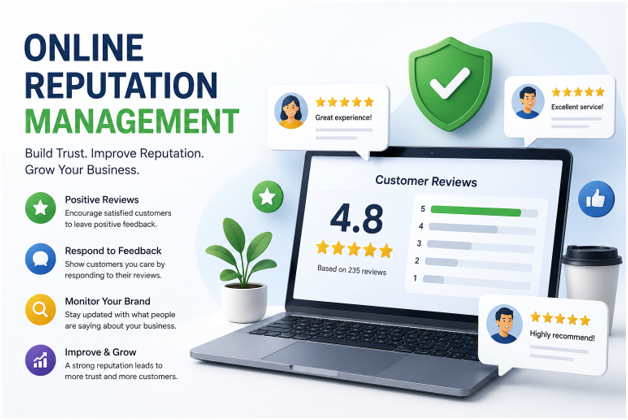
Let’s be honest: your online reputation isn’t just some trendy marketing buzzword anymore. It is a core business asset, full stop.
We live in an era where people form ironclad opinions about your company long before they ever step through your front door or click “add to cart.” They are looking at your search results, skimming your Google Business Profile, and judging you based on random social media posts in real-time. It only takes one highly visible, misleading review or a totally incorrect map listing to scare away a massive wave of customers and bleed revenue. In 2026, actively protecting and shaping what the internet says about your brand isn’t just a good idea—it’s survival.
What does online reputation management actually mean?
When we talk about online reputation management (ORM), we are talking about the daily, messy work of tracking and shaping how your business lives online. It is an ongoing project. It means diving into your reviews, fixing broken directory listings across the web, replying to customer feedback (even the annoying stuff), and consistently pushing out helpful content that actually reflects who you are.
The companies winning right now are the ones treating their reputation as a core strategy. They build trust at lightning speed and keep people coming back for more.
Why Google Reviews hold all the power
Think about it: Google Reviews are usually the very first thing a potential customer sees. When someone pulls up your Google Business Profile, your star rating, your most recent comments, and your basic details slap them right in the face. Those first impressions stick hard.
When you have a steady stream of positive feedback, a few amazing things happen naturally:
- Immediate trust: New customers feel a huge weight lift off their shoulders, making them way more likely to take a chance on you.
- Local SEO wins: You get a massive boost in local search visibility. Google loves active businesses, meaning nearby customers find you first.
- Sky-high conversion rates: Shoppers naturally gravitate toward businesses that already have a stamp of approval from the crowd.
On the flip side, a string of unaddressed negative reviews does the exact opposite. It creates immediate doubt and pushes people straight into the arms of your competitors.
Why your public image carries extra weight this year
Modern buyers are deeply skeptical, and they rely heavily on the real-world experiences of others. They will literally sit there comparing star ratings, reading through dozens of reviews, and scanning social media chatter before spending a single dime. Because everyone behaves this way now, a rock-solid online reputation gives you some very concrete advantages:
- You break down buying walls: Consistent, recent, and positive reviews act as a safety net. Customers feel safe choosing you because others did it first.
- You pop up everywhere in search: Search engines give massive preference to businesses with accurate profiles, steady review activity, and real user engagement.
- You can command better prices: A great reputation lets you charge what you are actually worth. When people perceive high value, price arguments fly out the window.
- You win the tiebreakers: When your services and prices look exactly like the guy down the street, your pristine reputation is the ultimate tiebreaker.
Real, actionable steps to fix your digital footprint
If you want to move the needle today, stop overcomplicating it and focus on these five things:
- Just ask for the review: Make it stupidly simple for people to leave feedback. Send direct links via text or email right after a great interaction.
- Stop ignoring people: Reply to comments fast, and keep it professional. Say thank you for the love, and handle complaints with real empathy and actual solutions.
- Keep your eyes open: Monitor your brand mentions across platforms regularly. Catching a small issue early stops it from snowballing into a full-blown PR crisis.
- Put out helpful stuff: Publish actual, valuable content like quick guides, FAQs, and real case studies that showcase your expertise.
- Fight the fakes: Don’t just sit there and take fake or malicious reviews. Learn platform rules and report policy-violating spam immediately.
Take a look at a quick real-world scenario: a tiny neighborhood café started printing a Google Review link directly on their receipts and made a rule to reply to every single comment—good or bad. Within just three short months, their average rating jumped, their search visibility spiked, and foot traffic went through the roof. Small, daily habits yield massive returns.
Looking down the road
The world of ORM is only going to get more complex as AI tools, evolving local search algorithms, and new review platforms change the ways consumers dig up info on businesses. But through all that tech noise, the core principles won’t change. Transparency, fast responses, and real, human interactions are always going to win.
In conclusion
Your digital footprint is easily one of your most fragile yet valuable assets. In 2026, managing your reviews, stomping out misinformation, and talking directly to your community aren’t optional chores you can push off to next quarter. They literally dictate how the market discovers and trusts your brand. Prioritize your reputation now, and the visibility, loyalty, and revenue will follow.