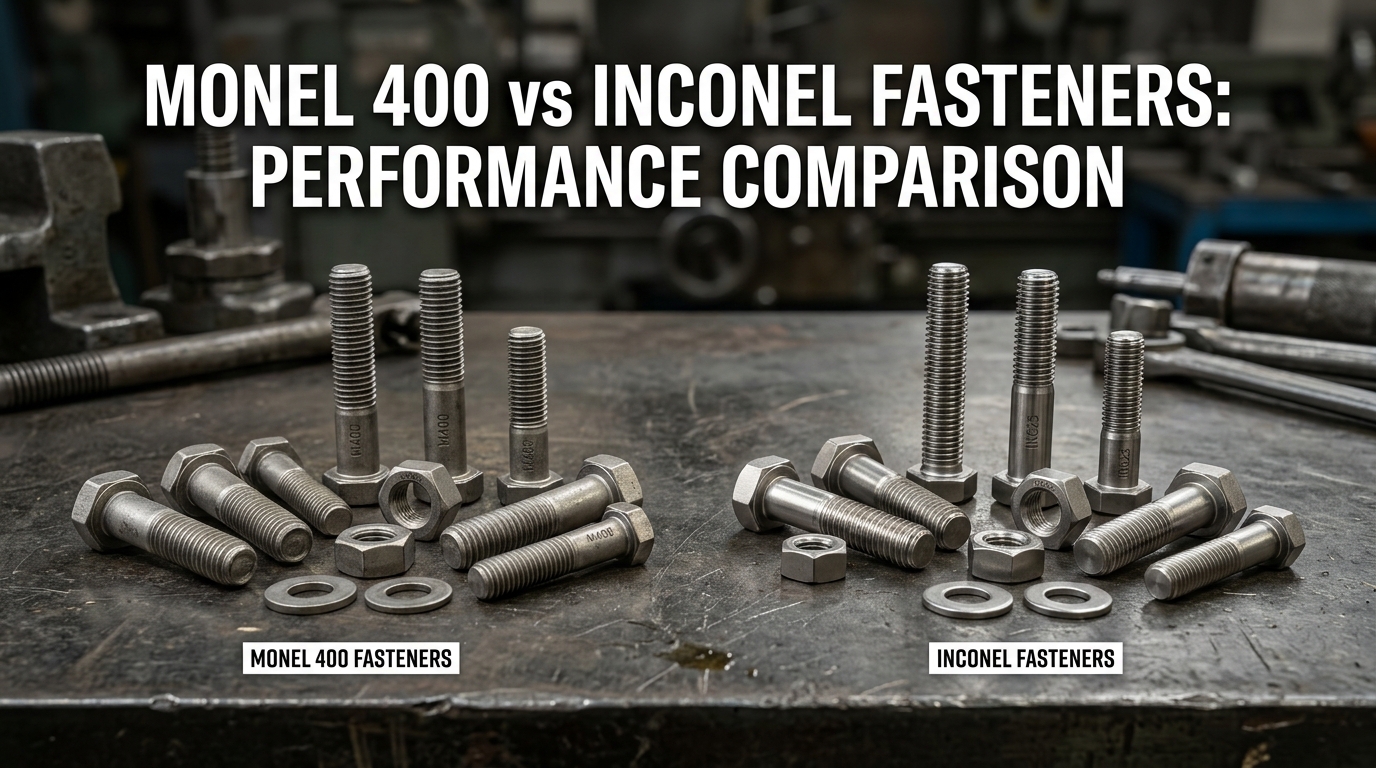
Monel 400 vs Inconel Fasteners is one of the most practically important comparisons in nickel alloy fastener selection and the answer isn’t the same for every application. Both are premium nickel-based alloys. Both offer superior corrosion resistance compared to standard stainless steel fasteners. But their performance profiles point in different directions, and specifying the wrong one for the service environment creates exactly the kind of fastener failure that premium material is supposed to prevent.
Introduction
The choice of fasteners for use in maritime, offshore, chemical processing and high-temperature industrial applications is a material science decision with important safety and maintenance implications. Monel 400 fasteners and Inconel fasteners are both nickel alloy fasteners, but they are designed for different principal threats and it is this understanding that determines the right specification selection.
Understanding Monel 400 and Inconel Fasteners
What Are Monel 400 Fasteners?
Monel 400 bolts, nuts, studs, washers and threaded components have good seawater corrosion resistance, hydrofluoric acid resistance and endurance in decreasing chemical conditions. In chloride-rich or mildly acidic conditions, Monel 400 fasteners are standard in seawater systems, naval hardware and chemical plant connections.
What Are Inconel Fasteners?
Inconel Fasteners are fasteners made of nickel-chromium alloy, used in high-temperature environments. The defining characteristic of the alloy is the chromium content is the ability to create and hold a stable oxide layer at high temperatures. This prevents scaling and oxidation, where most other technical materials would break down quickly. Inconel 625 fasteners’ qualities are strong strength retention at extreme temperatures and great resistance to pitting in moderately demanding situations.
Alloy Composition Differences: Nickel Copper Alloy vs Nickel Chromium Alloy
Composition of Monel 400 Fasteners
Nickel copper alloy fasteners like Monel 400 consist of about 65% nickel and 30% copper with small amounts of iron and manganese added. Copper provides the seawater and hydrofluoric acid resistance Monel is known for, substantially altered response of the alloy surface to corrosive assault in reducing conditions.
Composition of Inconel Fasteners
Nickel chromium alloy fasteners, such as Inconel, have high chromium content and varied molybdenum and iron contents. The chromium in INCONEL makes it a good choice for oxidizing environments . At high temperatures, this chromium generates a protective oxide coating that would harm Monel and most other standard alloys.
Corrosion Resistance Monel 400 vs Inconel
Marine and Saltwater Resistance
Marine grade fasteners Monel 400 outperform Inconel in direct seawater service and chloride-rich marine environments. Monel’s copper content provides natural seawater resistance and biofouling resistance that Inconel doesn’t match in submerged or splash-zone marine applications. Offshore platform hardware, naval shipbuilding, and desalination plant connections all favor Monel 400 in seawater contact applications.
Chemical Processing and Acid Resistance
Monel 400 handles hydrofluoric acid, sulfuric acid at moderate concentrations, and reducing acid environments better than most Inconel grades. Inconel grades, particularly 625, handle oxidizing acid environments better. Chemical processing applications with mixed acid exposure may require careful grade selection, as the wrong choice produces accelerated attack rather than corrosion protection.
Oxidation and Environmental Stability
Inconel fasteners handle oxidizing atmospheric and process environments at elevated temperatures in ways that Monel cannot. At high temperatures in air or oxidizing process streams, Inconel’s chromium oxide layer provides protection that Monel’s copper-nickel chemistry doesn’t generate equivalently.
High Temperature Nickel Alloys Comparison
Temperature Handling Capabilities
In typical temper settings Inconel grades 625 and 718 have greater tensile strength than Monel 400. Higher tensile strength takes on more structural loads and higher preload needs. Inconel often offers the structural advantage when both high strength and corrosion resistance are required in an application.
Performance Under Thermal Cycling
Inconel handles repeated heating and cooling cycles with better fatigue resistance at elevated temperatures. In applications where fasteners experience continuous thermal cycling boiler hardware, heat exchanger bolting Inconel’s superior high-temperature fatigue resistance provides more reliable long-term joint integrity.
Mechanical Strength and Load Performance
Tensile Strength and Hardness Comparison
Inconel grades particularly 625 and 718 carry higher tensile strength than Monel 400 in most temper conditions. Higher tensile strength handles heavier structural loads and higher preload requirements. For applications where both high strength and corrosion resistance are required simultaneously, Inconel typically has the structural advantage.
Fatigue and Stress Resistance
Both alloys offer good fatigue resistance compared to standard stainless steel fasteners. In vibration-intensive environments offshore structures, marine machinery, industrial rotating equipment both outperform standard grades. At elevated temperatures, Inconel’s fatigue performance advantage over Monel becomes more pronounced.
Offshore Fasteners Material Selection: Which Performs Better?
Monel 400 in Offshore and Marine Systems
Offshore hardware in direct seawater or splash-zone contact, subsea pipeline connections, marine pump fittings, and desalination plant bolting all favor Monel 400. The alloy’s seawater corrosion resistance and natural biofouling resistance make it the practical specification where seawater contact is the primary service condition.
Inconel in High-Heat Offshore Applications
Gas turbine hardware, heat exchanger bolting in high-temperature process service, refinery reactor connections, and high-temperature process vessel fasteners favor Inconel. When the primary threat is temperature and oxidation rather than seawater corrosion, Inconel’s thermal stability justifies its cost premium.
Industrial Applications of Monel 400 and Inconel Fasteners
Industries Using Monel 400 Fasteners
Marine, shipbuilding, desalination, chemical processing handling reducing acids, and offshore platforms in seawater-contact service. Asiad Steels, alongside other recognized suppliers such as Bhansali Enterprises and Metalica Forging, supplies certified Monel 400 bolts and fasteners to these industries with full material documentation and export capability.
Industries Using Inconel Fasteners
Aerospace, power generation, oil and gas high-temperature process service, petrochemical reactors, and industrial furnace hardware. The high-temperature performance profile drives the specification in every case.
Cost vs Performance Considerations
Initial Material Costs
Both Monel 400 and Inconel fasteners cost more than standard stainless steel. Inconel grades particularly 625 and 718 carry a higher material premium than Monel 400, reflecting the higher alloy complexity and processing requirements.
Lifecycle and Replacement Economics
Fastener replacement in marine, offshore, and high-temperature environments is expensive not just for the material itself but for the access, shutdown time, and labor involved in a critical connection replacement. Both alloys reduce replacement frequency compared to stainless in their respective service environments, which consistently makes the lifecycle economics favorable despite higher initial material cost.
How to Choose Between Monel 400 and Inconel Fasteners
Seawater contact and marine environments Monel 400. High-temperature oxidizing service, gas turbine hardware, aerospace Inconel. Mixed environments with both chloride and elevated temperature exposure require careful grade-specific assessment because neither alloy handles all aggressive conditions equally.
Conclusion
Inconel vs. Monel 400 Fasteners are an environmental contrast. Monel 400 is very good for marine, seawater and acid reduction. Inconel is good for oxidizing and high temperature environments. Carefully examine your operating temperature, corrosive media and load requirements before specifying. Choose a fastener with the service life your application demands. For Monel 400 fastener specifications and availability, the Monel 400 bolt page provides the full dimensional and grade reference.