Most port operations still run on a patchwork of disconnected systems. Berth planners work from one screen. Yard teams use another. Equipment status lives in a third platform that nobody fully trusts. The result is a constant cycle of reactive decisions made with incomplete information.
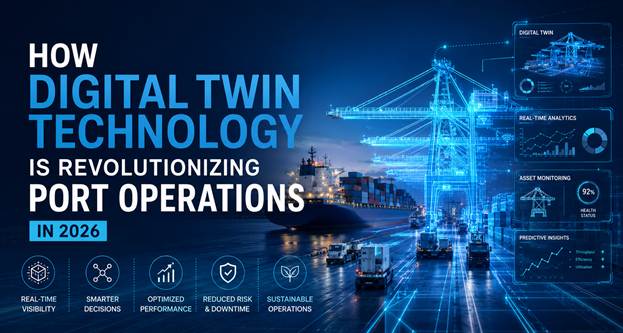
Digital twin technology in ports breaks that cycle. It replaces fragmented data views with a single, live virtual replica of the entire terminal, updated continuously from sensors, systems, and operational feeds. What used to take hours of cross-referencing now happens in seconds, automatically.
This shift is no longer a pilot project at a handful of forward-thinking terminals. It is becoming a baseline expectation for any port that wants to stay competitive in 2026 and beyond.
What a Port Digital Twin Actually Is (and What It Is Not)
A port digital twin is a live virtual model of a physical port environment. It mirrors every asset, process, and operational condition in real time, from vessel positions and crane load cycles to gate queues and yard density. It is continuously updated by IoT sensors, terminal operating systems, weather feeds, and equipment telemetry.
What it is not is a dashboard or a reporting tool. A static view of yesterday’s data is not a digital twin. The defining characteristic is the live, two-way connection between the physical port and its virtual counterpart.
When a crane develops unusual stress patterns, the twin flags it before a breakdown occurs. When a vessel arrival is delayed, the twin automatically recalculates berth schedules, yard allocation, and truck gate timing across the entire terminal. Operators see the adjusted plan on one screen, in real time, without manually updating three separate systems.
That operational coherence is what makes smart port technology built around a digital twin fundamentally different from incremental digitization.
Why Traditional Port Operations Are Hitting a Wall
Ports are absorbing more volume, larger vessels, and tighter schedule windows than they were designed to handle. Ultra-large container ships now carry over 24,000 TEUs. When one berths, the burst of activity it creates puts enormous strain on manual coordination.
A senior planner with 20 years of experience can manage that. But that same planner cannot simultaneously monitor 40 pieces of equipment, track 6,000 container positions, anticipate truck gate congestion, and adjust berth sequencing for three incoming vessels, all at once.
Manual operations also produce inconsistent outputs. Performance varies by shift, by individual, and by how much pressure the terminal is under at any given moment. That inconsistency creates unpredictability that ripples outward into supply chains.
Digital port operations built on a twin model remove the variability. The system holds all the information, surfaces the right decision at the right time, and gives operators the ability to act rather than scramble.
What Digital Twin Technology Unlocks Across Port Operations
Real-Time Port Monitoring at the Operational Level
Real-time port monitoring is the foundation that every other capability builds on. With IoT sensors feeding live data into the twin, port operators have continuous visibility across every part of the terminal simultaneously.
Crane utilization, container dwell times, truck turnaround speeds, and vessel ETAs all appear in a single operational view. Anomalies surface immediately. Supervisors stop chasing status updates and start making decisions based on what is actually happening right now.
The Port of Rotterdam’s digital twin, spanning 42 km of port area, integrates live data on ship traffic, infrastructure, weather, and geographic conditions to support exactly this kind of decision-making at scale.
Predictive Maintenance Before Failures Happen
Equipment downtime in a container terminal is expensive in ways that compound quickly. A crane goes offline, crane productivity drops, vessel loading falls behind schedule, the ship departs late, and the schedule disruption cascades to the next port of call.
Port automation solutions connected to a digital twin change that dynamic by shifting maintenance from a reactive to a predictive model. Sensors on cranes, vehicles, and conveyor systems feed continuous performance data into the twin. Machine learning models analyze that data for patterns that precede failures, triggering maintenance alerts days or weeks before a breakdown would have occurred.
Rotterdam reduced crane repair expenses by 18% after adopting twin-driven predictive alerts. That figure represents direct cost savings, but the larger value is in avoided schedule disruptions that would have cost far more.
Scenario Planning Without Real-World Risk
One of the most underused capabilities of a port digital twin is scenario simulation. Before making any significant operational or infrastructure change, port operators can test it inside the twin first.
Adding a new berth? Simulate the traffic flow impact before construction begins. Expecting a labor dispute that reduces gate staffing? Model the throughput consequences and pre-position resources accordingly. Exploring a new vessel schedule offered by a major shipping line? Run it through the twin to see how it affects yard density and truck appointment windows before committing.
This turns the twin into a strategic planning environment, not just an operational one. Decisions that used to rest on experience and intuition now rest on simulated evidence.
What Gets in the Way of a Successful Implementation
The technology is available. The barrier for most ports isn’t access to digital twin platforms. It’s the underlying conditions that determine whether those platforms can actually work.
Data quality is the first problem. A digital twin is only as accurate as the data feeding it. Ports with fragmented legacy systems, inconsistent data formats, or gaps in sensor coverage cannot build a reliable twin on top of that foundation. The data infrastructure has to be addressed before the twin goes live.
Affordability is a real constraint, particularly for mid-tier and smaller ports. The initial investment required for sensor infrastructure, connectivity, platform licensing, and integration work is substantial. Many ports rely on public funding or public-private partnerships to make the numbers work. Without that support, the gap between technology-strong and technology-limited ports grows wider.
Organizational readiness is the third barrier, and it’s the one that gets the least attention. A senior port consultant’s survey of port leaders found that planning, not technology, remains the largest challenge in digital transformation programs. The twin doesn’t run itself. It requires operators who understand how to interpret and act on what it surfaces, which means training investment and change management discipline from the start.
Conclusion
Ports seeing real results from digital twin technology share one thing: they built the right foundation before deploying the platform. At INTECH Creative Services, we work with terminal operators to get that foundation right, from data integration and connectivity infrastructure to live twin implementation and operator training. Our ports and terminals solutions have helped global operators including DP World achieve centralized, real-time operational visibility across multi-terminal environments. If your port is ready to move beyond reactive operations, our team is ready to help you get there.