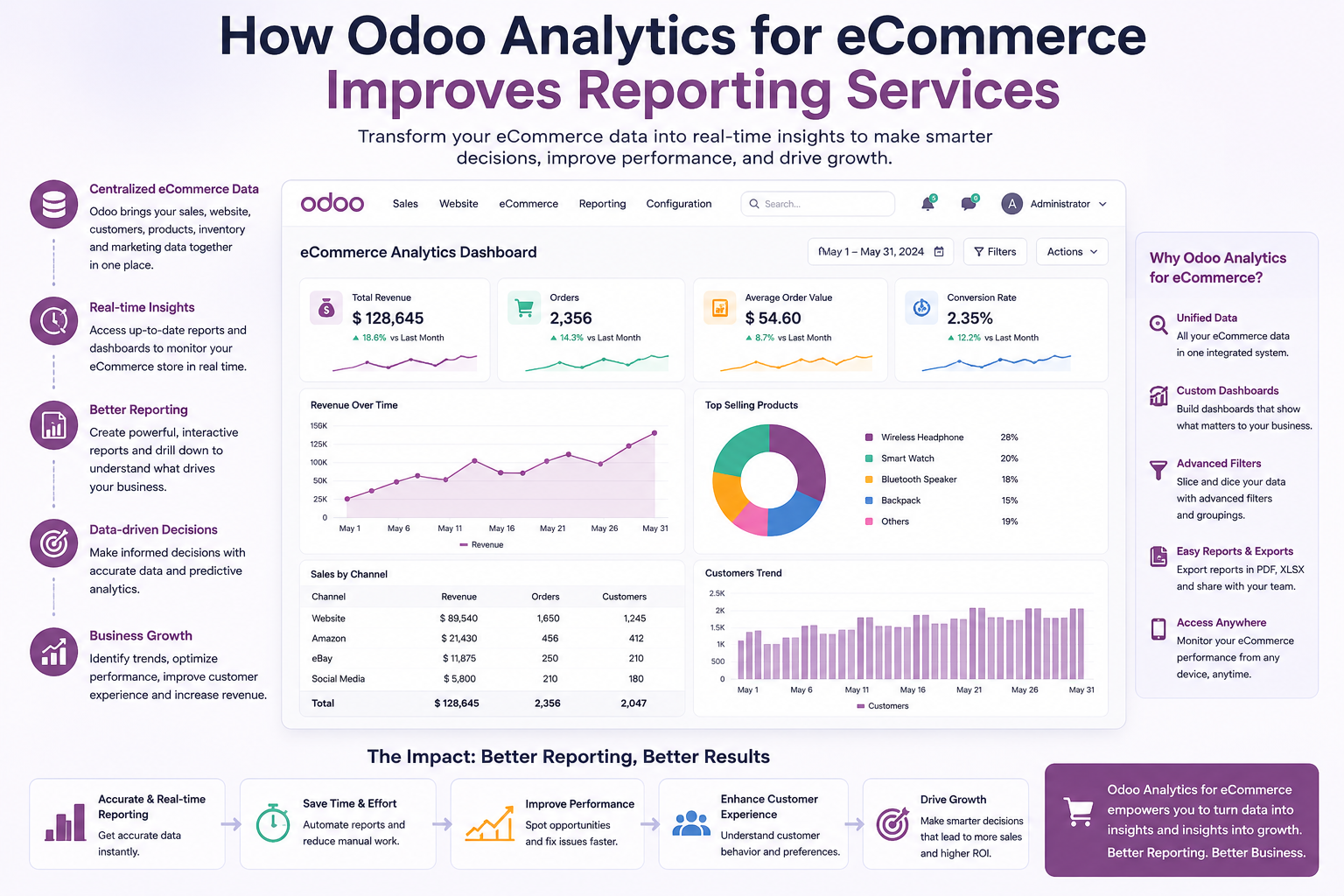
Running an eCommerce business is not just about pushing products online anymore. Real success depends on reading how customers behave, keeping inventory under control, tracking revenue, and making decisions from real time data… and honestly it all moves real fast. With no dependable reporting, a business can end up missing opportunities, having trouble to enhance performance, and reacting too slowly when the market shifts.
And yeah, this is where Odoo analytics for eCommerce together with Odoo reporting services really comes in handy. Together, they deliver solid insights, automated reports, and dashboards you can adjust , so the people making choices can act with more clarity, boost day to day efficiency, and maintain sustainable growth for the long run.
Understanding Odoo Analytics for eCommerce
Odoo analytics for eCommerce is like a business intelligence feature that lives inside the Odoo ERP ecosystem and, sort of in a direct way, lets online businesses gather, organize and then interpret operational data. It brings together specifics from a mix of business actions—sales, inventory, accounting, purchasing, marketing, customer relationship management, and also website performance—then it funnels everything into one common reporting area.
Rather than depending on separate spreadsheets or a set of tools that dont really talk to each other, teams can use near real-time insights from one centralized spot. That means managers can look at the most important performance indicators, spot sales patterns sooner, understand how shoppers truly buy, and finally make decisions using dependable numbers. And since every department feeds the same database, the reporting becomes more solid, more aligned ,and stays consistent throughout the organization even when the business situation shifts.
The Importance of Accurate Reporting for eCommerce Businesses
Reporting is kind of the backbone for strategic choices in online retail . Every single transaction , each customer interaction , inventory movement , and even the financial side, ends up leaving behind useful info that can nudge growth. If there isn’t any structured reporting, companies may end up missing the small signals, like sales sliding down, operational expenses that are rising, or even customer tastes moving in a new direction.
Today’s eCommerce firms really need reports that update automatically, and that actually mirror what’s taking place right now inside the business. With strong reporting in place , business owners can judge marketing activity properly , estimate demand without guessing too hard, handle inventory with less friction , and also lift customer satisfaction. At the same time, dependable reports shrink manual busywork, lower the odds of reporting errors, and make it easier to respond sooner to market shifts , which ultimately gives them a clear competitive edge.
How Odoo Reporting Services Centralize Business Data
One of the biggest strengths of Odoo reporting services, is that they let you kinda centralize data from each department into one unified reporting platform, more or less. Instead of making separate reports for finance, inventory, sales, and customer management, Odoo basically brings it all together in integrated dashboards, and also in those deeper, more detailed reports.
That centralized way of working removes repeated information, lowers the odds of inconsistencies , and makes sure every department is working off the same precise data. Managers don’t really have to go hunt down reports from different systems anymore , because the information syncs automatically. As a result, decisions tend to happen faster, collaboration usually improves, and overall business performance is just easier to judge across multiple departments.
Real-Time Analytics Improve Reporting Accuracy
Traditional reporting methods usually lean on historical data, which can already feel outdated by the time the report is made. With Odoo analytics for eCommerce, though, that hassle gets sorted out, you get a real time view of how the business is moving. Each new order, payment, shipment, inventory adjustment, or even customer activity shows up in the reports pretty much instantly, meaning it’s not stuck behind delays, or dragging along.
Since it is real-time, the teams can catch issues before they quietly turn into bigger headaches. For example, if a product suddenly starts seeing higher demand , the inventory reporting updates right away, and purchasing can act faster to refill stock before real shortages show up. At the same time the financial perspectives stay current with revenue and expenses, so management can guide the business using quicker and more trustworthy choices, instead of just guessing based on yesterday’s numbers .
Better Sales Analysis Through Odoo Analytics
Sales reporting is one of those really useful uses of Odoo analytics for eCommerce, like businesses can get super specific insights about how certain products are doing, the whole customer purchasing pattern thing ,average order values, seasonal variations and even whether sales growth is actually moving upward over time.
Instead of just sitting there staring at total sales numbers companies can figure out which items deliver the best profit margins , what kind of customer segments bring in the most revenue ,and which selling channels end up performing the strongest. With that it becomes simpler to adjust pricing approach , refine the product catalog and aim marketing budgets exactly where they matter. Also, advanced analytics helps teams compare what’s happening right now with what was happening earlier so longer term planning becomes more accurate, less guesswork more signal.
Inventory Reporting Becomes More Efficient
Inventory management kinda feels absolutely critical to eCommerce profitability , because if you end up with too much stock it just sits there and piles up. That means extra storage expenses, plus it becomes this whole messy situation, honestly. On the flip side there’s also understocking , where things go sideways too, sales slip, customers get irritated, and they just move on. In that kind a scenario, Odoo reporting services really do help, because they deliver solid inventory reports and that lets teams sort of keep an eye on what’s on hand , how the warehouse is working day to day , how suppliers are performing , and even if inventory turns over quickly or just drags on too long.
Then once the inventory analytics are built in, you start spotting smaller signals , and those repeating patterns , like you can anticipate future stock needs by using past demand along with the current sales flow. Managers get sharper visibility on the fast moving products, the slow selling items , the reorder points , and whether the warehouse process is behaving as it should. In general it supports better planning, trims operational costs a bit , and it also helps make sure products are available at the exact moment customers need them.
Customer Analytics Enhance Business Growth
These insights then help companies shape personalized marketing campaigns, tweak customer retention strategies, and build more grounded connections with the existing customer base. Once you get a clearer picture of which customers bring in the highest revenue, and which products pull that “repeat buyer” interest, the whole process turns into better customer satisfaction, while also supporting long-term profitability. And yes, customer analytics also help with targeted promotions—those can really boost marketing return on investment.
Why Odoo Analytics and Reporting Services Drive Long-Term Success
Since eCommerce competition keeps growing , businesses kind of can’t rely on just the basics reports anymore. They need more than simple summaries, like intelligent analytics that actually gives meaningful insights , and at the same time , help cut down on manual reporting so decisions can be made faster. Odoo analytics for eCommerce, along with Odoo reporting services , sort of work hand in hand, giving you a full view across most business functions , not only one area.
When business data is centralized, you end up with real time analytics, and everything stays in sync , which matters a lot. Financial reporting also gets a lot cleaner, inventory management becomes more accurate, and those customizable dashboards let teams track what’s relevant , in a way that fits their habits. With that all in place, Odoo helps organizations run more smoothly, and move forward using data driven decisions with more confidence . And honestly, companies that invest in advanced analytics and reporting usually see better customer experiences, smoother day to day workflows, higher profitability, and more steady long term growth even as the eCommerce marketplace keeps changing.