Do you want to understand how supply chain automation supports enhancing efficiency, accuracy and growth? Then you are at the right blog. Here, we have prepared a detailed blog that answers all your questions. Let’s explore.
What is Supply Chain Automation?
Supply chain automation refers to a scenario where an organization utilizes the use of automation technologies such as machine learning, AI, and digital process automation in performing supply chain functions without much human interaction.
The adoption of the technology streamlines the management of services and goods and helps organizations scale up their operations.
Why Are Businesses Incorporating Automation into Their Supply Chains?
When businesses depend on manual processes for coordinating raw materials from a variety of vendors, there will be chances of loss of orders, which may affect the timely delivery of goods.
Automated systems provide employees the ability to work around the problem through the handling of high volume order handling, management of various suppliers and 3PL relationships, accounts payable functions, and facility management while avoiding the increase of labor.
Since automation is associated with the ability to do more using fewer resources.
It may be quite helpful in mitigating the effects of rising costs of materials, reduced storage space, and the cost of transportation.
For instance, automated demand and inventory management can help avoid unnecessary material purchases and waste.
In addition, picking robots can navigate smaller spaces compared to human workers and fork lifts. Furthermore, AI-powered route optimization can reduce fuel expenses.
Such actions can create opportunities for employees to work on innovations or other cost savings projects.
It may give procurement managers an opportunity to negotiate and analyze vendor contracts rather than focusing on the purchase process.
Benefits of Supply Chain Automation
Cost Reduction and Efficiency Improvement
Supply chains happen to be among the most expensive processes in sectors such as consumer packaged goods and industrial products , the consulting firm reports.
Supply chain automation reduces costs through the elimination of repetitive and labor-intensive tasks, which may be slow, expensive, and error-prone such as data entry, order processing, and inventory counting.
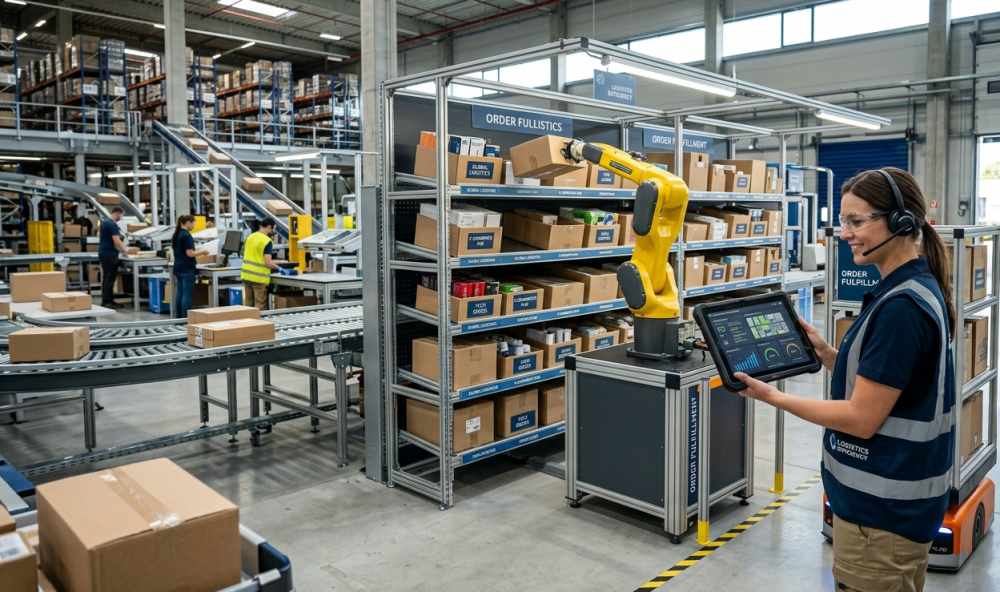
An automated warehouse that employs robotics is capable of processing orders much faster than manual gathering of products, thereby reducing labor costs and errors that could lead to loss of sales or even returns.
Consequently, businesses will be able to process large order quantities using less effort.
Order processing is faster through robotic automation compared to manual picking of products, besides being less labor-intensive and costly, leading to errors.
This implies that firms will be able to process large order quantities using less effort.
Improved Production and Delivery Speeds
Automation greatly enhances the speed of production using robotic assembly lines and mechanized operations that result in more production than the traditional way.
For example, some car companies utilize robots for welding and painting as part of assembling the vehicles.
Automation also contributes to improved delivery speeds through the use of automated storage and retrieval systems.
They enable the locating and gathering of goods to be much faster in order to minimize time in fulfilling orders, as well as transportation systems that automatically find efficient delivery paths.
The above mentioned factors ensure that faster deliveries are made possible.
Enhanced Visibility and Transparency
With capabilities of real-time monitoring of stocks, shipping, and manufacturing, the automated system will assist in addressing this challenge by ensuring that all concerned parties have the most updated information.
With a well-integrated ERP system, organizations will be able to keep track and communicate the status of their goods and shipments at all times.
This way, they will be able to detect and solve any problems that may arise and hinder the order processing process.
Increased Accuracy and Error Reduction
Automation makes the process easier by increasing accuracy while avoiding errors.
Think of the hectic activities in a warehouse.
Rather than using a person to manually write down product codes one at a time, automation can use devices such as barcode readers and RFID technology to record product codes as they pass through the supply chain process.
This increases efficiency because there is no need to wait for any manual activity to take place for data to be recorded into the system.
Cost Reduction Without Compromising Quality
Automation enables lowering costs because it increases efficiency without reducing the quality of the process.
Robotic production systems perform certain repetitive tasks better and faster than people, thus saving money spent on salaries and ensuring higher precision in performing tasks.
Automated quality control is possible, as well, using various sensors, including cameras, as well as AI-based pattern recognition.
Automated quality control will help achieve higher accuracy through manual inspection replacement, supply chain audit improvement, and quicker identification and solution of any problems that arise.
More savings will be made due to fewer returns and recalls.
Faster Decision-Making and Responsiveness
In such a rapidly changing supply chain, organizations that have instant access to real-time information are able to take important strategic decisions immediately.
For instance, in the event of any unexpected increase in demand, AI systems can notify managers and increase manufacturing and transportation channels to ensure that goods are delivered to customers on time.
AI systems can assist in making different types of decisions, whether it is forecasting demand or making source decisions.
Actually, in a MHI survey, 40% of firms believed that AI will give them a competitive edge.
Improved Customer Satisfaction
For companies to be more profitable, they have to adopt customer-oriented supply chain models.
This is because customers have the capacity to alter the focus of the supply chain.
Due to the new consumer values, the rise of the farm-to-table culture among restaurants has made most of them change how they source their raw materials while at the same time requesting for information regarding the eco-friendly or organic nature of the food products they purchase.
Consumer pressure has also caused a revolution in the fashion industry supply chains due to their concern over the poor working conditions and the requirement for companies to lower their carbon emissions.
Regulatory Compliance Assurance
Automation of supply chain procedures plays a great role in reducing the chances of any errors that might endanger the ability of a business to remain compliant and leave behind adequate audit trails.
This is because the systems will be able to record all stages in which the product was handled.
It eliminates the problem of compliance issues and penalties while providing companies with assurance that everything is being done correctly.
Automation of Manual Process
The list of manual processes which can be automated continues to grow, spurred by the fast adoption of artificial intelligence in the supply chain.
These repetitive, mundane activities can all be automated, including purchase order creation, filling out customs forms, robotic handling and packaging of goods in warehouses, and consolidating, reserving, and rerouting shipments.
Nearly 25% of firms have already applied robotic process automation (RPA) to logistics and warehousing, with 67% more having plans to do so.
RPA is used in these two industries to pull transport and storage information from different data sources and automate shipment scheduling, tracking, and order fulfillment by entering this information into relevant systems.
Conclusion
Within today’s growingly complicated supply chain environment, automation becomes essential. Not only does automation eliminate errors, but it also increases speed and visibility. It is impossible to deny that supply chain automation yields a positive return on investment for any logistics process. For seamless supply chain automation, you need to hire expert developers who hold industry experience and expertise.