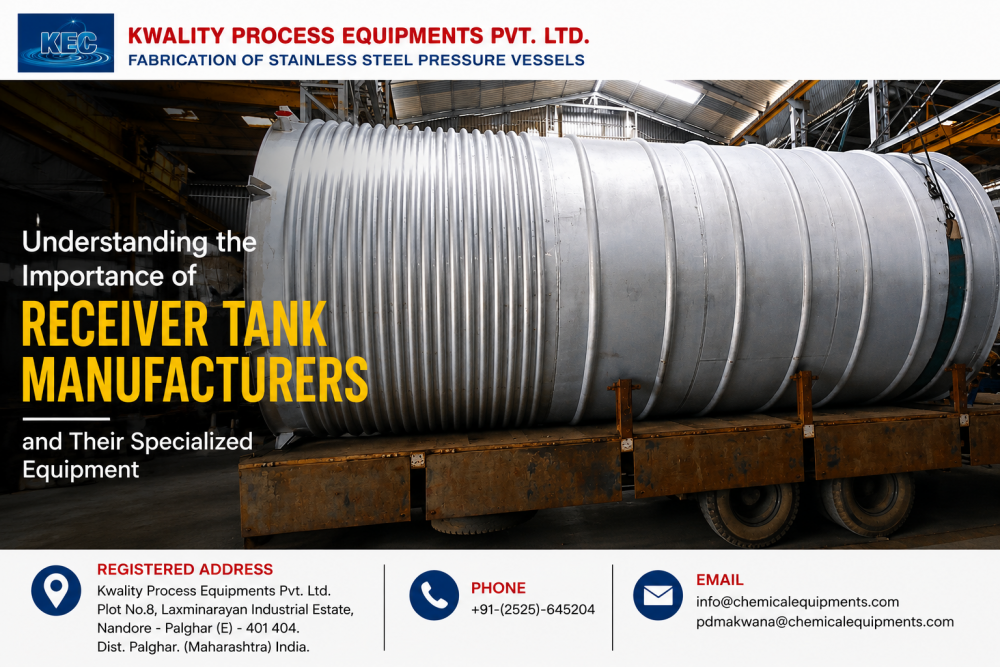
If you walk into a standard manufacturing plant, you will likely see dozens of ordinary receiver tanks holding compressed air or water. These are made by receiver tank manufacturer but are not the same as the one at the unit of a chemical manufacturing plant. Therefore, if you walk into a petrochemical refinery, a pharmaceutical lab, or a fertilizer plant. The tanks you see there are an entirely different breed of engineering, materials used, and so on.
In the chemical industry, equipment failure doesn’t just mean a temporary loss of pressure. Because it means toxic leaks, explosive hazards, and catastrophic plant shutdowns with loss of life and money to a greater extent. This is exactly why sourcing equipment from a specialized chemical receiver tank manufacturer is non-negotiable because the value they bring has higher ROI.
In this post, we will explore what a true chemical-grade receiver tank is, along with the different types available. At the same time, we will understand why the manufacturer behind the equipment matters just as much as the tank itself.
What is a Chemical Receiver Tank? (And How It Differs from Standard Tanks)
A standard definition of the receiver tank will tell you it is simply a vessel used to store a reserve of air or fluid. However, that’s not entirely accurate or true because the definition changes as per use in different industry applications. In the chemical process equipment manufacturer, a Chemical Receiver Tank is a highly engineered, heavy-duty pressure vessel designed to work robustly. It safely collects, buffers, and stores highly corrosive acids, volatile petrochemicals, reactive gases, and high-purity distillates. To ensure that the plant and people working there are safe and that the plant runs smoothly by storing products in the best way possible.
Instead of just holding standard air, these tanks act as critical holding zones during complex chemical reactions. They are often placed downstream from heat exchangers, distillation columns, or condensers to “receive” the condensed chemical fluid. Because they must survive highly toxic materials, extreme heat, and immense pressure fluctuations (including full vacuum environments). Therefore, they are produced at a chemical process equipment manufacturer site and built using advanced metallurgy and stringent global safety codes.
Rather than just providing passive storage, these advanced vessels actively manage and protect the chemical process through several critical functions:
- Inert Gas Blanketing: They have a design that usually involves maintaining a “nitrogen blanket” (or another type of inert gas) above the liquid to keep any volatile chemicals from interacting with oxygen, oxidizing, or creating an explosion hazard.
- Pressure and Pulsation Buffering: The chemical receivers perform the role of essential shock absorbers in chemical plants, especially one made by Kwality Process Equipments Pvt. Ltd. By absorbing any pressure surges and flow surges before they reach the delicate chemical metering pumps.
- Temperature Control Capability: Chemical receivers, unlike normal storage tanks, are equipped with temperature control jackets around them to prevent boiling, degradation, and crystallization of certain chemicals.
- Drainage of Zero Dead-Leg: These chemical receivers have dish bottoms or conical bottoms so as to make sure that there is complete draining of the liquid and there will be no chemical left behind in any way.
- Vapor or Phase Separation: They often contain a specialized vented nozzle which separates any toxic fumes or vapor from the liquid.
Why the Manufacturer Matters: Chemical-Grade vs. Normal Fabricators
Why can’t you buy a receiver tank from a standard receiver tank manufacturer or steel fabricator? The answer lies in the metallurgy and safety testing they conduct upon the products made at their unit. Standard fabricators work with basic carbon steel and general welding techniques, which doesn’t qualify as a standard for chemical ones. However, if you put Hydrochloric Acid or reactive chlorides into a standard tank, it will corrode and leak within days.
A dedicated chemical process equipment manufacturer possesses the specialized technical capabilities required to forge tanks out of “exotic” and highly resistant metals. They employ certified clean-room welding, advanced X-ray testing for weld integrity, and design codes like ASME to ensure the tank never fails. Even when it is put under extreme stress. Here is a look at the technical specifications you can expect from a top-tier chemical equipment manufacturer:
| Category | Technical Specifications & Capabilities |
| Materials of Construction (MOC) | Titanium, Tantalum, Zirconium, Hastelloy, Inconel, Monel, Nickel, Cupro-Nickel, Duplex & Super Duplex Stainless Steel, Austenitic Stainless Steel, Alloy 20 |
| Design & Engineering Codes | ASME Section VIII Div 1 & Div 2, DIN, JIS, IS, CE / PED Compliance |
| Configuration / Orientation | Vertical and Horizontal configurations |
| Operating Pressure | Capable of handling Full Vacuum to High-Pressure environments (custom-designed based on process requirements) |
| Dish / Head Types | Torispherical, Semi-Ellipsoidal, and Hemispherical Heads |
| Testing & Quality Assurance | PMI (Positive Material Identification), Radiography Testing (RT), Ultrasonic Testing (UT), Dye Penetrant Testing (DPT), Hydrostatic & Pneumatic Testing |
| Manufacturing Customization | Custom volumetric capacities, integrated nozzles for vents, drains, safety relief valves, and instrumentation |
| Chemical Industry Applications | Safe storage and handling of highly corrosive acids, reactive chemicals, high-purity pharmaceutical compounds, and volatile petrochemicals |
Types of Chemical Receiver Tanks
Because chemical processes vary wildly, Kwality Process Equipments Pvt. Ltd. manufactures these tanks that are rarely “one-size-fits-all.” Therefore, the surging need for customised receive tanks for different work, whether by shape or size, is seen. Manufacturers typically categorize them based on orientation and process-specific functions. Here are these distinctive types of receive tanks classified by manufacturer for easy use.
1. Vertical Receiver Tanks
Designed for facilities where floor space is limited. Vertical tanks are excellent for gravity-feeding chemicals into downstream pumps or process vessels.
2. Horizontal Receiver Tanks
Often used when processing large volumes of liquid, or in processes where the chemical liquid needs time to settle and separate (such as separating water from a petrochemical product).
3. Vacuum Receiver Tanks
Engineered with thicker walls and specialized dished heads (like Hemispherical heads). These are built specifically to withstand negative pressure (full vacuum) without buckling or imploding.
4. Distillate / Condensate Receivers
Specifically designed to sit below a condenser. These catch the highly purified, condensed liquid chemicals as they drop out of a vapor state.
Key Benefits of Specialized Chemical Receiver Tanks
The major benefits of the specialized tanker that you can get from Kwality Process Equipments Pvt. Ltd. show the various benefits. That can make your mind up to integrate them into your chemical process ecosystem, these are:
Extreme Corrosion Resistance
Built from materials like Titanium, Hastelloy, or Zirconium, these tanks offer decades of lifespan even when holding the world’s most aggressive chemicals.
Process Purity
For the pharmaceutical and food industries, high-grade alloys prevent the metal from leaching into the product, ensuring 100% pure chemical batches.
Catastrophe Prevention
Due to X-Ray (Radiography) and Ultrasonic testing, plant managers have total peace of mind that microscopic cracks won’t cause a disastrous leak or explosion.
Common Industry Applications
The equipment that can sustain and is proven to be the best investment requires a highly customized, heavy-duty nature. It requires experienced professionals because these chemical receiver tanks are also the backbone of the world’s most demanding industries, including:
- Petrochemicals & Refineries: Safely storing volatile hydrocarbons and corrosive refining byproducts.
- Pharmaceuticals & Bulk Drugs: Buffering high-purity Active Pharmaceutical Ingredients (APIs) in sterile environments.
- Agrochemicals & Fertilizers: Handling highly reactive ammonia, nitrates, and harsh acids.
- Desalination & Water Treatment: Surviving the highly corrosive nature of concentrated saltwater and purification chemicals.
Final Words!
A receiver tank in a chemical plant is not just a storage container. It is best understood by a receiver tank manufacturer who works with the chemical industry to produce their vessel and storage tanks. They are the ones who engineered the products that are rigid enough to sustain harsh chemical reactions, leaks, and more. Manufacturing a vital safety barrier between a highly reactive chemical and the outside world, so the rest can be safe and prevented from damage.
By understanding the profound difference between a standard vessel and a chemical-grade vessel, plant engineers can make informed decisions. Partnering with a specialized chemical equipment manufacturer like Kwality Process Equipments Pvt. Ltd. ensures that your equipment is engineered. To survive the harshest conditions imaginable, protecting both your process and your people.