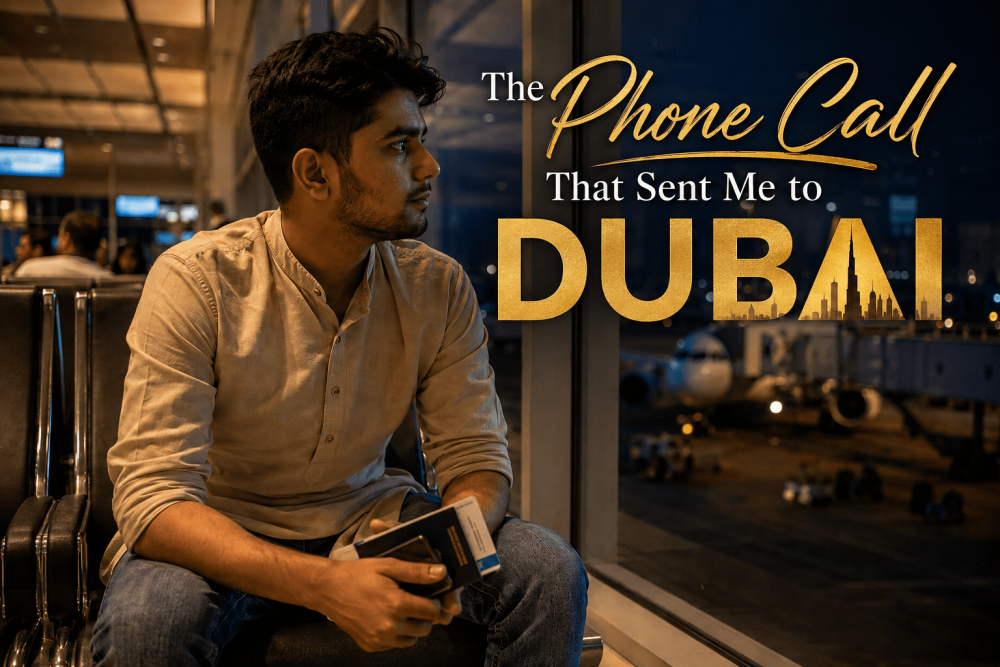
It was 11:47 PM when my phone rang. I remember the time exactly, because I had just switched off the lamp and was staring at the ceiling, thinking about nothing in particular — the way you do on an ordinary Tuesday night. My brother’s name flashed on the screen. Fawad never called this late. Not once, not in the six years he’d been living in Dubai.
I picked it up before the second ring finished.
“Noor,” he said, and his voice was wrong. Too quiet. Too careful. “Abbu’s in the hospital. It’s his heart. You need to come.”
I don’t remember much of the next ten minutes. I remember sitting up so fast the room tilted remember my mother, three hundred kilometers away in Lucknow, calling right after, crying in that broken way where the words come out sideways. Remember thinking, absurdly, that I hadn’t even spoken to my father properly in almost two months — just the usual “everything’s fine, right?” on Sunday calls, never anything real.
And then the practical panic set in. I needed to be in Dubai. Not next week. Not in three days. Now.
If you’ve never had to arrange emergency international travel in the middle of the night, let me tell you — it strips away every illusion you have about being a capable adult. I sat on my bedroom floor at 1 AM with my laptop balanced on my knees, tabs open everywhere, trying to figure out flights, trying to figure out money, and then hitting the wall every traveler from India knows too well: the visa.
A regular UAE visa can take days. Sometimes longer, if there’s any hiccup in documentation. I remember staring at my passport, at my father’s blurry photo pinned to my study table from years ago, and feeling this cold, useless fear — the fear of being stuck on the wrong side of a border while someone you love is fighting for their life on the other side.
It was my cousin Ayesha, half-asleep on a video call, who finally said the words that mattered: “Noor, apply for the express visa. People say it gets done in 24 hours.” She’d used a licensed travel agency called Arabiers Holidays UAE for her own trip last year, and she trusted them enough to send me their link — Dubai Express Visa, almost as an afterthought, the way you’d mention anything at 2 AM. Knowing it wasn’t some random website, that it was an actual registered agency and not a scam I’d stumble into at 2 AM out of desperation, made it easier to trust in that moment.
I filled out the form with shaking hands, uploaded my documents, and then did the hardest thing of all — I waited. Grief has a strange relationship with waiting. Every notification sound made my stomach drop. I kept refreshing my email like it would change something. I kept picturing my father’s face, the way he used to hum old Rafi songs while watering the plants on our terrace, completely unaware that somewhere his daughter was sitting on a cold floor praying for a piece of paperwork to move faster than usual.
The visa came through in under a day. I still don’t fully understand the relief I felt seeing that confirmation email — it wasn’t happiness, because there was nothing to be happy about yet. It was more like someone had finally opened a door that had been slammed shut in my face.
I booked the earliest flight out of Lucknow the next morning, a middle seat between a sleeping stranger and a window I couldn’t stop staring out of. Somewhere over the Arabian Sea, I finally let myself cry — quietly, the way you learn when you’re surrounded by people who don’t know your story.
Dubai, when I landed, didn’t look like the postcard city I remembered from Fawad’s photos. It looked like a blur of highway signs and hospital directions on my phone, my hands cold despite the heat outside. My brother met me at arrivals, and for a second neither of us said anything. We just held onto each other in the middle of the airport, two people who suddenly understood how fragile everything really was.
Abbu was in the ICU when I reached — stable, they told me, but it had been close. Closer than anyone had said on the phone, because that’s what families do; they soften the truth until you’re standing in front of it yourself. I sat beside his bed that first night, holding a hand that used to hold mine when I was learning to walk, and I thought about how strange it was that a single visa — a single piece of timely paperwork — had been the difference between me being there for this moment or missing it entirely.
He recovered. Slowly, with the stubbornness that runs in our family, he recovered. Three weeks later, I sat with him on Fawad’s balcony, the Dubai skyline glittering in a way I hadn’t even noticed on my first, panicked day there, and he asked me — half-joking, half-serious — “How did you get here so fast?”
I told him about the sleepless night, the frantic search, the express visa that came through faster than I’d dared hope. He just nodded slowly and said, “Sometimes time is our worst enemy, my child. And sometimes, it’s our best friend too.”
Sometimes time is your worst enemy. And sometimes, it’s your best friend.
I flew back to Lucknow ten days later, lighter than when I’d left, carrying a kind of gratitude I didn’t have words for yet. I still think about that night often — the phone call, the panic, the strange mercy of a system that, just this once, moved as fast as my fear did. Not every story about visas and paperwork is boring. Sometimes it’s the thin, invisible thread that decides whether you get to say goodbye, or hello, in time.
That night taught me something I carry with me on every trip since: when it comes to family, you don’t wait for the “right time” to travel. You find the fastest way there, and you go.