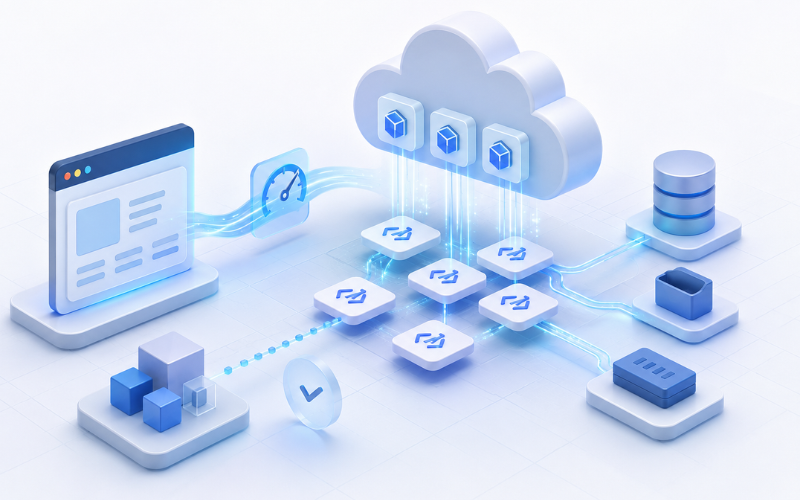
The current digital platforms demand scalability, speed and reliability without the complexity of running infrastructure. Serverless computing has come forth as a very strong tool that gives businesses the ability to create and run applications without managing servers, resources provisioning, and backend infrastructure. Rather than having dedicated environments, developers are able to concentrate on application logic only as cloud providers will automatically scale, make availability and performance. This change greatly eliminates overheads in operations and web architecture becomes simpler.
With the ever growing demand of scalable cloud based web apps, organizations are shifting to serverless architecture as a way of enhancing agility and cost effectiveness. Conventional infrastructure is prone to capacity planning, server monitoring and manual scaling that further complicates and slows down the development. Serverless computing eliminates these issues, as it is an automatic scaling of resources according to the actual demand. This is why it is the best in cases when companies need to create flexible applications that would be able to support unpredictable traffic without any changes in performance.
Understanding Serverless Computing in Modern Web Architecture
Serverless computing is a developmental model of the cloud, in which backend services are executed on-demand. Rather than operating continuously, functions are only invoked when some event occurs, like an HTTP request, database update or user action. This model that is event-driven is also more efficient and makes resources used when they are required.
Serverless architecture is also compatible with development based on microservices. Applications are divided into smaller functions which can be deployed independently and therefore making the deployment faster and manageable. This modular design improves the maintainability, risks reduction and gives the teams the ability to upgrade single components without compromising the whole system. This architecture has the benefit of being flexible and long term effective to performance in businesses that are developing scalable web application in the cloud.
The other significant benefit is in-built high availability. Cloud providers spread the workloads among the various regions and infrastructure layers. This makes sure that the applications do not stop running even when there is a sudden traffic flow or a failure of the infrastructure. Consequently, serverless computing enhances reliability, and less manual failover settings are required.
Key Benefits of Serverless Architecture
Reduced Infrastructure Management
Serverless computing removes server provision, operating system upgrades and maintenance. The development teams would be able to work on the features rather than infrastructure. This has a great effect of making operations simpler and accelerated.
Automatic Scaling
Serverless architecture is auto-scaling in nature and depends on the demand of the traffic. The number of users getting the application is ten or ten thousand, the system dynamically scales. This is to assure that the cloud based web apps have functional performance automatically.
Cost Optimization
Under serverless computing, a business only pays resources used in the running of the software. Idle server costs are also non-existent and this makes this model to be cost-effective in applications with changing traffic patterns.
Faster Deployment
The functions can be deployed separately by developers. This is enabling quick iteration, constant integration and faster rollouts of features. Serverless architecture is more effective in supporting agile processes, and enhancing productivity.
Improved Performance
Serverless computing is an effective distribution of workloads and latency is minimized. The applications are fast in responding to the user requests and enhances the user experience and interaction.
Serverless Computing vs Traditional Architecture
Conventional web architecture uses dedicated servers which are on-line. This needs to be scaled, monitored and maintained manually. Peak traffic infrastructure should be provided even when there is low usage leading to the wastage of resources.
Serverless architecture on the other hand executes code only on demand. This saves on overheads, enhances scalability and costs are minimized. Cloud providers automatically deal with load balancing, availability and scaling. This makes serverless computing more effective option to use in the present day cloud based web applications.
Moreover, the classic systems are usually complicated to deploy pipelines. Serverless computing makes it easy to deploy since it provides independent release of functions. This decreases the downtime and enhances velocity of release.
Use Cases for Serverless Computing
The applications that serverless computing is well adapted to include are:
- API backends
- SaaS platforms
- Real-time applications
- Event-driven workflows
- Chat applications
- E-commerce platforms
- Data processing systems
- Cloud based web applications.
- Microservices architecture
- IoT applications
These applications bring out how versatile serverless architecture can be in dealing with various loads effectively.
How Serverless Computing Reduces Web Architecture Overhead
Serverless computing reduces overheads by removing the management of infrastructure. There is no longer any requirement in teams to configure servers, monitor uptime, and scale policies. Cloud providers are automatic in doing these.
The other overhead reduction by serverless architecture is modular development. The functions are independently operating and therefore, debugging is less challenging, and the complexity is less in the system. This is also a better way of enhancing reliability since a failure in one of the functions will not have an impact on the whole application.
DevOps are also made easy by serverless computing. Deployment can be easily continued because functions may be deployed one at a time. This will minimize the down time and enable the teams to publish updates more quickly.
Building Scalable Cloud Based Web Apps with Serverless Architecture
Serverless computing offers a high degree of scalability to cloud based web applications. The applications are capable of managing burst traffic without reducing the performance. This would be particularly vital to companies that have campaigns or product release or seasonal promotions.
Organizations looking to implement scalable architecture can benefit from professional scalable application development services that design optimized serverless environments. A well-structured serverless system improves speed, reliability, and long-term scalability.
Additionally, modern platforms require seamless integrations with APIs, databases, and third-party services. Serverless architecture simplifies these integrations and supports event-driven workflows. Businesses investing in advanced web development services can leverage serverless computing to build high-performing applications with reduced maintenance overhead.
Challenges of Serverless Computing
Although serverless computing has numerous benefits, the following considerations should be made:
- When the functions are activated after the inactivity, cold start latency may take place.
- The distributed functions can be monitored using sophisticated logging applications.
- Dependence on vendors could go up with the high dependency on one cloud provider.
- Complex workflows can have the need of orchestration tools.
These limitations can be reduced by having a proper planning and architecture design.
Best Practices for Implementing Serverless Architecture
In order to optimize the value of serverless computing:
- Write small and single purpose functions.
- Use event-driven architecture
- Introduce effective monitoring and tracking.
- Optimize execution time
- Store and use controlled databases.
- Secure API endpoints
- Install caching where necessary.
- Check on cost utilization on a regular basis.
These are practices that will make cloud based web applications efficient and scalable.
Conclusion
The concept of serverless computing is changing the current web architecture in that it makes less of a management of the infrastructure and enhances scalability. Serverless architecture provides businesses with the ability to create efficient cloud based web applications without the complexity of operational operations using automatic scaling, cost optimization, and how quickly it can be deployed. The model will enable the teams to concentrate on innovation and leave the performance and availability to the cloud providers.
Fine Digital Marketing Agency assists companies to embrace serverless computing systems that enhance their performance, minimize overhead, and enable them to scale out in the long term. Through serverless architecture, organisations are able to develop strong cloud based web apps that align with the requirements of the users, are able to provide better experiences and can be reliable in performance. Since the digital ecosystem is ever-changing, serverless computing is emerging as a main building block of scalable and web architecture of the future.