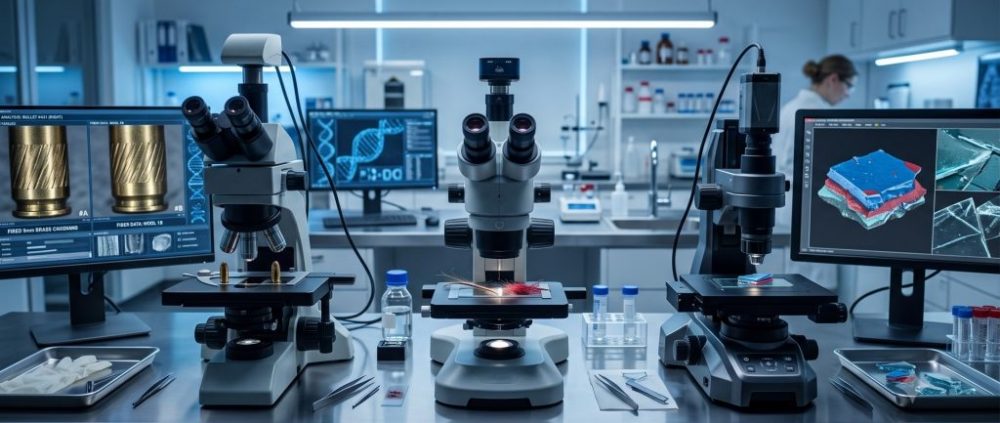
A forensic microscope does more than help you see fine details. It determines whether the evidence you submit will hold up in court or fall apart once it gets challenged.
Most labs do not fail because of bad science. They fail because the wrong tool ended up in the wrong workflow. That happens more often in forensic procurement than people want to admit.
This article compares three forensic microscopes used in evidence analysis, so you can match the right tool to the right job before it matters where it really counts.
Why Choosing a Forensic Microscope Is Not Like Buying a Standard Lab Scope
- A standard lab scope shows you what exists. A forensic microscope has to prove it in court.
- Forensic work demands strict documentation, traceability, and evidence handling standards.
- The wrong choice creates gaps in your evidence chain, not just your workflow.
The Three Main Types of Forensic Microscopes and What Each One Does Best
Comparison Microscopes: Built for Side-by-Side Evidence Matching
These use a dual optical system that lets examiners view two samples at the same time through a single eyepiece. Ballistics labs rely on them heavily for matching bullet striations and toolmarks to a specific firearm. When a case goes to court, this is the kind of visual evidence that actually moves a jury.
Stereo Forensic Microscopes: Where Trace Evidence Gets Sorted First
Low magnification, wide field of view, strong depth perception. This is the first tool a technician reaches for when sorting hair, glass fragments, paint chips, or soil samples pulled from a scene. It does not go deep, but it gives you a fast, clear picture of what you are working with before committing to higher-level analysis.
Digital Forensic Microscopes: Documentation-First Workflows
It doesn’t have an eyepiece. Everything goes straight to a monitor and gets saved as high-resolution images or video. Newer labs lean toward these because analysis and documentation happen in one step, which cuts down case processing time without cutting corners on accuracy.
Three Forensic Microscopes Worth Comparing Head to Head
Leica FS CB Comparison Microscope: The Benchmark in Ballistics Examination
Federal crime labs do not reach for the Leica FS CB because of the branding. They reach for it because it delivers matched optical paths and consistent side-by-side viewing that holds up under legal scrutiny. The dual bridge system gives examiners precise stage control on both sides, and the illumination stays balanced across both viewing fields. That balance matters when you are studying bullet striations where even slight lighting inconsistency can throw off an interpretation. If your lab processes firearm evidence in any real volume, this is the tool everything else gets compared to. The price reflects that positioning, so it fits best in established labs with dedicated casework budgets.
Olympus SZ61 Stereo Microscope: Reliable Trace Evidence Analysis Without the Overhead
Not every forensic task needs a premium comparison bridge. The Olympus SZ61 has built a quiet reputation in trace evidence labs because it performs where it counts without demanding a large capital investment. The zoom range runs from 6.7x to 45x, the tilting head reduces fatigue during long examination sessions, and it pairs cleanly with Olympus camera modules for documentation. Fiber cross-sections, glass fragment sorting, hair comparison under preliminary review, these are the tasks it handles consistently well. Think of a hit-and-run investigation where preliminary fiber work on the SZ61 pointed investigators in the right direction before compound analysis confirmed the match. That kind of early-stage clarity is exactly what this scope is built for.
Keyence VHX-7000 Digital Microscope: When Documentation Is the Workflow
The Keyence VHX-7000 treats analysis and reporting as one task rather than two separate steps. There is no eyepiece. Output goes directly to a monitor as high-resolution stills or 4K video, and the built-in depth composition feature produces fully focused images even across uneven surfaces, which is genuinely useful for toolmark and impression evidence. Onboard measurement tools and report generation cut case processing time in a meaningful way. The honest caveat is that there is a learning curve, and labs should budget for training time alongside the equipment cost.
What to Actually Compare Before Purchasing a Forensic Microscope
- Magnification vs. resolution: Higher magnification sounds impressive on a spec sheet but resolution and optical clarity under your actual lab lighting conditions matter far more in daily casework.
- Illumination type: Reflected, transmitted, and polarized lighting serve different evidence types. Don’t compare models until you know your casework needs.
- Camera and documentation compatibility: A great optical system is worth little if it cannot interface with your existing evidence management system. Please confirm integration before purchase.
- Stage size and sample handling: Space is needed to move around large, irregular pieces of evidence. A cramped stage slows down examiners and creates handling risks.
- Service and support availability: Equipment goes down. What matters is how fast your vendor responds when it does. A long service wait on a critical tool can stall active cases.
- Training requirements: Some systems have steeper learning curves than others. Factor that time and cost into your decision, not just the sticker price.
The Right Forensic Microscope Comes Down to What Your Lab Actually Does
No single forensic microscope covers every evidence type. The right choice depends on what your lab handles most and how your documentation workflow actually runs.
Comparison scopes hold up best for ballistics and fiber matching. Stereo scopes are where trace evidence triage begins. Digital scopes pull analysis and reporting into one step.
Budget, caseload, and existing infrastructure all factor into that decision. Knowing the differences upfront is what keeps forensic labs accurate and prepared when cases go to court.