
Introduction
Enterprise Resource Planning systems promise order in a world of spreadsheets, sticky notes, and late-night reconciliations, a beautiful promise honestly. Yet many businesses discover sometimes painfully that implementing ERP is less about software and more about discipline. A polished dashboard does not magically fix chaotic workflows. Even the most sophisticated system can stumble without clarity, planning, and patience. Many organizations partner with a custom erp development company expecting instant transformation. Reality tends to respond with a raised eyebrow. Success with ERP requires strategy, structure, and steady leadership not wishful thinking dressed as digital ambition.
Mistake #1: Treating ERP as a Magic Wand
ERP is often introduced like a superhero arriving to rescue operations from inefficiency. Expectations skyrocket. Processes remain flawed. Disappointment follows. Software automates what already exists, good or bad. If inventory records are inconsistent before implementation, automation simply speeds up inconsistency. One executive once declared that the ERP “should fix everything by Q2 as though systems respond to quarterly pressure. ERP is powerful, but it is not mystical. Businesses must repair broken workflows before digitizing them. Otherwise, complexity becomes faster, not smarter and frustration becomes an unintended KPI.
Mistake #2: Ignoring Clear Business Goals
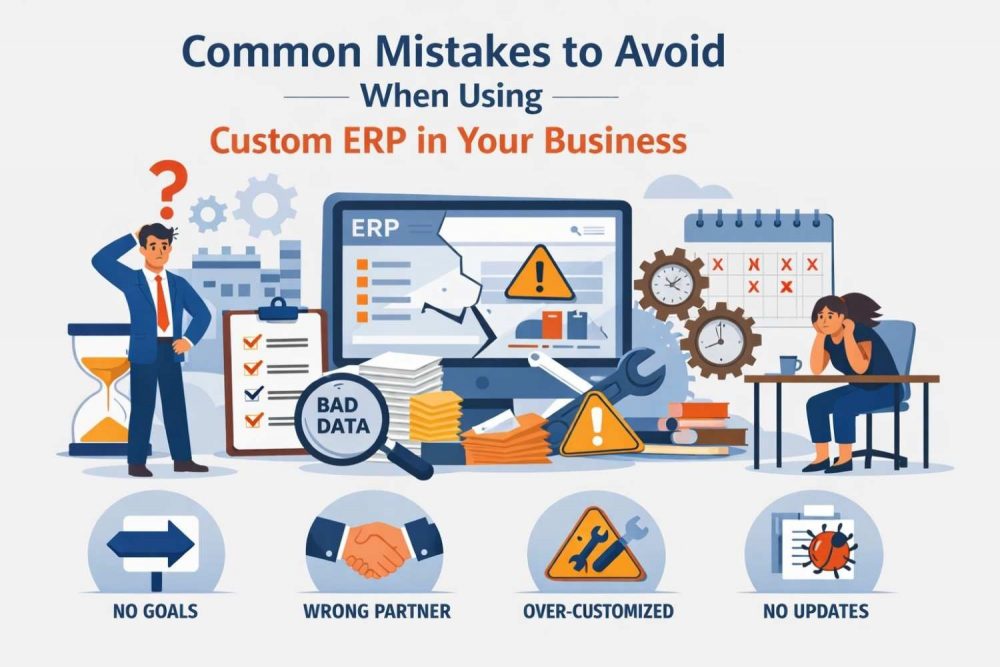
Many ERP projects begin with enthusiasm and end with confusion because measurable objectives were never defined. Digitization is mistaken for optimization. Dashboards glow beautifully, yet no one agrees on what success looks like. Without KPIs tied to revenue, cost control, or efficiency, ERP becomes an expensive reporting tool rather than a strategic engine. Growth requires direction. Technology without alignment drifts. Goals should be written, measurable, and reviewed consistently. When strategy leads and software follows, ERP becomes transformative. When strategy is absent, even the most elegant interface feels strangely hollow.
Mistake #3: Choosing the Wrong Development Partner
Selecting a vendor based solely on price is rarely a wise strategy. Expertise, industry familiarity, and communication matter far more than a persuasive sales presentation. A reliable custom erp development company listens before building, challenges assumptions, and explains trade-offs clearly. The wrong partner overpromises timelines and underestimates complexity. Misalignment creates delays, scope creep, and budget strain. Collaboration—not mere coding—defines successful ERP development. Businesses should evaluate experience, technical depth, and post-launch support. The right partner feels like a strategic ally; the wrong one feels like a costly lesson.
Mistake #4: Poor Data Migration and Cleanup
Data migration is rarely glamorous, yet it is critical. Dirty, duplicate, or outdated data transferred into a new ERP system simply carries old problems into a new environment. Think of it as moving houses without decluttering—every unnecessary box follows. Testing is essential. Validation is essential. Patience is essential. Without careful preparation, reporting inaccuracies and operational disruptions become inevitable. ERP thrives on accurate information. Clean data supports better decisions, smoother workflows, and credible analytics. Skipping this stage saves time initially, only to cost far more later.
Mistake #5: Skipping Employee Training
Technology changes quickly; habits change slowly. Employees unfamiliar with ERP often revert to spreadsheets or parallel systems, the infamous “shadow processes.” Resistance typically stems from uncertainty, not stubbornness. Proper training fosters confidence. Clear documentation reduces frustration. Ongoing support builds trust. Implementation does not end at deployment; adoption defines real success. Teams must understand not only how the system works but why it matters. When people feel included and informed, ERP becomes a tool of empowerment. When training is neglected, productivity declines and enthusiasm quietly fades.
Mistake #6: Over-Customization
Customization can be beneficial, but excessive modification creates complexity and maintenance challenges. Businesses sometimes request features that mirror every old process instead of improving them. The result? A rigid system that struggles to scale. Modern erp solutions are designed with flexibility in mind; overloading them with unique patches often increases costs and reduces stability. Strategic customization should solve real problems—not preserve outdated habits. A balanced approach ensures long-term adaptability. Too much tailoring turns ERP into a fragile framework rather than a sustainable operational backbone.
Mistake #7: Neglecting Ongoing Maintenance and Updates
ERP is not a one-time purchase; it is an evolving ecosystem. Security patches, performance updates, and feature enhancements require continuous attention. Neglecting maintenance invites vulnerabilities and inefficiencies. Markets change. Regulations change. Businesses change. ERP must adapt accordingly. Regular audits and performance evaluations maintain alignment with company goals. Ignoring updates may appear cost-effective short term, yet long-term risks grow quietly. Sustainable ERP management treats the system as a living asset monitored, refined, and improved over time.
Mistake #8: Failing to Measure ROI
Investment without evaluation rarely leads to clarity. ERP projects often conclude with relief rather than review. However, measurable outcomes determine real success. Has order processing improved? Are operational costs reduced? Is decision-making faster? Tracking ROI provides insights for refinement and justification for continued investment. Without metrics, ERP becomes an abstract achievement rather than a tangible asset. Structured evaluation reinforces accountability and highlights opportunities for optimization. Measuring performance ensures the system contributes directly to growth rather than merely existing as infrastructure.
Best Practices to Avoid These Mistakes
Successful ERP implementation requires structured planning and realistic timelines. Stakeholder involvement ensures alignment across departments. Phased rollouts reduce operational disruption. Comprehensive testing minimizes surprises. Continuous feedback loops encourage improvement. Clear communication bridges leadership and operational teams. Most importantly, ERP must align with long-term business strategy. Thoughtful execution transforms ERP from a technical project into a strategic milestone. Prevention, preparation, and persistence define sustainable outcomes. Organizations that prioritize these principles experience smoother transitions and stronger operational performance.
Conclusion
ERP systems do not fail because of technology alone; they falter when expectations outpace preparation. Software reflects the clarity or confusion within an organization. When processes are refined, goals defined, and teams trained, ERP becomes a powerful foundation for growth. When shortcuts dominate planning, complexity multiplies. Thoughtful leadership, strategic partnerships, and disciplined execution determine success. In the end, ERP is not about automation alone, it is about alignment. Businesses that approach implementation with patience and purpose discover that efficiency is not accidental; it is carefully engineered.
FAQs
1. What is custom ERP?
Custom ERP is a tailored enterprise resource planning system designed to match specific business workflows, requirements, and industry standards.
2. How long does ERP implementation take?
Implementation timelines vary based on company size and complexity, typically ranging from several months to over a year.
3. Is custom ERP better than off-the-shelf software?
Custom ERP offers greater flexibility and alignment with business processes, while off-the-shelf solutions provide faster deployment.
4. Why is training important in ERP implementation?
Training ensures employees understand and effectively use the system, increasing adoption and productivity.
5. How can ROI be measured after ERP implementation?
ROI can be measured through cost savings, improved efficiency, faster reporting, and enhanced operational performance.