
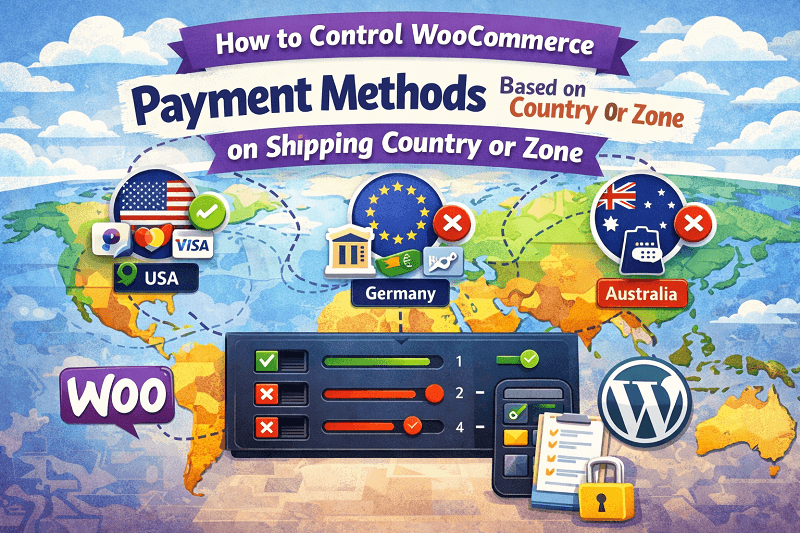
Payment options look simple on the surface. Customer reaches checkout, sees a few methods, picks one, and pays. But once you sell across regions, things get messy fast. Some gateways work only in certain countries. Some charge higher fees in specific zones. Others cause failed payments that support teams then have to clean up later.
This is where control starts to matter. Not control in a rigid sense, but practical control. Showing the right payment option to the right customer at the right time. That is the real value behind WooCommerce conditional payment gateways.
When payment logic matches the shipping country or zone, the checkout feels smoother. Fewer errors, fewer confused customers, and less manual fixing afterward. It also feels intentional, like the store knows what it is doing. Which honestly matters more than people admit.
Why Shipping Location Should Decide Payment Options
Shipping country already influences taxes, shipping rates, and delivery time. Letting it also guide payment methods makes sense. Some gateways are country specific. Some banks block cross border transactions. Some payment providers simply do not support certain regions.
If a customer in one country sees a payment method that will fail later, that creates frustration. They may abandon the checkout entirely. Or worse, complete the order and then face issues.
Using conditional payment methods for WooCommerce allows store owners to avoid this situation altogether. You decide upfront what shows and what stays hidden based on shipping details.
This approach also helps with compliance and fees. Certain payment processors have rules tied to regions. Showing them only where allowed keeps things clean.
Understanding Shipping Zones and Countries in WooCommerce
WooCommerce already has a solid shipping system. Shipping zones group countries, regions, or postal codes together. Each zone can have its own methods and rules.
What many store owners do not realize is that these zones can also act as triggers for payment logic. Instead of thinking in terms of customers, think in terms of destinations.
For example, Zone A covers domestic orders. Zone B covers international orders. Each zone has different shipping methods and now different payment rules too.
WooCommerce conditional payment gateways work by listening to these conditions. When checkout detects the shipping country or zone, it adjusts available payment methods automatically. No custom code, no manual toggling.
It feels invisible to the customer, which is exactly how it should be.
Real World Examples That Actually Matter
Theory is fine, but examples make this click.
Imagine you sell physical products worldwide. For domestic orders, you want to offer cash on delivery and local bank transfer. For international orders, those options make no sense.
With conditional payment methods for WooCommerce, you simply hide cash on delivery when the shipping country is outside your domestic zone. The checkout instantly adapts.
Another example. A gateway like Stripe works globally, but you prefer PayPal for certain regions due to trust or currency reasons. You can show PayPal only for specific countries while keeping Stripe as the default elsewhere.
There are also cases where shipping carriers require pre-payment. If a certain shipping method is selected, you may want to hide pay later options. Shipping choice and payment choice start working together instead of against each other.
How Conditional Rules Improve Checkout Experience
Checkout is a fragile moment. Too many options create hesitation. Irrelevant options create confusion. Failed payments destroy trust.
By using WooCommerce conditional payment gateways you reduce noise. Customers see only what applies to them. This makes the decision faster and more confident.
It also reduces support tickets. Many payment related tickets come from customers trying to use a method that should not have been available to them in the first place.
There is also a subtle psychological effect. When a checkout feels tailored people assume the store is professional. They are more comfortable entering payment details. That comfort translates into conversions.
Sometimes small logic changes lead to big results.
Managing Payment Rules Without Touching Code
One reason many stores avoid advanced logic is fear of code. Nobody wants to maintain custom snippets that break after updates.
A plugin built for conditional payment methods for WooCommerce removes that barrier. Rules are set using conditions like shipping country shipping zone cart total product category or user role.
You choose a condition then choose which gateways to show or hide. That is it. No PHP files no hooks no debugging sessions at midnight.
This also means rules can evolve. You can adjust logic as your store grows without rebuilding anything. Add a new country tweak a zone update a payment rule. It stays manageable.
Handling Edge Cases and Mixed Carts
Real stores are messy. Some carts include products that ship from different locations. Some customers change shipping address mid checkout.
Good conditional logic accounts for this. Payment rules should update dynamically as shipping details change. If the shipping country switches the available gateways should refresh immediately.
This dynamic behavior is a big reason WooCommerce conditional payment gateways matter. Static setups cannot handle these changes smoothly.
Mixed carts also matter. For example, if one product cannot be shipped to a certain country, then the payment options tied to that country should not appear either. Payment logic follows shipping reality.
These edge cases are where manual setups usually fail.
Reducing Failed Transactions and Refunds
Failed payments cost time and money. Payment processor fees still apply in some cases. Support teams spend hours responding to emails. Customers lose patience.
By hiding incompatible gateways early, you reduce failure rates. Customers are guided toward methods that are known to work for their location.
Conditional payment methods for WooCommerce act as a filter. They quietly remove risky options before the customer even considers them.
This also helps with refunds. When payment and shipping rules align, there are fewer disputes, fewer chargebacks, and fewer awkward explanations.
It is not flashy, but it is effective.
Scaling International Stores the Smart Way
As stores grow internationally, complexity increases. New currencies, new gateways, new regulations. Trying to manage this manually does not scale.
Using WooCommerce conditional payment gateways gives you a framework. You can add regions one by one without breaking existing logic.
For example, start with domestic rules. Then add a zone for Europe with its own payment setup. Later, add Asia with a different mix. Each zone remains isolated in logic but unified in experience.
This modular approach keeps things sane. You always know why a payment method appears or does not appear.
Final Thoughts
Controlling payment methods based on shipping country or zone is not about restriction. It is about clarity. Customers should never have to guess which payment option will work.
With the right setup, WooCommerce conditional payment gateways become a quiet helper in the background. They reduce friction, prevent errors, and make checkout feel intentional.
When payment choices match shipping reality, everyone benefits. Customers complete orders with confidence. Store owners deal with fewer problems. Support teams breathe easier.
That is what good conditional logic does. It stays out of the way while making everything work better.