The Emergence of Eco-Friendly Startups
Green startups refer to businesses whose main emphasis lies on sustainability. In other words, unlike conventional businesses whose major aim is to make profits, the major aim of green startups is to reduce their impact on the environment in terms of their carbon footprint and resource efficiency. While conventional businesses may regard sustainability as a secondary goal, green startups adopt a completely different stance. Increasing public awareness of global warming has largely influenced this trend, driven by initiatives of international organizations such as the United Nations and many others.
During the last decade, there has been a tremendous increase in climate tech startups. This rise has been stimulated by a combination of environmental issues, favourable policies, and investments. At the same time, it indicates a general transition from CSR (Corporate Social Responsibility) activities to a more sustainable business model. It is worth mentioning that today young entrepreneurs who embrace innovation ecosystems play an essential role in bringing about change in that area.
Thus, eco-friendly startups are not simply new players in the market but important forces promoting sustainable development in the global economy.
Driving Forces Behind the Green Startup Boom
The rapid growth of sustainable businesses can be attributed to several environmental, economic, and technological factors. Foremost among these is climate change, which has gained importance in recent years because of scientific reports from the Intergovernmental Panel on Climate Change and their consequences. Moreover, the increase in natural disasters makes it imperative to implement innovative solutions to the current problem.
Governments from all around the world has emerged to facilitate sustainable entrepreneurship. For instance, agreements on climate control at an international level, such as the Paris Agreement, pose ambitious targets to achieve carbon neutrality, utilizing different financial tools like subsidies, green finance, and taxation.
In turn, the growing popularity of investments in accordance with ESG (Environmental, Social, and Governance), together with venture capital funding for climate technology businesses, presents another contributing factor. Besides, a change in people’s attitude can be observed due to increased demand for sustainable goods from generation Z and millennials.
Finally, technological progress constitutes another key element, as cheaper renewable energy, as well as developments in AI, IoT, and blockchain, enables implementing sustainability efficiently.
Innovative Solutions: How Startups Are Tackling Climate Change
Eco-conscious startups are among the leaders in climate innovation, providing scalable solutions in various industries. Besides being technologically innovative, they can adapt their methods to different environments around the world, thus making them key players in sustainable environmental development.
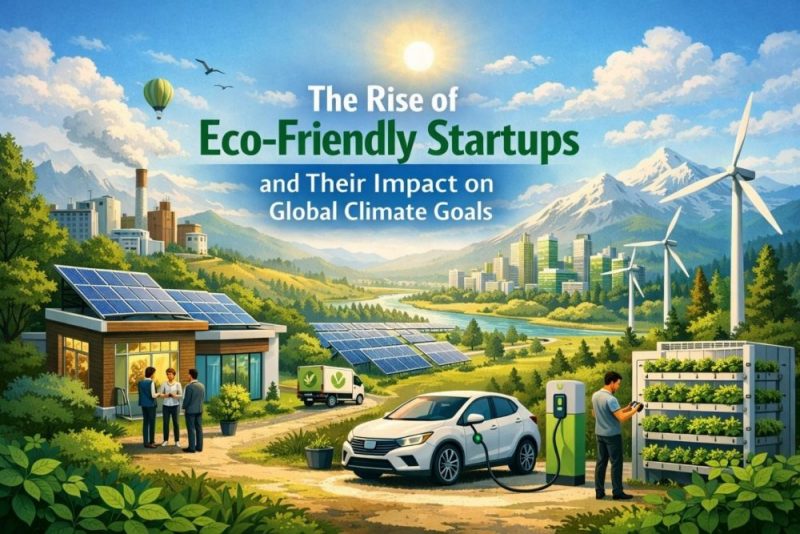
1. Alternative Energy: In the green business industry, companies are attempting to integrate alternative energy sources by using decentralized systems of energy generation, such as microgrids, as well as solar and wind energy.
2. Sustainable Agriculture: Firms in this industry have made strides toward sustainability by being cost-effective and productive without using too much water and other chemicals in their farming process. In addition, these firms introduce new ways of agriculture such as precision agriculture and vertical agriculture.
3. Circular Economy & Waste Management: Recycling and upcycling of waste are some methods used in managing waste effectively. Zero-waste firms also encourage consumers to embrace sustainability by designing new products.
4. Sustainable Transport: Use of electric cars and transportation reduces the carbon print in urban areas; moreover, smart transportation systems increase fuel efficiency.
5. Carbon Capture and Climate Technology: Measurement of greenhouse gas emissions and information generation for policymakers regarding environmental issues, entrepreneurs from across the globe are developing carbon capturing technologies and climate intelligence software.
Impact on Global Climate Goals and Sustainability Targets
Eco-friendly companies contribute to the advancing global objectives regarding climate change by reductions in carbon emissions through innovative approaches that reduce the impact of industries on the environment. The business model of such enterprises corresponds to the objectives established in the United Nations Sustainable Development Goals, such as affordable and clean energy, responsible consumption and production, and climate action.
Apart from innovation acceleration and employment generation within the scope of green economies, eco-startups exert pressure on companies operating in conventional industries to introduce sustainable practices into their business operations. These organizations can assist national and international authorities in reaching net-zero emissions goals.
However, looking at green ventures from a critical angle, one can identify several drawbacks. It is difficult to measure the exact environmental impacts of green ventures due to the high risk of greenwashing. The problem of scalability is evident for those countries that do not have advanced infrastructure and financial resources.
Conclusion
In today’s era, eco-friendly ventures have played an influential role in bringing innovation and facilitating progress towards global climate goals. On one hand, such ventures provide innovative means that can contribute significantly to a sustainable future, but on the other hand, they also face several challenges.
These ventures need adequate resources to become successful. For overcoming such obstacles, cooperation between the government and such ventures is essential. Moreover, corporate organizations will also need to come together with these entrepreneurs in order to enhance their influence further. In the coming years, climate technology is likely to define the upcoming entrepreneurship trends.