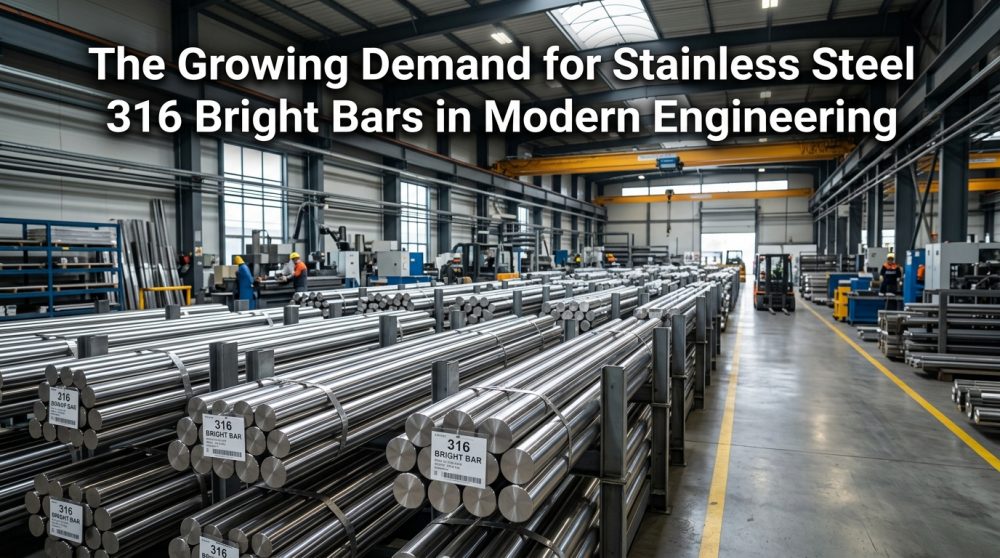
Engineering industries across the entire globe now call for stainless steel bright bars with much more precision. These criteria, dimensional tolerance, surface finish standards and long-term corrosion behavior all feed into procurement decisions and SS 316 bright bars consistently meet the most stringent of these. As engineers move away from less performing alternatives, demand for this grade has steadily increased from chemical processing plants to marine fabrication yards.
What Is a Stainless Steel 316 Bright Bar?
Composition and Material Properties
Bright bar stainless steel 316 has a different chemical composition than standard austenitic grades. It has about 16-18% chromium, 10-14% nickel and 2-3% molybdenum. Addition of molybdenum increases its pitting resistance index as compared to SS 304. It is preferred in environments containing chlorides, sulfates or acidic media. It has a tensile strength of 515 to 690 MPa, depending on temper and section size. It also has a yield strength of about 205 MPa that gives it enough ductility to be machined without risks of cracking or breaking.
Manufacturing Process of Bright Bars
Bright bars are produced from hot-rolled or forged billets, which are then cold-drawn or cold-rolled. Cold-working results in the refinement of the grain structure, tight dimensional tolerances to the h9 or h11 fit and removal of the mill scale covering black bar surfaces. A final straightening pass keeps the bow within 0.5 mm per metre on most commercial lengths. The result is a bar that needs little or no pre-machining before it goes onto the lathe or milling table.
Difference Between Bright Bars and Black Bars
The black bars leave the rolling mill with the oxide layer still present and thus the surface condition varies over the cross section. Bright bars go through additional cold-working and surface finishing, so the skin is clean, smooth and geometrically consistent. For precision-turned components, consistency matters because the machinist can cut directly to final dimensions without allowance for scale removal or surface irregularity.
Key Properties Driving the Demand for SS 316 Bright Bars
The molybdenum-bearing chemistry of SS 316 bright bars gives them a combination of properties that other grades cannot replicate at the same price point. Here is why engineers specify them so frequently.
Excellent Corrosion Resistance
The 2-3% molybdenum content resists pitting and crevice corrosion in chloride-rich environments better than SS 304.
With a tensile strength of up to 690 MPa, these bars withstand cyclic mechanical loads without fatigue-related cracking over long service periods.
Smooth Surface Finish and Precision Dimensions
Cold-drawing produces a surface roughness of Ra 0.8 to 1.6 µm, reducing downstream machining time and ensuring consistent fits in assembled components.
Good Machinability and Weldability
SS 316 machines cleanly with carbide tooling at standard cutting speeds and welds without intergranular corrosion risk when post-weld annealing follows the process.
Resistance to Chemicals and Moisture
Concentrated organic acids, phosphoric acid solutions, and salt-spray environments that degrade ferritic grades leave SS 316 surfaces intact across operating temperatures up to 870°C.
Why Modern Engineering Industries Prefer Stainless Steel 316 Bright Bars
Procurement teams choose materials that reduce total life cycle cost. But stainless steel bright bars of grade 316 overcome this hurdle, as their corrosion resistance does away with the protective coating cycles that lower grades require every three to five years.
In subsea, coastal or chemical plant environments, the reliability of materials directly impacts plant uptime. The price difference between SS 304 and SS 316 bar stock is trivial compared to the cost of an unplanned chemical reactor shutdown. Cold-drawn bright bar is also valued for its close dimensional tolerances that help save setup time and minimize scrap rates on CNC turning lines. SS 316 used for high temperature service up to 870°C. Intermittent exposure does not require costly alloy upgrades for oxidation resistance.
Major Applications of Stainless Steel 316 Bright Bars
Cold-drawn SS 316 bright bars turn up across sectors where dimensional accuracy and long-term corrosion resistance must work together, instead of working separately.
Marine Engineering
Shaft components, propeller fittings and underwater fasteners made from SS 316 bright bar resist seawater corrosion and biofouling-related pitting that damage lower-grade alternatives in 18 to 24 months after immersion.
Chemical Processing Equipment
SS 316 machined reactor agitator shafts, valve stems and pump internals resist concentrated acids and alkalis at high temperatures with no surface degradation that would contaminate process streams.
Food and Beverage Industry
Hygienic conveyor components, mixer shafts and filling-line parts require a surface finish below Ra 0.8 µm; bright bar stock meets those standards and complies with FDA and EC 1935/2004 food-contact regulations.
Construction and Infrastructure
Structural fasteners, balustrade components and architectural fixings made from SS 316 bright bar perform in coastal construction sites where salt-laden air accelerates corrosion in carbon steel hardware within two to three seasons.
Automotive and Mechanical Engineering
Precision-turned exhaust components, fuel injector bodies and sensor housings benefit from the tight h9 tolerances that cold-drawn stainless steel 316 bright bar delivers straight from the bar without additional grinding passes.
Stainless Steel 316 Bright Bar vs Other Stainless Steel Grades
Grade selection shapes long-term performance and maintenance schedules, so understanding where SS 316 differs from adjacent grades saves costly re-specifications later.
Corrosion Resistance
SS 316 outperforms SS 304 in chloride and acid environments because molybdenum raises the pitting resistance equivalent number from roughly 18 to 26, a measurable and significant improvement in aggressive media.
Strength
SS 316 and SS 304 have comparable tensile strength ranges of 515 to 690 MPa, but SS 316L has a lower yield strength of 170 MPa, making it the preferred choice when ductility post-welding is more important than hardness.
Surface Finish
Cold-drawn SS 316 bright bar achieves Ra 0.8 to 1.6 µm consistently, whereas hot-rolled black bar in any grade requires additional grinding or turning to reach that finish level before precision machining begins.
Industrial Suitability
SS 316 suits the chemical, marine and food industries where contamination risk is high. SS 430 ferritic grade works in milder indoor environments but lacks the austenitic toughness needed for dynamic load applications.
Cost-Effectiveness
SS 316 commands a 15 to 20% premium over SS 304 at current mill pricing, but eliminates protective coating expenditure and extends component service intervals from three years to ten or more in corrosive duty cycles.
Factors to Consider Before Selecting SS 316 Bright Bars
Specifying the right bar stock avoids costly substitutions mid-project. These selection points cover the variables that engineers and procurement teams overlook.
- Confirm the diameter and length range against your machining centre’s capacity, since cold-drawn bright bars run from 5 mm to 100 mm in diameter in standard stock.
- Confirm the surface roughness value required before ordering to avoid unnecessary downstream grinding. Ra 0.8 µm for food grade and Ra 1.6 µm for general engineering.
- Match the mechanical strength specification to your design load. If yield strength above 170 MPa is critical to component performance, choose SS 316 over SS 316L.
- Check the chloride level and temperature of the working environment. SS 316 may not be good enough in high chloride media for a long time at 60°C and above. You may need duplex stainless steel.
- Before issuing a purchase order, please ensure that the bar stock is in accordance with ASTM A276 or EN 10278 or relevant IS standards as per your project drawings.
Conclusion
Demand for stainless steel 316 bright bars continues to rise as engineering projects increasingly specify materials that perform reliably over the entire service life rather than at commissioning. With Molybdenum-enhanced corrosion resistance, precise cold-drawn dimensions and international material standards, SS 316 bright bar is the practical default for marine, chemical, food-grade and structural applications. Early procurement team and fabricator specification of this grade reduces rework costs and maintenance intervals over the life of the project.