Introduction
Unpaid claims remain one of the biggest cash flow problems in revenue cycle management in healthcare. The inability to collect on claims because of delays or denials from insurance companies negatively impact cash flow and administrative work. This is where urgent care billing services become so important, as they are a means to manage, track and recover outstanding payments more efficiently and to unburden providers.
With efficient management of unpaid claims, the medical billing account receivable increases, providing financial stability and operational efficiency for urgent care centers.
Unpaid claims for Urgent Care.
The primary definition of an unpaid claim, or a rejected claim, occurs when either an insurance provider or a patient doesn’t remit payment for a billed amount within the standard timeframe. These payment delays typically occur because of coding errors, inadequate documentation, missing patient eligibility or simply denials for a claim.
In an urgent care setting, with the high volume of patients and often walk-in, scheduled less visits, billing errors are much more likely. As such, urgent care billing services have to deal with a huge amount of unpaid claims that require follow up, correction, resubmission and more to ensure revenue is collected.
How Urgent Care Billing Services help with Claim management
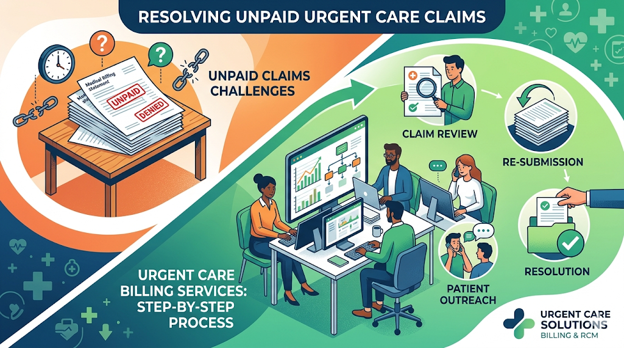
The main goal of any urgent care billing service is to ensure that each and every medical service is accounted for and reimbursed accordingly. When the claims are not paid then they start with a systematic process to retrieve outstanding payments.
They use the medical billing system to track claims and see where payments have not been made, sorting them by different types of claim rejection, including denial and pending claims and prioritizing the highest paying claims to recover most of the revenue in less amount of time.
Managing Denials and claim correction
Denial management is a crucial aspect of unpaid claims for urgent care billing services as this is where a vast number of rejected claims can be recovered if corrected in a timely manner. Whether this involves coding, missing medical necessary documents, missing patient eligibility or other issues the billing service can address them in time to recoup revenues.
Certified coders and billing experts examine all medical records for accuracy and ensure correct ICD-10, CPT and HCPCS codes are used for each service to maximize claim reimbursement and minimize denials. This allows for efficient accounts receivable in medical billing and recovery of revenue.
Follow up and insurance communication
Once a claim is rejected and corrected it must be resubmitted and continuously followed up with the payer to ensure that the claim does not become aged. An aging account is another concern that must be managed with ongoing follow up to collect outstanding payments and bring down the value.
The urgent care billing service has the resources to continue the follow-up process even with insurance provider’s lack of timely responses. Billing specialists are diligent with constant communication with insurance providers to gather updates on the claim’s status and address any additional requirements needed to process the payment. This also helps identify any repetitive problems being caused by a specific payer.
Patient responsibility and secondary billing
Not all unpaid claims are insurance providers’ faults; at times the responsibility of payment is on the patient, such as for deductibles, co-payments, or any outstanding charges post-insurance payment. Urgent care billing services provide patient billing services that includes sending patients clear bills and reminders to process the payments.
Using these additional billing options means that all avenues are being explored to acquire payment and contribute to improving medical billing account receivable and overall decreasing any outstanding payments or bad debt.
Technology in unpaid claims management
Advanced billing software is the main system to identify aged accounts and follow up. This can drastically improve the entire process for an urgent care billing service; as these systems are designed to be systematic and efficient. Technology helps to identify potential coding and billing errors before the claim is even sent to the payer, further increasing chances for successful payment, and ensuring optimal medical billing account receivable.
Artificial Intelligence has an important role to play in identifying claim issues early, thereby preventing a claim from becoming an unpaid claim.
Aging Reports and financial analysis
An aging report for medical billing accounts receivable must be used daily and/or weekly, in order to identify those claims that are becoming too old and are at risk of becoming uncollectible. Medical billing companies for urgent care will use this data to further categorize each claim and determine a strategy of who should be contacted, what needs to be done and in what timeframe.
This allows for strategic action to ensure medical billing account receivable is as healthy as possible.
Appeals and resubmission
Even with efficient systems there are still times when a claim is denied and although all criteria has been met, an appeal is required. Medical billing services will work on drafting and submitting the appeal with any supporting documentation and policy numbers that will aid in overturning the denial. There are strict guidelines on appeal deadlines, so time sensitivity is of great importance when managing this process for urgent care centers.
The final product of successful appeal and resubmission directly relates back to the medical billing account receivable for an urgent care center.
Conclusion
Unpaid claims are a common but manageable issue that urgent care billing services are specifically designed to handle. Through thorough denial management, diligent follow-up processes and strategically using technology, medical billing account receivable increases for an urgent care center, giving them a much-needed avenue to enhance revenue and allow them to focus more on their patients rather than complicated administrative processes.