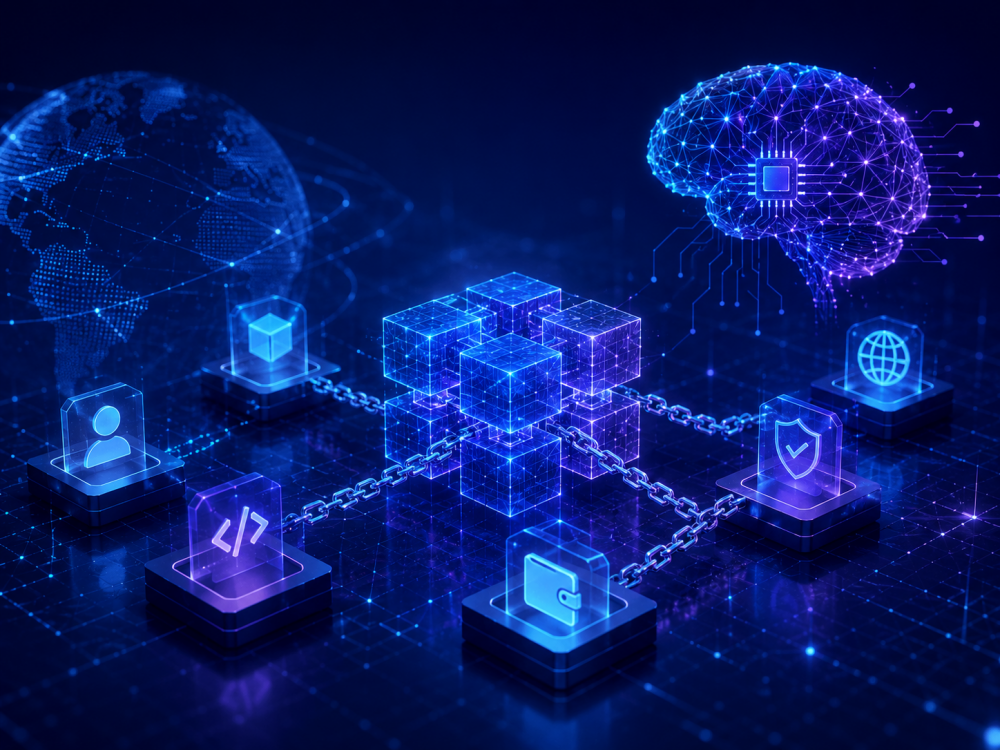
The Internet is experiencing its biggest revolution since smartphones were invented. The convergence of two technologies Artificial Intelligence and Blockchain is a phenomenon that has yet to be fully understood by most businesses. They’re not just making decentralized applications easier to build, but they’re making the possibilities for decentralized apps more and more possible, more and more accessible, and less expensive.
It is no longer a choice for anyone working with or assessing any dApp software development business nowadays. It is the distinction between creating something which heads a market, and creating something that lags behind before it even gets to market.
Pre-AI State of DApp Development
Blockchain development has been known for being complex, costly, and slow. Highly specialized developers were required to write smart contracts. Security audits were manual, time consuming and expensive. The user interfaces were not as user friendly as classic web applications. But the hurdle for founders who were not technically savvy was so great.
Because of these hurdles, only teams with substantial funding could allow the time needed to create a good quality decentralized application. It was a “pick two” situation for a startup with a great idea, but a small budget: sacrifice security or sacrifice timelines which amounted to months!
That’s completely different now, over the past few years.
What is the impact AI has on dApp development?
From smart contract writing and auditing to front-end interface creation and on-chain user behavior analysis, artificial intelligence is transforming each layer of the decentralized application development stack.
Generating & Auditing Smart Contracts
Writing and auditing smart contracts is one of the most time-consuming aspects of any decentralized application. If one single logical flaw occurs within a smart contract, millions of dollars can be lost and, once deployed on-chain, these mistakes can’t be corrected.
In front of the human auditor even looking at the code, smart contract code can now be generated directly from plain language descriptions, common vulnerability patterns can be identified by AI-powered tools, and optimizations can be suggested that can help to reduce gas costs. What used to take weeks of senior dev time can now be done in a fraction of that time without compromising quality.
This has a direct impact on the cost of developing the dApp software. By speeding up development cycles and providing AI-driven auditing, fewer hours are needed to work off a billable contract from concept to deployable code. By incorporating AI throughout software development, teams can produce better results in less time and provide these benefits to their clients.
It is a brand-new approach to on-chain user experiences.
The traditional decentralized applications have not been user friendly. Most mainstream users are not familiar with concepts such as gas fees, wallet confirmations, and transaction signing when interacting with a dApp.
AI is helping to fill this gap by developing adaptive interfaces that adjust to a user’s behavior. An AI-driven DeFi application can tell when the user stops on the confirmation screen and present a simple description of what’s happening behind the scenes. Machine learning can be applied to a yield farming platform to provide suggestions for the most effective staking strategies, depending on the user’s previous experience and the state of the market.
These enhancements are making decentralized apps accessible and usable for people beyond the crypto world.
Fraud Detection & Risk Management
Rug pulls, flash loan attacks, and wallet draining exploits are common issues in the decentralized finance (DeFi) space. AI is now being used to track on-chain activity in real-time and to signal any suspicious transaction patterns, preventing losses before they even occur.
By analyzing past exploit data, machine learning models can recognize the early indicators of an exploit, such as unusual liquidity patterns, token approvals, or wallet clustering, and take automated, proactive measures to prevent them, which is much quicker than any human team could manage.
In the world of a dApp software development company that creates products that engage with real user funds, AI-powered security monitoring is no longer a luxury but a necessity.
AI’s Trustworthiness is Improved with the Emerging Blockchain Technology.
AI and blockchain can’t be viewed as a one-way street. In the same way that AI is streamlining and enhancing the creation of dApps, blockchain is also addressing some of the core issues in AI.
A distributed AI Model Governance system.
A major objection that has been raised against the Modern AI systems is that they are run by a handful of big corporations. They have no external accountability for their data, their decisions or for how they can be updated or changed.
The Blockchain offers transparency and decentralization in the governance of AI. Decentralized autonomous organizations are able to vote on the updating of AI-models. Smart contracts can also dictate the guidelines for the usage and compensation of AI-generated outputs. Data provenance can be tracked on-chain, allowing data audits to determine what data influenced a model’s actions.
An entire new class of Web3 platforms is being born which are decentralized AI marketplaces that could help give the AI industry a more democratic alternative to the corporate model of ownership, and where those contributing to training data could be automatically rewarded via token systems.
The Implications for Web3 Platform Development
The synergy of AI and blockchain is not only reshaping individual dApps. It is changing the potential of Web3 platforms at scale.
Reduce development costs and expedite time to market
Now the AI factor cannot be ignored while estimating the dApp software development cost. By integrating AI into their coding, testing, documentation, and UI prototyping workflows, development teams have a cost model that is fundamentally different from those that are using only manual processes.
What used to take six months and a team of several people dedicated to the project can be done in a more efficient manner, allowing for AI to perform repetitive parts of the development process and freeing up the time of senior engineers for the more intricate architectural decisions that demand real expertise.
This efficiency gap is a significant factor for founders and enterprises looking to partner with the best dApp development company. Firms that have incorporated AI in their development process can provide more competitive timelines and prices without compromising on the quality of their work.
Cross-Chain Intelligence
Fragmentation has been a challenge in Web3 since the beginning. Without bridges, which are vulnerable to their own attacks and compromises, value and data stuck on Ethereum can’t easily interact with assets on Solana, BNB Chain, or Avalanche.
To facilitate the seamless transfer of assets or data points between blockchain networks, intelligent cross-chain routing systems are being developed using AI, which automatically detects the most efficient and secure routing path. This is ushering in a new era of Web3 platforms capable of interoperability between different chains, without having to worry about the complexity of it all.
Autonomous On-Chain Agents
The most future-oriented trend in the AI-Blockchain nexus is the rise of autonomous on-chain agents: AI-powered systems that are equipped with their own crypto wallets, can transact, communicate with smart contracts, and manage on-chain assets without human touch.
The agents have already found application in DeFi for portfolio rebalancing, in NFT auctions for intelligent bidding, and in the governance of DAOs for analyzing proposals and recommending voting. As this technology continues to grow, it will give birth to brand new types of decentralized applications that could not have existed in the past.
The ability to create and launch a chain-based AI agent is quickly emerging as a defining skill of one of the top dApp development companies, distinguishing them from those that are still working with yesterday’s toolset.
Conclusion
AI and blockchain are not just a trend that is still in the horizon. It’s happening now and it’s already distinguishing the successful DApps from the ones that are struggling to gain some traction.
Companies that make an early decision to partner with teams that are not only well-versed in AI but also have a solid grasp of blockchain and ensure their product development leverages AI for enhancing user experience and blockchain for trust and transparency will gain a substantial competitive edge over those attempting to catch up. They have the tools. The talent exists. The only factor is the speed at which your team can make use of them.