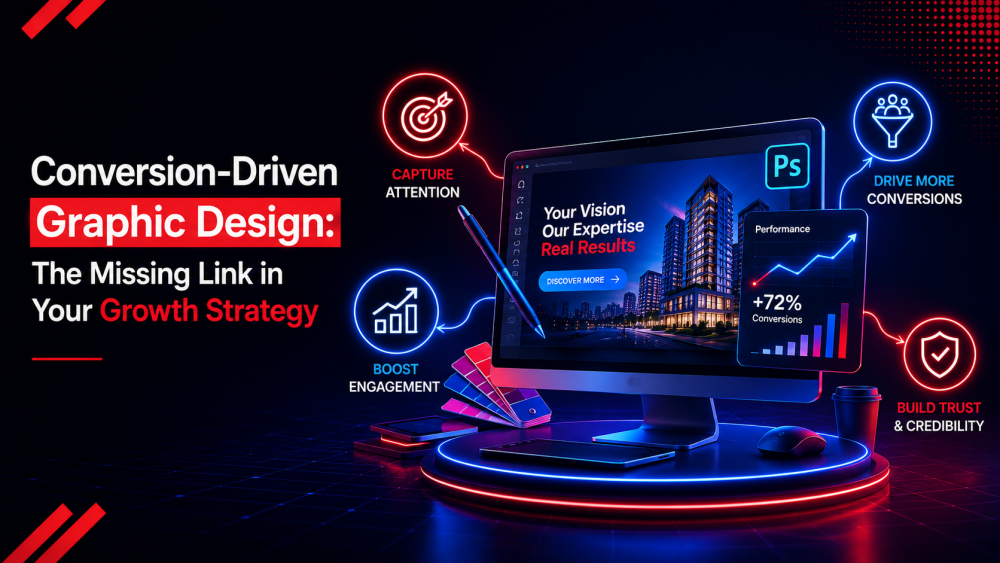
Businesses spend a lot of money on advertising, content marketing, SEO, and social media campaigns to bring in visitors. But many are struggling to turn that traffic into leads and customers. The problem isn’t often the marketing strategy itself, but what occurs after potential customers arrive.
This is where graphic design for business branding plays a crucial role in shaping how visitors perceive a brand and whether they take the next step. It bridges the gap between attracting attention and driving meaningful conversions.
Why Attractive Design Alone Is Not Enough
There are plenty of businesses that put a lot of emphasis on the looks of their websites, landing pages, ads, and marketing collateral. Visual appeal is important, but pretty designs that don’t inspire action rarely deliver meaningful business results.
A visually stunning page may help to attract attention, but if visitors can’t quickly understand the value of proposition or find the next step, they are likely to leave without converting.
Conversion-driven graphic design has a different goal. Every design element has a reason and helps you reach a specific business goal, whether that goal is-
- Lead Generation
- Book an appointment
- Encourages for purchasing products
- Boost newsletter subscriptions
- Requesting demonstrations
Design plays an active role in the customer journey in this approach.
Understanding the Difference – Traditional Design vs. Conversion Design
| Traditional Design | Conversion-Driven Design |
| Focuses on visual appeal | Focuses on user action |
| Prioritizes creativity | Prioritizes business outcomes |
| Multiple competing elements | Clear visual hierarchy |
| Can create distractions | Guides users toward a goal |
| Measures aesthetics | Measures conversions and engagement |
Companies that focus on conversion-oriented design often see that even subtle visual changes can have a major impact on lead generation and sales performance.
The Key Principles Behind High-Converting Visuals
High-converting visuals are built on proven psychological and user-experience principles.
Establish a Strong Visual Hierarchy
Visitors should immediately know where to look when they land on a page. Size, spacing, contrast, and positioning can be used strategically to guide the viewer’s attention to the most important information.
Elements that deserve priority include-
- Headlines
- Value propositions
- Call to action buttons
- Customers testimonials
- Contact forms
Clear visual hierarchy reduces confusion and improves decisions.
Focus on One Primary Action
One of the biggest mistakes in conversions is providing too many choices at once.
Be it a landing page, advertisement or email campaign, there should be one clear next step for the user. A specific call to action removes distractions and helps increase engagement.
Examples include-
- Download the guide
- Schedule a consultation
- Start a free trial
- Request A Quote
Conversions tend to increase when users know exactly what to do.
Reduce Friction Wherever Possible
Small barriers can even cause users to abandon conversion.
To cut down on friction-
- Streamline forms
- Remove needless fields
- Use clear navigation
- Increase readability of page
- Ensure Fast loading times
The easier it is for users to complete an action, the more likely they are to do so.
How Graphic Design Supports Business Branding
Many organizations think of graphic design for business branding as logos, color, and visual consistency. While those elements are important, branding also affects trust and perception.
Consistent visual presentation helps customers-
- Recognize the brand
- Establish familiarity
- Develop confidence
- Feel comfortable making purchase decisions
Strong branding coupled with conversion focused design creates a seamless customer experience from first interaction to final conversion.
The Importance of Design in Lead Generation
Well-designed lead generation converts anonymous visitors into qualified prospects.
Some of the most effective lead-generation assets are-
- Landing Pages
- Downloadable resources
- Webinar Sign Up Pages
- Email sign-up forms
- Paid advertising creatives
Each asset should be designed with a clear objective and minimal distractions. Using color, imagery, typography, and calls-to-action strategically can greatly increase lead capture rates.
Why Sales Teams Need Better Creative Assets
Marketing and sales are often seen as separate functions, but design plays an important role in both.
Well-crafted sales enablement creatives assist sales teams in communicating value more effectively through-
- Product demonstrations
- Case Studies
- Sales decks
- Proposal documents
- Customer success materials
Well-designed work provides clarity and professionalism. It makes it easier for prospects to understand solutions and make decisions with more confidence.
Mobile-First Design Matters More Than Ever
Now a large percentage of online traffic comes from mobile devices. Unfortunately, most companies still design primarily for desktop users.
Conversion-focused design calls for-
- Mobile-friendly designs
- Sizes of readable text
- Buttons that are easy to tap
- Fast page performance
- Simplified user journeys
A good mobile experience often translates directly into conversion rates.
Measure, Test and Improve
A common mistake for businesses is to assume their design decisions are correct without testing them.
Instead, organizations should-
- Analyse user behavior
- Review heatmap data
- Conduct A/B testing
- Track conversion metrics
- Continuously optimize asset
Testing takes the guesswork out and helps identify which visual elements actually influence customer behavior.
Conclusion
In today’s tough competition within the online industry, merely good graphics are not enough. The businesses require their graphic designs to be both effective and appealing at the same time. Through understanding the behavior of the users, minimizing resistance, enhancing graphic designs for corporate branding, optimizing lead generation design, and generating sales enablement creatives, it is possible to turn ordinary marketing elements into growth drivers.
The most successful brands understand that high converting visuals aren’t just about looking professional, they are about guiding customers to action. When design and business goals are aligned, performance branding is a measurable driver of long-term growth and revenue.
Meta Desc –