Saltwater environments put every material under consistent electrochemical stress. Chloride concentrations in open ocean water are around 19,000 ppm. At that level, grades like 304 and 316 stainless steel start to pit and develop crevice corrosion relatively quickly. Add continuous humidity, variable operating pressures, and biological fouling on flange faces, and you have conditions that carbon steel and standard austenitic grades simply do not hold up against over time.
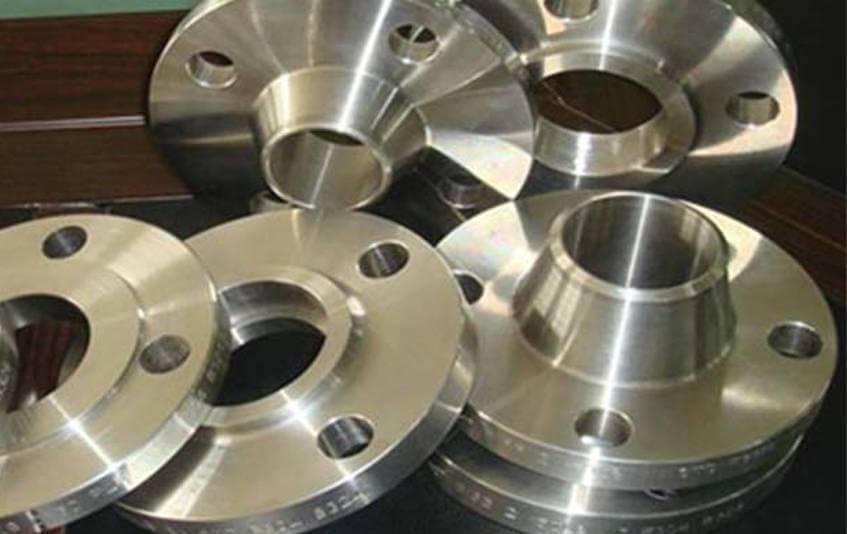
Monel 400 Flanges are manufactured from a nickel-copper alloy, roughly 63-70% nickel and 28-34% copper. That composition is what makes them suitable for continuous seawater service, where other materials need frequent replacement.
Why Marine Environments Demand High-Performance Flanges
Carbon steel flanges in seawater corrode at 0.1 to 0.5 mm per year under moderate conditions. Near dissimilar metal connections or high-velocity flow zones, that rate climbs. At those numbers, you are looking at replacement within three to five years, plus the downtime, inspection costs, and recommissioning that come with each replacement.
Monel 400 flanges carry tensile strength from 480 to 690 MPa, yield strength around 170 MPa minimum, and 35% elongation. Those figures hold up under the cyclic loading patterns that come with wave-influenced offshore pipework. The alloy also handles operating pressures across the range used in shipboard and offshore systems without significant strength reduction over long service periods.
What Makes Monel 400 Flanges Ideal for Marine Applications
Corrosion Resistance in Seawater
Corrosion rates in flowing seawater sit under 0.025 mm per year at moderate velocities. A nickel-copper oxide film forms on the surface and stays stable in chloride-rich media rather than breaking down. Up to 480°C steam temperatures, the alloy holds that resistance without sensitisation or phase transformation.
High Mechanical Strength
Offshore and shipboard systems run continuously for five to ten years between planned shutdowns. The alloy does not show significant strength reduction over those periods, which matters more than short-term load ratings for systems that stay pressurised around the clock.
Resistance to Biofouling
Barnacles, mussels, and microbial biofilm create differential aeration cells where they attach. On iron-based alloys, this produces pitting and undercutting corrosion beneath the attachment points. Monel 400’s surface chemistry reduces initial attachment and limits that kind of degradation. Not eliminated, but measurably reduced compared to carbon steel or standard stainless.
Long-Term Cost Efficiency
Carbon steel flanges in offshore seawater service typically need replacement within three to five years. Monel 400 flanges regularly reach service lives above twenty years in the same conditions. The cost difference at purchase narrows quickly once you account for shutdown time and replacement cycles over a ten or fifteen-year project life.
Common Marine Applications of Monel 400 Flanges
Shipbuilding: It is used in seawater ballast, bilge, and fire main pipework where saltwater contact runs continuously.
Offshore oil and gas: Found in seawater injection and produced water handling on topside and subsea piping systems.
Desalination plants: It is commonly applied in reverse osmosis and multi-stage flash units use them at high-salinity concentrate lines where brine concentration exceeds open seawater values.
Heat exchangers: They are used for flanged connections on tube-and-shell units handling seawater coolant, where erosion-corrosion at higher flow velocities is a concern.
Seawater cooling systems: The flanges are seen in pump inlets, strainer connections, and heat exchanger nozzles in power generation and industrial cooling loops.
Chemical transport vessels: They are mostly found in isolation and interconnection duty on bulk carriers handling corrosive cargo or seawater ballast near cargo tanks.
Importance of Choosing a Reliable Monel 400 Flanges Supplier
Material certification matters here. Flanges need mill test certificates traceable to the specific heat of alloy used, with chemical composition and mechanical property verification against ASTM B564 or equivalent. Without that documentation, there is no way to confirm what is actually going into the system.
Flange type availability is practical, too. Slip-on, weld neck, blind, socket weld, and lap joint configurations serve different assembly requirements. A supplier with limited stock creates substitution decisions that affect system design. Sealing face precision, whether raised face or ring-type joint, has to fall within ASME B16.5 or MSS SP-44 tolerances. Outside those tolerances, leak problems show up under pressure.
For offshore and shipbuilding projects, delivery reliability carries real weight. Material delays on those contracts translate directly into financial penalties. Suppliers like Pragati Metal Corporation, with over four decades of manufacturing and export experience across nickel alloys, including Monel, carry the documentation trail, size range, and export capability that these project specifications require.
Conclusion
Monel 400 Flanges possess corrosion resistance, mechanical strength, and dimensional stability under the conditions that are consistently produced by marine environments. Seawater immersion, chloride attack, high-temperature steam, and biological fouling all attack the alloy at rates that are not seen for conventional flange materials. The service life justifies the up-front cost for offshore platforms, desalination infrastructure, and shipboard systems that cannot absorb unplanned maintenance windows. Monel 400 Flanges Supplier is a qualified contact for material certifications, available specifications, and lead times for your project.