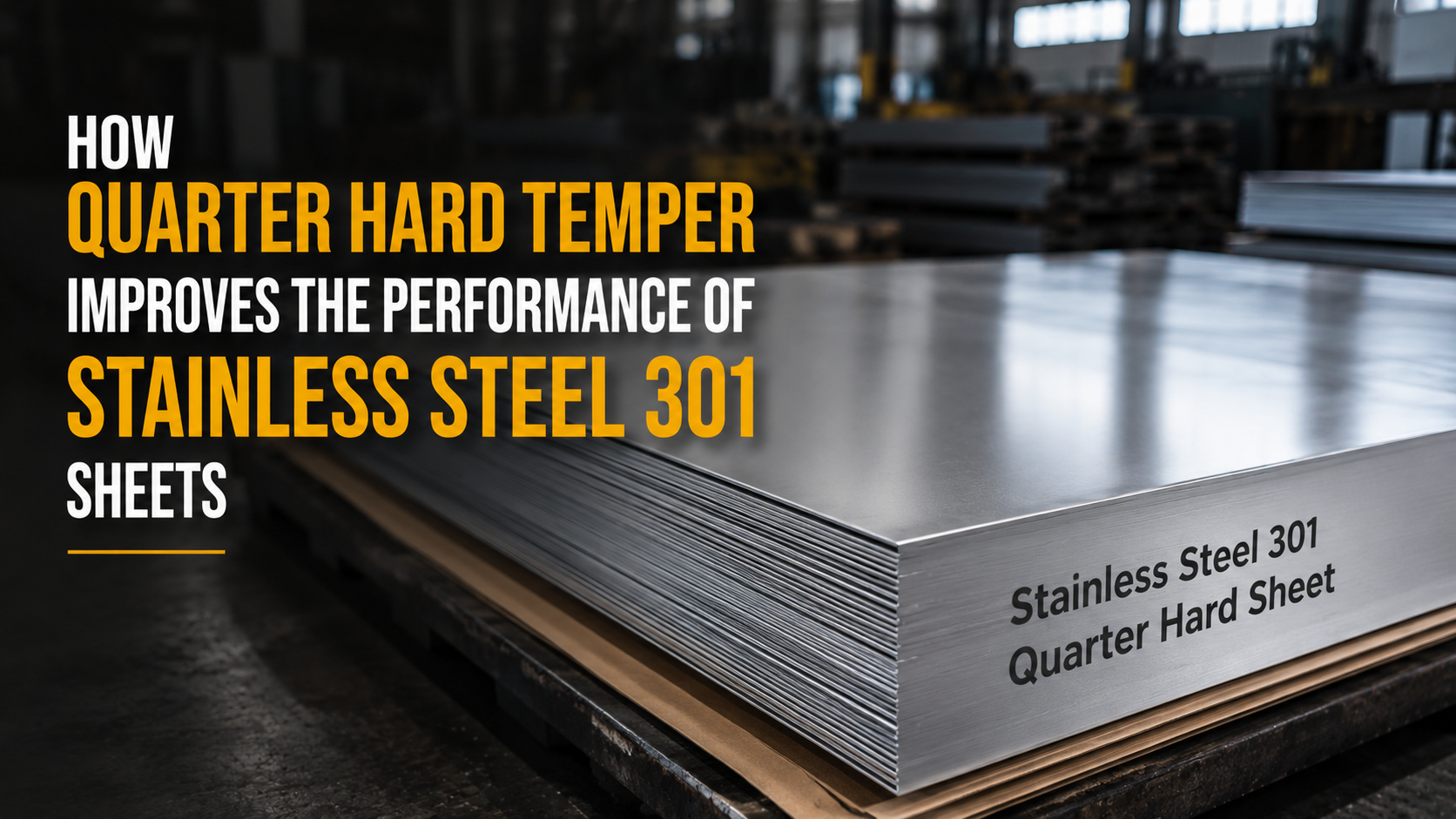
Stainless steel 301 is a highly adaptable alloy. The temper dictates how the material behaves during fabrication. Buyers look for a reliable SS 301 quarter hard sheet supplier because this temper offers a practical balance of strength and workability. A Stainless Steel 301 Quarter Hard Sheet undergoes controlled cold rolling. This increases mechanical properties without losing ductility. Industrial users rely on this material for parts requiring moderate forming and high durability under stress.
What Is Quarter Hard Temper in Stainless Steel 301 Sheets?
Mills produce the quarter hard condition through cold rolling. Steel passes through rollers at room temperature. This mechanical pressure alters the grain structure. The material gets stronger as it thins. The quarter hard state reaches 125,000 psi minimum tensile strength.
Annealed 301 is fully bendable and lacks cold rolling. The quarter hard version is noticeably stiffer. It resists deformation under load better than annealed metal. You get higher structural integrity while keeping formability for basic bending operations. Cold reduction dictates the final hardness level. Factory engineers calculate these rolling passes carefully.
Chemical Composition and Base Characteristics of Stainless Steel 301
The chemical makeup of grade 301 determines baseline behavior. It contains 16 to 18 % chromium, and the nickel content sits between 6 and 8 %. This lower nickel ratio causes the alloy to harden rapidly during mechanical processing.
Chromium provides standard corrosion resistance for most indoor and mild outdoor environments. The rapid work hardening rate allows mills to achieve high strength levels with minimal cold reduction. Heavy fabrication sometimes requires sourcing from a stainless steel 301 HR quarter hard plates supplier when thicker base profiles are needed. The chemistry supports significant strength gains safely.
Key Mechanical Improvements Offered by Quarter Hard Temper
Cold rolling fundamentally alters the baseline properties of the alloy. The quarter hard condition delivers specific mechanical upgrades over the soft annealed state for industry.
Increased Tensile Strength
The material reaches a minimum tensile strength of 125,000 psi. This allows fabricators to use thinner sheets for structural components. The overall weight drops while maintaining the required load capacity.
Higher Yield Strength
Yield strength defines the point of permanent deformation. The quarter hard condition sets the yield minimum at 75,000 psi. Parts hold their original shape under heavier mechanical stress profiles.
Better Wear Resistance
The surface hardness increases alongside the core strength. This physical density resists scratching and degradation. Moving parts made from this temper experience less friction damage during repetitive mechanical cycles.
Improved Fatigue Performance
Components face repetitive stress over time. The hardened structure resists microscopic cracking better than soft steel. This structural stability extends the working lifespan of parts subjected to mechanical vibrations.
How Quarter Hard Temper Improves Formability and Fabrication Efficiency
The quarter hard condition retains enough ductility for moderate industrial stamping. It cuts cleanly in the press without excessive tool wear. Fabricators can perform mild bending operations effectively. The metal requires larger bend radii than annealed sheets to prevent cracking at the sharp corners.
The added stiffness prevents warping during fabrication. Stamped parts hold tight geometric tolerances. The material does not twist unpredictably when removed from the forming equipment. This physical consistency directly lowers the rejection rate on the factory floor. Working with a reliable 301 quarter hard stainless steel sheet stockist ensures uniform batches.
Corrosion Resistance and Long-Term Durability Benefits
The chromium layer protects the surface against atmospheric corrosion. The quarter hard condition performs reliably in standard industrial environments exposed to moisture. It resists rusting without protective coatings.
This bare metal resilience delivers maintenance advantages. Facilities spend less time treating or painting components. The hardened surface prevents contaminants from embedding into the structure. Long term durability lowers replacement costs.
Comparison of Annealed, Quarter Hard, Half Hard, and Full Hard SS 301 Sheets
Annealed 301 provides maximum formability with the lowest base strength. Quarter hard introduces moderate strength while allowing standard bending. Half hard increases strength but restricts forming to simple bends. Full hard maximizes tensile strength for flat springs but becomes brittle.
Buyers match temper to their exact strength requirements. Quarter hard hits the middle ground for structural applications. Selecting the right condition prevents forming failures. A direct stainless steel 301 sheets manufacturer can guide this selection process based on shop drawings.
Industrial Applications of SS 301 Quarter Hard Sheets
Engineers specify this material for parts needing a balance of rigidity and minor shaping. The alloy appears frequently across several heavy manufacturing sectors right now.
Automotive Industry
Manufacturers use this temper for structural brackets and wheel covers. The material withstands road vibrations and resists metal fatigue. Automotive engineers rely on the steady strength to weight ratio.
Electrical Components
The metal serves as contact parts and heavy duty switchgear springs. It holds its shape under physical pressure. Electrical enclosures utilize the material for rigid framework and support structures.
Industrial Equipment
Conveyor system parts and heavy machinery guards require stiff materials. The quarter hard condition absorbs minor impacts without denting. Maintenance teams install these sheets in high traffic factory zones.
Architectural Components
Builders install exterior brackets and roof drainage supports made from this steel. The metal supports heavy environmental loads. It resists bending under the weight of accumulated snow or ice.
Why Buyers Choose ASTM A240 SS 301 Quarter Hard Sheets
Sourcing metal certified to ASTM A240 ensures strict standard compliance. This specification dictates exact chemical limits and mechanical testing for the steel. Buyers receive consistent quality across different mill batches.
This uniformity guarantees reliable performance on the fabrication floor. Machines do not need constant recalibration. Industrial procurement teams mandate this certification to eliminate material guesswork. When sourcing globally, partnering with an ASTM A240 SS 301 sheet exporter ensures international shipments meet these rigid standards.
Selecting the Right SS 301 Quarter Hard Sheet Supplier
Finding a capable supplier impacts production schedules and final product quality. Buyers must verify mill certification and current stock availability before placing large orders. A reliable vendor provides exact test reports tracing back to the original heat batch.
Proper vendor technical support resolves forming questions early in the planning phase. Good suppliers manage logistics effectively to prevent factory downtime. Industrial buyers focus on long term partnerships rather than just spot purchasing. This ensures stable material pricing over time.
Conclusion
Quarter hard 301 steel delivers a practical mix of strength and moderate formability. It handles demanding environments and constant mechanical stress. Industrial projects rely on these structural characteristics. Partnering with a verified supplier ensures you receive certified metal ready for immediate fabrication. Panchdeep Metal operates as a reliable source for these industrial materials.