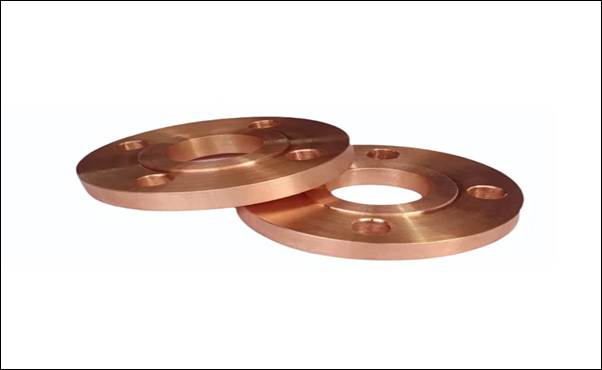
Copper flanges have been a staple in industrial piping for a long time, and for good reason. They connect pipes, valves, pumps, and other equipment while allowing the joint to be opened later for maintenance without cutting anything apart. Marine, HVAC, chemical, and power generation projects all use them regularly. The copper material holds up in conditions that corrode lesser alternatives, which is why high quality copper flanges stay in demand across project types. Picking the right Copper Flange is not just a matter of finding one that fits the pipe diameter.
What is a Copper Flange?
A copper fitting is a disc or ring fitting attached to a pipe end or equipment outlet. Two flanges bolt together to form a joint that can be undone without damaging the pipe, which matters in systems that need periodic inspection or component swaps.
Industrial Copper Flanges get specified where thermal performance and corrosion resistance both need to be addressed. Copper alloys stay stable in seawater lines, chemical transfer systems, and high-temperature fluid circuits longer than most alternatives. The flange also spreads the load at the connection point, so stress does not concentrate in one spot.
Key Properties of Copper Flanges
- Excellent corrosion resistance
In seawater and brackish water, copper alloys hold their integrity far better than carbon steel or standard stainless grades.
- High thermal and electrical conductivity
Heat moves through copper efficiently. In systems where the joint sits inside a thermal circuit, this is a real functional benefit.
- Good machinability and formability
Getting tight tolerances on a copper flange face is not difficult. Machining shops handle it with standard equipment, which keeps costs and lead times reasonable.
- Strong resistance to biofouling and seawater corrosion
Copper disrupts biological growth on contact surfaces. In marine and water treatment systems, less fouling means more stable flow over time.
- Long service life
A correctly installed copper flange in the right application lasts decades. Replacement intervals stretch out considerably.
Common Types of Industrial Copper Flanges
The type matters as much as the material. Each suits different pressure ratings, space constraints, and maintenance patterns.
- Slip-On Copper Flanges
These slide over the pipe and are welded at the face and back. Alignment is flexible during fitting. These work in low-pressure systems where the joint does not face significant mechanical stress.
- Weld Neck Copper Flanges
Butt-welded through a tapered hub. Stress transfers into the pipe body rather than concentrating at the weld. The right pick for high-pressure, high-temperature lines.
- Blind Copper Flanges
These don’t have a bore, just a solid plate closing off a pipe end or vessel nozzle. Standard for pressure testing and section isolation.
- Socket Weld Copper Flanges: Pipe end drops into a recessed socket, fillet-welded at the hub. Good for small-bore, high-pressure lines in confined spaces.
- Threaded Copper Flanges
These are threaded onto the pipe. No welding is involved. Useful where hot work is restricted, or welding access is simply not practical.
- Lap Joint Copper Flanges
This type works with a stub end fitting. The flange body rotates freely around the pipe, so bolt-hole alignment is straightforward. A sensible pick for systems dismantled and reassembled regularly.
Factors to Consider When Choosing the Right Copper Flange
- Pressure and temperature requirements
Flanges carry class ratings like 150 through 2500 under ASME, each with defined pressure limits at specific temperatures. Confirm the class suits actual operating conditions and leave room for surges.
- Pipe size and compatibility
Bore, bolt circle, and facing type all need to match the pipe and connected equipment. A dimensional mismatch does not show up until installation, and by then it causes real delays.
- Corrosion resistance needs
Different copper alloys behave differently in aggressive media. What works in a freshwater HVAC circuit may not suit a seawater cooling line. Check the media first.
- Application industry
HVAC systems lean on thermal efficiency. Marine work demands seawater resistance above most other considerations. Chemical processing needs alloy-media compatibility verified for each fluid. Water treatment benefits from copper’s antimicrobial behaviour. Power generation often deals with elevated temperatures that narrow material choices considerably.
- Installation and maintenance requirements
Some flanges behave differently in tight equipment rooms. Others cannot be repeatedly disassembled without degrading the joint. Think about access and maintenance frequency before committing to a type.
Applications of Copper Flanges
- Plumbing systems
Hot and cold distribution lines use copper flanges where durability and corrosion resistance matter over a long service life.
- HVAC and refrigeration
Copper handles thermal cycling without losing seal integrity, the way softer materials might.
- Marine and shipbuilding
Seawater cooling circuits and ballast systems regularly specify copper alloy flanges due to seawater resistance.
- Desalination plants
High-pressure saltwater environments are tough on most materials. Copper alloys are a standard choice in these facilities.
- Electrical and thermal systems
Where heat transfer at the joint is part of the system design, copper’s conductivity is a hard requirement.
- Industrial process piping
Refineries and chemical plants use copper flanges on lines where other alloys corrode out of service too quickly.
Benefits of Using Copper Flanges
- Reliable leak-proof connections
Copper machines are flat enough to seat gaskets properly. A well-installed copper flange joint does not leak under pressure.
- Excellent durability
The alloy holds up in corrosive conditions over a long time, and life cycle costs stay lower than materials needing more frequent replacement.
- Easy fabrication and installation
Standard tooling handles copper without special setups, keeping costs predictable.
- Low maintenance requirements
Periodic checks rather than active upkeep once in service.
- Good resistance to corrosion and scaling
Scale and biofilm take longer to develop on copper. Flow rates stay more consistent over the years.
Standards and Specifications
Copper flanges are made to ANSI/ASME B16.5 for dimensional and pressure-temperature requirements. ASTM B61 and B62 cover material specifications for steam bronze and composition bronze. European and international contracts often specify DIN or EN standards instead. Class ratings run from 150 to 2500 under ASME, each tied to a pressure limit that drops as temperature rises. Check that the supplied flanges match the standard your project documents specify. Not all suppliers are consistent about this.
Selecting High-Quality Copper Flanges
Material test certificates come first. Composition and mechanical properties need to be on paper. Copper alloy grades are not interchangeable, and the certificate is the only way to verify what was actually supplied.
Check dimensions against the relevant standard. Out-of-tolerance flange faces cause gasket failures and rework. Compliance with ASME, ASTM, or DIN/EN needs documentation. A supplier claiming compliance without paperwork is not useful on an audited project. On critical systems, ask for full traceability from raw material through to finished component. Third-party hydrostatic test reports are worth requesting on high-pressure orders. The cost is small relative to the cost of a joint failure in service.
Conclusion
Getting the right Copper Flange for an application comes down to type selection, alloy specification, and verifying that what gets supplied matches what was ordered. Industrial Copper Flanges hold up well in tough conditions, but only when the correct type and grade are chosen for the specific application. Skipping certification checks or overlooking dimensional tolerances creates problems that are expensive to fix mid-project. Source from suppliers who document what they supply and back it with test records.