Introduction
Food choices can reveal much about a consumer’s behavior. Where people eat and how much they spend on food both mirror lifestyle and economic changes. Traditional financial reporting alone cannot keep pace with the rapid price fluctuations in the market, so investment companies are now relying on food data scraping to obtain consumer food information.
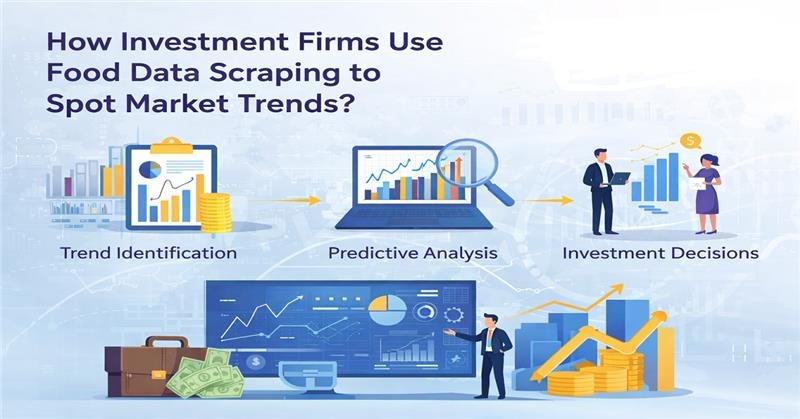
Investors use food data scraping to collect large quantities of publicly available online information about food by reviewing restaurant menus, delivery apps, grocery websites, food product reviews, and analyzing food companies on social media. Information obtained through food data scraping provides investors with early insight into changing consumer food habits. An example of this would be the increase in plant-based menu items, which could indicate the potential for growth for alternative protein companies.
Since food is frequently updated (often daily), there are opportunities to spot trends earlier than competitors. Further, food information supports previous views of investors within various food-related industries, such as restaurants, packaged products, agriculture, and food technology. Having access to real-time data allows investors to be more competitive in the marketplace. By scraping consumer food data, investment companies can generate actionable insights into consumer purchasing behaviour, thereby increasing their ability to understand the market and make informed investment decisions quickly.
What Is Food Data Scraping and How Does It Work?
Automated food data scraping collects food-related data from multiple online sources (e.g., e-commerce websites, delivery platforms) and structures it into a format that analysts can study. Bots or crawlers gather food data in bulk from these sources, obtaining information such as menu prices, ingredients, portion sizes, discounts, delivery times, and customer reviews. Analysts or AI tools then clean and analyze the scraped data.
For instance, using food data scraping to extract menus from thousands of restaurants in major metropolitan areas allows for an appraisal of food prices across different cities, revealing price trends, popular cuisines, and emerging dietary preferences, such as a rise in vegetarian options. Besides that, using a grocery store’s product data allows investors to evaluate the stability of the food supply chain and inflation.
Legal standards apply to all reputable companies that collect data through scraping; for example, those that scrape food-related data. No company would violate anyone’s Consumer Rights by scraping food data, as long as they conduct their business in accordance with the laws governing data collection.
Every company scraping food data does so with consumers’ interests in mind; therefore, they prioritize consumers’ privacy and data rights and only use publicly available information, considering consumers’ feelings on this matter to be irrelevant. Ultimately, companies’ scraping of food data aims to create datasets that enable business owners to forecast food trends and evaluate risks, helping them invest in and launch food-related businesses.
Identifying Consumer Trends Through Food Data
Food data scraping is an essential tool for investment firms to identify emerging consumer trends early and respond quickly to changes in consumer demand that may indicate a potential shift in their financial performance. Through data scraping, investment firms can track consumer behaviour in near real time; for example, if demand for gluten-free or vegan food continues to increase, this may be evidence of consumers’ rising awareness and interest in their health and wellness.
Similarly, if premium food and beverage items are becoming increasingly popular in specific geographic regions, it may indicate that those consumers have more disposable income. Conversely, if restaurant foot traffic is decreasing, it may suggest that consumers are currently facing financial difficulties.
Investment firms will also monitor consumer behaviour based on the types of cuisines they eat, how price-sensitive consumers are regarding food products, the sizes of the portions they eat, and where they source their ingredients. By monitoring these data points by region, investment firms can predict which food brands and restaurant chains will continue to succeed.
Investment firms are also interested in food delivery data. When food delivery sales on online platforms increase, it can signal lifestyle changes due to greater urbanization and/or less time to prepare meals. Food delivery sales data can provide investors with insights into food delivery platforms and companies that support them.
By developing trend signals from raw food data, investment firms can access information about consumer behaviours before those behaviours are proven in traditional market reports.
Using Food Data to Evaluate Companies and Industries
The role food data scraping plays in evaluating company/industry performance is significant for investment firms looking to understand “real-world” operating performance, rather than relying solely on what the company provides.
For example, by scraping restaurant reviews and ratings, an investor can gain insight into brand perception and customer satisfaction. In many cases, when ratings consistently decline, it may indicate operational issues. Conversely, in the restaurant industry, if a company is rapidly expanding its menu or raising prices, demand is likely strong and/or growing.
In the grocery sector, by tracking the availability and pricing of products, investors can gauge how well the supply chain is functioning. For example, if a brand has frequent out-of-stock products, it may indicate that production is unable to meet demand or that demand is increasing unexpectedly.
Food data also provides insight into how competitors compare. Investors can analyze how different brands price their products in the same category, introduce new products, and/or respond to trends. This information is valuable when determining how to allocate their capital.
Additionally, food data scraping enables more accurate assessments of a company’s market position during the due diligence phase of mergers and acquisitions, providing investors with a clearer perspective on the company’s market position rather than relying on outdated or incomplete data.
Predicting Market Movements and Reducing Risk
Investment firms share the same core goal of predicting where markets will move; therefore, food data scraping is extremely helpful in helping them achieve it. Because of its close connection to the economy, food spending and food data reflect broader economic trends when those data change.
For example, rising prices for staple food items may suggest inflationary markets. An increase in demand for discounted meals or private-label grocery products signals a downturn in consumer confidence. Thus, the evidence investment firms can gather from trends in this data is used to inform adjustments to portfolio strategies.
Food data also plays a vital role in the firm’s risk management. By regularly monitoring food trends across regions, firms can identify impacted areas due to supply chain disruptions, labour shortages, or changes in laws/regulations, and thus reduce their investment exposure in markets that could be vulnerable.
Firms also study the impact of subsequent seasonal trends (e.g., increases in beverage sales during summer months or in demand for comfort foods during winter months) on anticipated revenue cycles. Food data, when combined with other sources of alternative data, enables higher predictive accuracy.
Future of Food Data Scraping in Investment Strategies
Investment firms will increasingly use information scraped from food-related data to develop more advanced investment strategies, enabled by rapid advances in data collection, analysis, and interpretation. Scraped data, when combined with alternative sources such as mobility data, social media activity and trends, and economic indicators, will enable investment firms to gain a more comprehensive view of the market by integrating a wide variety of information.
Sustainability and ethical consumption practices will become increasingly important as consumer expectations for transparency in how their food is produced and its source grow. Tracking sustainability and ethical consumption practices will allow investment firms to determine which companies and products align with consumers’ long-term values.
Compliance with regulatory requirements will remain a priority for investment firms, so they need to be responsible in their use of data. Responsible data use will allow investment firms to build trust while minimizing legal risks.
Conclusion
By using food data scraping, investment firms have gained a new way to analyze and understand both the market and consumer behaviour across many sources in real time, including restaurant, grocery store, and food delivery service websites. By using this data from the comfort of their own offices, these firms can now identify new customer buying trends much sooner and evaluate companies with greater accuracy, thereby reducing their overall market risk. As the need for alternative sources of information to guide financial decisions becomes more prevalent, food data scraping will continue to provide valuable insights into food-related investing. As more companies rely on alternative data, those that effectively use food data scraping will better predict changes. This will help them stay competitive and make informed investment decisions.