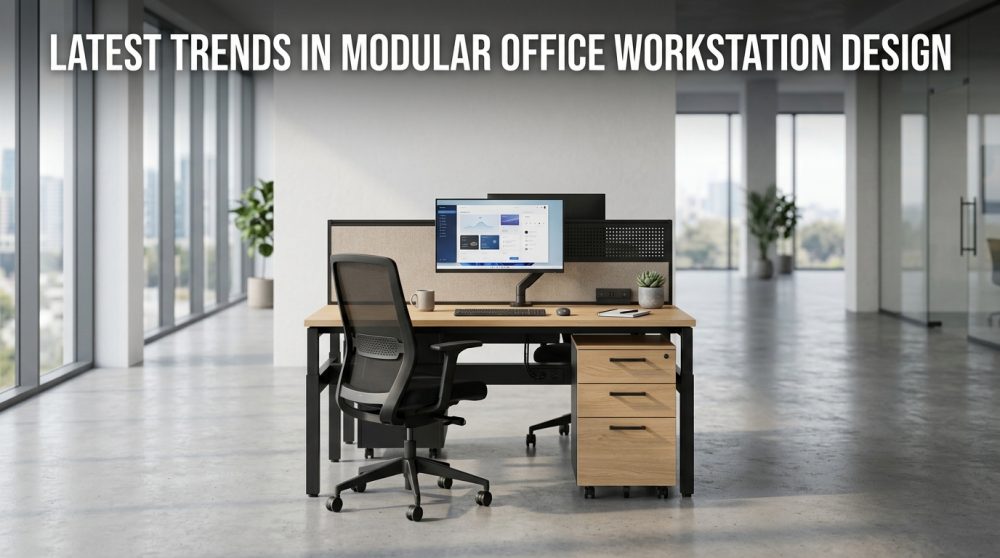
Office layouts are in constant flux. Teams grow, shrink, move to hybrid work, and then adjust again. In Mumbai and across the wider Western Zone, facilities managers are dealing with the same reality. The real issue is choosing furniture that will still be functional five years from now. The article outlines what modular office workstation design looks like in 2026, which materials are worth focusing on, and what you should expect from a well-designed system over a ten- to fifteen-year commercial life.
The Evolution of the Modern Workspace
What Defines a Modular Office Workstation Today?
A modular workstation is a set of independent components that bolt together rather than a single fixed unit. Steel leg frames, utility beams, work surfaces, and clip-on acoustic screens are the core parts. You can take one apart without disturbing the desk next to it.
What’s changed in recent years is the weight and bulk of those parts. Older systems relied on thick wooden side panels to create structure. Current options use aluminium alloy extrusions and slim steel brackets instead. The desk surface is supported without bulk on the sides, which opens up the floor space underneath considerably.
Surface finishes have also improved. High-pressure laminates with impact-resistant ABS edges are the standard specification for commercial use. The ABS edge is the important part: it prevents chipping when desks are moved and reconfigured, which happens more often than most procurement teams expect.
Adapting to Hybrid Work: The Demand for Flexibility
Most corporate offices no longer have a predictable headcount on any given day. A floor that seats sixty people might see thirty on Monday and fifty-five on Thursday. The furniture has to work for whoever sits down.
Benching systems address this directly. They use shared structural legs between adjacent desk positions, which reduces the number of metal parts on the floor and opens up the path space underneath the run. Fewer parts also means a lower cost per seat when you’re fitting out a large floor.
The real value is reconfiguration. A well-specified modular system lets facilities teams unbolt and relocate individual desks or full rows without any specialist tools and without affecting the workstations around them.
Key Design Trends Shaping 2026
Collaborative Zones and Agile Setups
Workstations are no longer planned purely for solo work. The desks at the end of a run now often use curved or semi-circular surfaces so that team members can gather with laptops without blocking the main office aisles. Central media hubs and shared project tables connect directly into the workstation cluster, which cuts down the time people spend moving between areas.
Screen materials on acoustic dividers have expanded beyond standard fabric. Pinnable fabric panels, magnetic whiteboards, and lightweight core boards are all available within the same system. A team can choose the combination that matches how they actually work.
Ergonomics at the Forefront
Sit-stand desks are now a default feature in most commercial offices rather than a luxury upgrade. Their electric or counterbalanced mechanisms are housed within telescopic steel legs, keeping the work surface free of visible hardware. To get desk height right, you need to plan around the chairs that will be used, selecting seating and desk models together. Ergonomic modular workstations and chair ranges, including those from MillerKnoll, specify the clearances the desk must allow. Textured, anti-glare laminates reduce reflections from strong overhead lighting, and monitor arms fixed through standard grommet holes let users adjust screen distance, height, and tilt independently.
Biophilic Design Integration
Steel planter boxes are now available as add-on accessories that attach at the end of desk runs or on top of storage units. Surface finishes include natural wood veneers, timber-grain laminates, and matte textures. These replace the solid white and grey plastic-looking finishes that defined commercial workstations for the previous decade.
The shift isn’t about aesthetics alone. Offices that use natural-looking materials alongside plants and daylight access tend to have lower reported fatigue levels among staff.
Sustainable Materials and Practices
Workstation substrates use particle board and medium-density fibreboard rated E0 or E1 for low formaldehyde emissions. If you’re specifying for a LEED or GRIHA-rated project, the substrate rating is one of the first material points your certifier will check.
Acoustic tiles are manufactured from recycled PET felt, derived from post-consumer plastic bottles. Metal parts use powder coating rather than solvent-based paint, which removes volatile organic compounds from the process entirely.
Technology Integration
The structural beam under the desk does more than hold the surface up. It acts as an enclosed raceway that keeps power lines separated from data cables. Desk surfaces have flush-mounted flip boxes that give access to power sockets, USB-C ports, and HDMI connections without any loose hardware sitting on the surface.
Vertical cable channels run from the floor box up into the beam, so there are no trailing cords between the floor and the desk. Under-desk brackets hold small form factor CPUs or docking stations off the floor, which protects them from dust and makes cable management significantly cleaner.
Benefits of Embracing Modern Modular Workstations
Enhanced Productivity and Efficiency
Integrated cable routing keeps the work surface clear. Users get more usable desk area for their actual work rather than managing cables around equipment. Proper desk height and correct screen placement help people stay focused for longer without physical discomfort building up over the course of the day.
Improved Employee Well-being and Satisfaction
PET felt acoustic screens absorb ambient office sound. In an open-plan floor with hard ceilings and surfaces, background noise is one of the most consistent complaints from staff. These panels don’t eliminate noise but they reduce it to a workable level.
Adjustable sit-stand mechanisms allow employees to change their posture throughout the day. Static muscle loading from sitting in one position for seven or eight hours is a well-documented cause of back strain. The ability to stand for periods, even briefly, reduces that load.
Cost-Effectiveness and Future-Proofing
If a single component is damaged during a reconfiguration, you replace that part. You don’t replace the cluster. Steel frames and high-pressure laminate surfaces withstand frequent dismantling without degrading, so the asset holds its value during relocations. Shared leg configurations require fewer total parts, which brings down the initial procurement cost per seat on large floor plans.
Choosing the Right Modular Workstation System
Customisation and Scalability for Diverse Needs
A good system uses a uniform structural beam but accepts different leg styles, screen heights, and storage accessories. That consistency across the beam standard is what makes the system genuinely scalable: you can add to it years later without having to change the core infrastructure.
Different roles need different configurations. Engineering and technical teams typically need wider surfaces for multiple monitors. Administrative roles need more under-desk filing space. A system that accommodates both without requiring separate product families is worth specifying.
Partnering with Expert Suppliers
The Workrite team works with corporate buyers across the Western Zone to match specific material codes to local project requirements, including delivery schedules, site preparation, and on-site assembly.
Before specifying any system, Workrite evaluates the structural engineering and weight capacities of the brands they distribute against the client’s long-term floor plan. Not every international brand is suited to Indian commercial conditions, and that assessment is part of the service.
Conclusion
Selecting materials and structural layouts for modular workstations depends on how durable they are. The current direction in commercial office design, towards flexible configurations, ergonomic support, and low-emission sustainable components, gives facilities managers a clearer set of specifications to work from than was available even five years ago.
Workrite’s team can assist with matching specific system requirements to your floor plan. Contact us to arrange a showroom visit or a site assessment across the Western Zone.