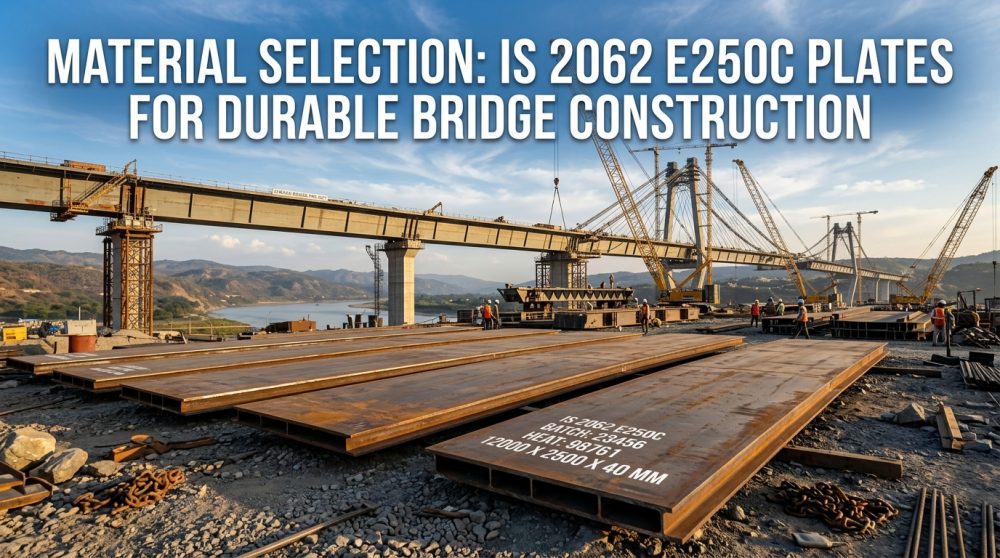
Bridge construction requires structural steel that handles constant stress, traffic loads, and outdoor weather exposure. Material selection directly affects the lifespan and structural safety of these projects. Triton Alloys supplies steel plates to industries including refineries, mining, railways, power plants, cement, defense, and constructions. For major bridge structures, IS 2062 E250C plates are chosen by project engineers. These structural plates possess precise mechanical traits needed to manage moving loads. An incorrect steel specification leads to cracking or high maintenance costs. This overview covers why this specific grade works for heavy infrastructure frameworks.
Understanding IS 2062 E250C Plates
IS 2062 is the Bureau of Indian Standards specification for hot rolled structural steel. The E250C designation tells fabricators the exact mechanical limits and quality tier. The letter E means structural steel. The number 250 marks the minimum yield strength required, measured in Newtons per square millimeter. The C suffix points to a specific quality classification concerning impact testing performance and steel killing methods, separating it from grades A or B. This grade is produced as fully killed steel. Fully killed means the steel undergoes thorough deoxidation during production. This step leaves the metal with a uniform grain structure, minimizing internal defects and creating uniform strength across the plate thickness.
The mechanical performance determines how these plates perform under heavy weight. The material properties must hit specific minimum baselines to maintain safety.
- Yield Strength: 250 N/mm² min
- Tensile Strength: 410 N/mm² min
- Elongation: 23% min
Yield strength is the point at which steel will begin to permanently deform under load. Ultimate tensile strength is the maximum stress the plate can take before it breaks apart. The elongation is not less than twenty-three percent. High elongation means that material still has good ductility. This structural flexibility lets the bridge parts bend slightly under traffic loads without fracturing suddenly.
The Chemical Composition Advantage
The physical limits are defined by the chemical layout of IS 2062 E250C plates. The elements are controlled so that the plate is easy to cut and weld, but strong. This grade limits the carbon content to a low maximum, because a high carbon percentage makes steel hard but brittle, which ruins weld quality. Manganese is added to improve hardness and tensile strength without encouraging cracking. Silicon is used to deoxidize during refining. Impurities such as phosphorus and sulfur reduce impact resistance, and therefore their levels are kept low. Looking at the exact values of the standards, carbon is limited to a maximum of 0.20 percent while manganese is capped at a maximum of 1.50 percent. Both sulfur and phosphorus are tightly limited to a maximum of 0.040 percent each to protect structural toughness. Silicon is kept to a maximum of 0.40 percent to manage the deoxidation process cleanly. Finally, the total carbon equivalent is limited to a maximum of 0.39%. This is a standard formula which assesses weldability by combining carbon, manganese and other micro-alloys, and is called the carbon equivalent value. The carbon equivalent is limited to 0.39 maximum to avoid cold cracking during welding. This chemical balance ensures that workshop teams handle fabrication easily without needing complex preheating steps on the shop floor.
Fabrication and Performance Benefits for Bridges
Excellent Weldability
The low carbon limits and the carbon equivalent fixed at 0.39 max mean these plates are easy to weld. Bridge construction requires joining thick plates to form deep beams. This steel grade can be welded with standard workshop tools without creating brittle zones next to the weld lines. It minimizes the need for long preheating or post weld heat treatments, which keeps fabrication work moving quickly.
Suitability for Heavy Load Structures
Bridges are heavily loaded, statically and dynamically, by freight traffic, passenger cars, and the dead weight of the structure itself. These plates have a minimum yield strength of 250 N/mm2 and are well-suited for wide spans. The steel keeps its shape under persistent downward pressure. This performance helps when building heavy plate girders that must stay straight for decades.
Corrosion Resistance
Bridge infrastructure sits out in rain, high humidity, and river environments. Even though this is standard structural steel rather than stainless steel, the controlled chemistry gives it basic resistance against outdoor rusting compared to basic commercial carbon steels. The uniform grain from the fully killed production process helps slow down deep rust pitting, preserving the steel thickness in wet settings.
Durability and Longevity
Bridges are subject to constant vibration, strong winds and seasonal temperature variations. This material grade has good impact absorption, which makes it resistant to metal fatigue from millions of traffic cycles. The minimum of twenty-three per cent elongation means that stress points do not become sudden breaks. This longevity ensures that the asset can continue to operate safely for its designed life, with reduced downtime for maintenance.
Applications in Bridge Construction
The metal is used in modern transport infrastructure for primary load-bearing segments. Structural fabricators use these plates to fabricate main girders, box sections, and cross girders to support the main concrete deck. They are used in railway bridges, highway flyovers, and large pedestrian walkways. The plates are also cut down to make splice plates, heavy gussets, and connection brackets that bind large structural frames together. The steel handles the high shear stresses found in heavy freight lines and urban highway systems.
Conclusion: The Preferred Choice for Reliability and Strength in Bridges
Selection of steel for public infrastructure requires a balance between strength measures, welding behavior and raw material costs. These practical field needs for bridge builders are met by IS 2062 E250C plates.A minimum yield strength of 250 N/mm² alongside twenty-three percent minimum elongation gives the mechanical support needed to handle continuous transportation traffic. The controlled carbon and manganese levels mean the steel stays simple to weld and form into large girders without structural cracking. Triton Alloys distributes these plates to construction contractors, engineering firms, and fabricators globally. Selecting this specific standard grade helps ensure that completed bridges remain secure, upright, and stable for decades of daily service.