There is a moment every crash game player knows. The multiplier ticks past 2x. Then 5x. Then 10x. Your finger hovers over the cashout button, heart rate climbing with every decimal, and somewhere between rational thinking and raw instinct, you make your call. That split-second decision, hold or fold, is what makes crash games one of the most psychologically intense formats in online gaming. The game looks simple: a curve rises, you cashout before it crashes, and you walk away with your multiplied stake. But simplicity is part of the trap. Underneath that rising line sits a web of psychological triggers so powerful that players return round after round, convinced that this time they will read the curve perfectly.
The Crash is Coming!
Crash games are built on a simple loop: the curve rises, tension builds, and your brain convinces you that this time you will read it right. Dopamine, near-misses, and live social pressure keep players locked in round after round. Understanding the psychology behind it is the only real edge you have.
Why Does Your Brain Get Hooked on the Crash Curve?
The Dopamine Loop
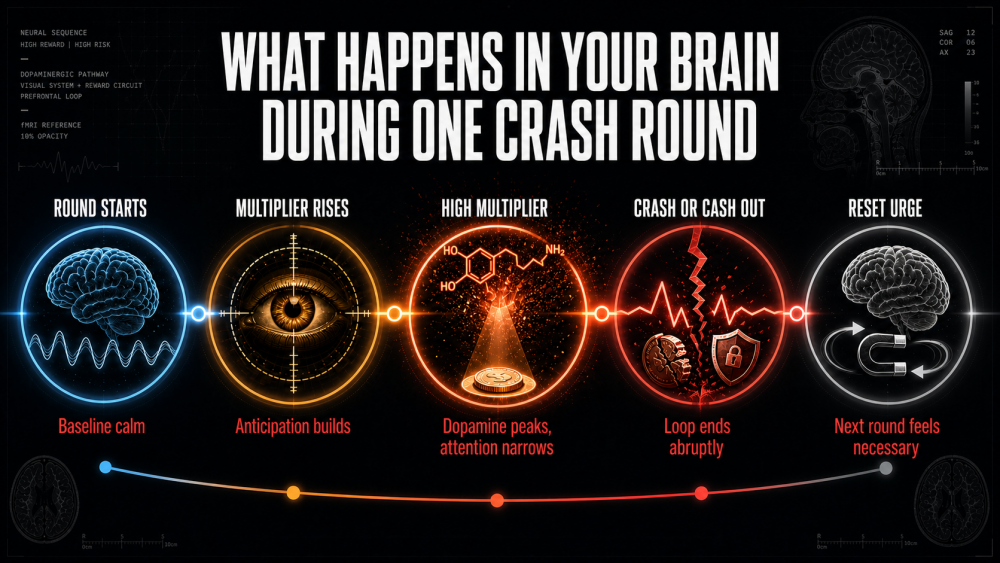
Most people assume the dopamine hit in crash games comes from winning. But it starts much earlier, the moment the multiplier begins climbing. Dopamine is not just a reward chemical. It is an anticipation chemical. Your brain’s reward circuitry fires when a prize becomes possible and grows more likely with every passing second. That is exactly what a rising multiplier does. It creates a real-time feedback loop where the reward signal keeps intensifying as long as you stay in.
At 2x you are calm. At 5x something shifts. At 10x your entire focus narrows to that curve and nothing else. When the crash finally hits, the loop ends abruptly. Abrupt endings are psychologically uncomfortable, and the fastest way to resolve that discomfort is to start the next round immediately.
The Illusion of Control
Every crash outcome is determined by a certified RNG algorithm before the round even starts. The curve is not responding to player behavior, timing, or table volume. It follows a pre-calculated sequence that no human can predict through observation.
And yet, ask any regular crash player how they approach the game and they will describe a system. Some count seconds between crashes. Others track multiplier sequences. Many develop a personal read on specific time windows. None of these carry mathematical validity, but they all feel real. This is the illusion of control, the documented tendency to believe personal skill influences outcomes governed purely by chance. In crash games it is particularly strong because the game looks like it rewards timing. You do press a button. The mechanics feel interactive, even though the result was sealed before your first bet landed.
The danger is that the illusion deepens with experience. The more rounds a player completes, the more convinced they become that their pattern recognition is improving. In reality they are building confidence in a skill that does not exist, which makes walking away progressively harder.
Near-Miss Effect
Imagine cashing out at 1.21x and watching the crash land at 1.20x. That one-decimal escape is one of the most psychologically potent experiences in crash games. It does not feel like a near-loss. It feels like a triumph. Your brain registers it as confirmation that your read was right and your timing was sharp.
Neuroscience research consistently shows that near-miss events activate the same reward circuitry as actual wins. The ventral striatum, a region central to reward processing, responds to near-misses with activation patterns nearly identical to successful outcomes. The psychological message is not “you almost lost” but “you were that close to winning.” That message functions as encouragement, reinforcing the urge to continue regardless of the financial outcome.
FOMO and the Social Pull of the Curve
Most online games are solitary. Crash games deliberately break that mold. Every active player’s bet and cashout multiplier is visible in real time, creating a live leaderboard of decisions that everyone at the table watches simultaneously.
Watching someone cashout at 47x while you folded at 3x triggers immediate social comparison. That comparison almost always lands unfavorably, because you remember the 47x you missed far more vividly than the 3x you safely collected. Live chat amplifies it further. Players celebrate big multipliers, commiserate over crashes, and push each other toward holding longer.
Enjoy the Curve Without Losing Control
The single most effective habit for crash players is setting a target multiplier before the round starts, not during it. Pre-committing to a specific cashout point removes the emotional override the rising curve produces. It means your decision gets made at a calm moment rather than at peak dopamine.
Fixed session limits and stop-loss amounts work the same way on the bankroll side. Deciding in advance when you will stop takes that decision away from the version of you actively watching the curve climb. Treat every round as statistically independent, because it genuinely is. No patterns, no due multipliers, no streaks exist in a certified RNG environment.
The Curve Will Always Rise!
Crash games are compelling because the psychology behind them is powerful. Dopamine anticipation, the illusion of control, near-miss reinforcement, and social FOMO are not design accidents. They are the reasons millions of players load another round within seconds of the last crash landing.
Understanding those mechanisms changes your relationship with the curve. You stop chasing it and start managing it. The multiplier still climbs, the tension still builds, and the community still reacts in real time. The difference is that now you are the one who decides when to leave.
FAQs
Why are crash games so addictive?
Crash games combine dopamine anticipation, the illusion of control, near-miss reinforcement, and live social pressure into a fast-cycling format that creates one of the strongest psychological pulls in online games.
Can you predict when a crash game will crash?
No. Every outcome is determined by certified RNG before the round starts. No timing method or pattern tracking has any mathematical ability to predict crash points.
What is the near-miss effect in crash games?
A near-miss happens when you cashout just before a crash, sometimes by a single decimal. The brain processes this as near-success, activating the same reward circuits as a real win.
Do crash games use RNG?
Yes. Certified crash games use RNG to determine outcomes before each round starts. The rising curve is a visual representation of a pre-determined result.
What is the safest way to play crash games?
Set your cashout target before the round starts, apply fixed session and loss limits, and treat every round as statistically independent.
Why do younger players prefer crash games?
Generation Z players specifically value the live community experience, shared multipliers, real-time chat, and visible outcomes, over traditional solo slot formats.
Are crash games more intense than slots?
Yes. Sustained tension per round, fast cycle speed, and live social dynamics make crash games psychologically more intense than standard slot formats for most players.
What is the illusion of control in crash games?
It is the belief that personal timing or pattern recognition influences outcomes that are actually determined by RNG before the round begins.