If you run a business in India, chances are you’ve heard the term “DPDP Act” floating around in legal briefings, team meetings, or forwarded WhatsApp articles. And if you’ve been putting off looking into it — well, that’s exactly what this piece is for.
The Digital Personal Data Protection Act isn’t the kind of law you can quietly ignore and hope goes away. It changes something fundamental: the relationship between your business and the personal data of every Indian user you serve. How you collect it, store it, share it, and respond when something goes wrong — all of it now falls under a legal framework with real teeth.
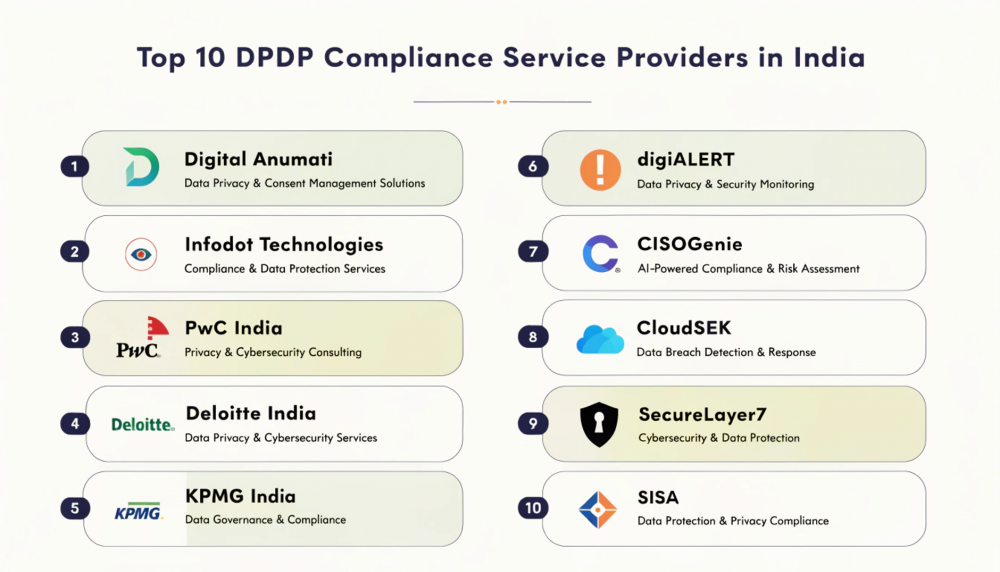
The good news is that you don’t have to decode it alone. Across India, a range of service providers — from focused boutique firms to the Big Four — have built practices specifically around helping businesses get this right. Here’s a grounded look at ten of them.
What are you actually signing up for?
Before getting into the providers, it helps to be honest about what compliance actually involves. It’s not just a legal filing or a one-time audit. It means answering some uncomfortable operational questions:
Are you collecting data your users actually know about and agreed to? Do you even know what data you’re sitting on, and where it lives? Is it protected in a way that would hold up under scrutiny? And if a breach happened tomorrow, do you know what to do in the next 72 hours?
These questions cut across your tech team, legal team, product roadmap, and vendor contracts. That’s exactly why most businesses find it worth bringing in outside expertise rather than trying to wing it.
The Providers
1. Digital Anumati
Most compliance tools were built for GDPR and then loosely adapted for India. Digital Anumati wasn’t. It was built ground-up for the DPDP framework, which makes a real difference when you’re trying to manage Indian user consent, map your data lifecycle under Indian law, and track your compliance status in one place. For startups especially, this kind of contextual fit is hard to find.
2. Infodot Technologies
Infodot tends to appeal to businesses that need proper compliance support but don’t have the bandwidth — or the budget — for a sprawling consulting engagement. They bring risk assessment, cybersecurity, and policy work together without making it feel like you’ve just kicked off a two-year project. If your team is already stretched thin, that restraint matters.
3. PwC India
PwC is the right conversation when your data situation is genuinely complex — multiple geographies, large volumes, cross-border transfers, or significant regulatory exposure. They don’t just hand you a checklist; they help you build a privacy strategy that holds up as your business scales. Big firm, but the India team knows the local regulatory context well.
4. Deloitte India
What Deloitte does differently is treat compliance as something that has to live inside your organization, not just on paper. Through audit, consulting, and risk management, they try to make sure that what gets implemented actually changes how people work — not just what the policy documents say. Useful when the human side of change is as much a challenge as the technical side.
5. KPMG India
If your primary concern is being audit-ready — whether for a regulator, a board, or an investor — KPMG brings a rigor and documentation depth that’s hard to match. Their frameworks are structured and thorough, sometimes to a fault, but that thoroughness is exactly what certain organizations need.
6. digiALERT
A lot of compliance firms are very good at telling you what needs to happen and then leaving you to figure out how. digiALERT actually helps you do it. Implementation, workflow automation, building the operational habits that make compliance sustainable — they get into the details with you. That’s rarer than it should be in this space.
7. CISOGenie
CISOGenie’s pitch is essentially: let technology handle the compliance tracking so your team doesn’t have to. Their GRC platform approach reduces the manual overhead of staying compliant, which matters a lot if you’re trying to grow your compliance program without proportionally growing your team.
8. CloudSEK
CloudSEK sits at the intersection of compliance and cyber threat intelligence. While most providers help you document and manage your compliance posture, CloudSEK is actively watching your external digital footprint for data exposure risks before they escalate. For organizations where data leakage is a genuine fear — not just a theoretical one — they cover ground others don’t.
9. SecureLayer7
There’s a gap between “our systems are documented as compliant” and “our systems are actually secure.” SecureLayer7 operates in that gap. Penetration testing, privacy audits, technical certifications — they care about whether your infrastructure would survive an attack, not just whether your policies look good on paper.
10. SISA
SISA has spent years deep in payment data security and fintech compliance. If your business processes financial transactions or operates anywhere near that ecosystem, their sector knowledge is specific in a way that a general compliance firm just isn’t. They know the nuances that matter in that space.
How to actually narrow this down
The right provider really does depend on where your business is right now:
Running a small or early-stage company? Digital Anumati, Infodot, and digiALERT are practical, accessible, and won’t bury you in the process before you’ve even started.
Operating at enterprise scale with complicated data flows? PwC, Deloitte, and KPMG have the bandwidth and experience to match what you’re dealing with.
Want to automate as much of the compliance burden as possible? CISOGenie and CloudSEK are both worth serious consideration.
Coming at this from a security-first angle? SecureLayer7 handles the technical validation side, and SISA is the specialist call if you’re in payments or fintech.
The Bigger Picture
There’s a tendency to frame compliance as a cost — something you spend money on to avoid a fine. That’s a limited way to see it. Increasingly, how a company handles user data and approaches DPDP Compliance is becoming a key factor in how customers decide whether to trust it. That dynamic is only going to become more pronounced in India as awareness grows.
The DPDP Act is in relatively early enforcement stages. There’s still time to get ahead of DPDP Compliance requirements thoughtfully rather than reactively. The businesses scrambling later will wish they’d used this window.
FAQs:
Q1. What is DPDP compliance?
A1. It means operating in line with India’s Digital Personal Data Protection Act, 2023 — the law that governs how businesses collect, use, and safeguard personal data belonging to Indian residents.
Q2. Who has to follow it?
A2. Any organization that processes data of Indian citizens. That includes domestic startups, large corporations, non-profits, and foreign companies with Indian users.
Q3. What does it actually require?
A3. The core pillars are consent management, data security, breach notification, collecting only what you need, and honoring users’ rights over their own data.
Q4. What’s the cost?
A4. It varies enormously. A small business with focused needs might manage it on a modest budget. A large enterprise doing a full-scale compliance overhaul will spend considerably more.
Q5. How long does it take?
A5. Simpler setups — a few weeks. Complex organizations with large, distributed data environments — several months, realistically.
Q6. What’s the downside of ignoring it?
A6. The financial penalties under the Act are significant. But the reputational fallout when customers find out their data wasn’t handled responsibly tends to be the harder thing to recover from.