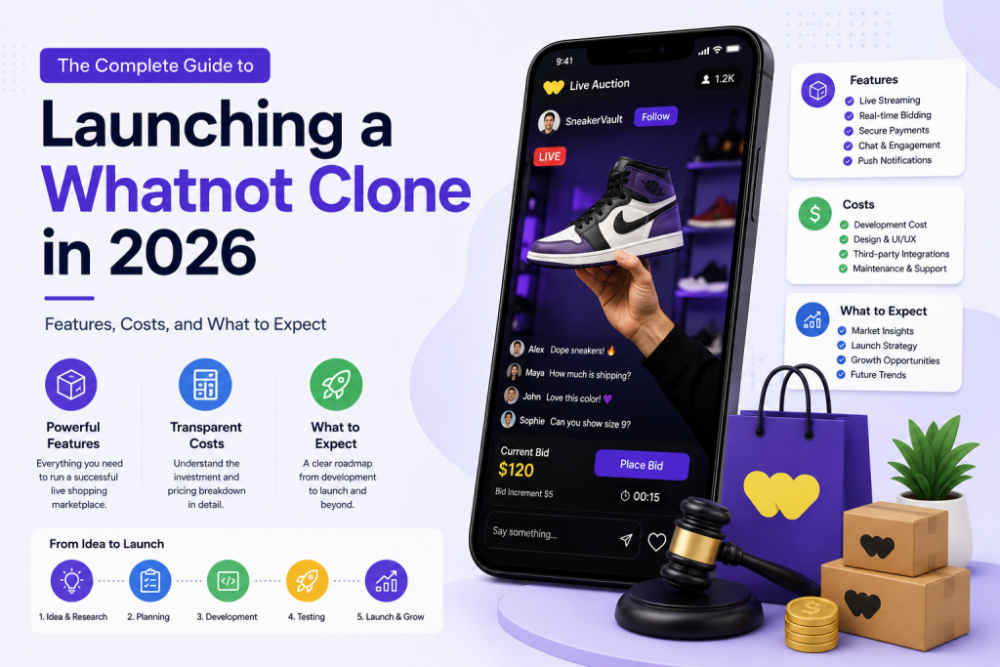
Live shopping has quietly become one of the biggest shifts in how people buy online. Instead of scrolling static product pages, millions of shoppers now discover items through live video, bid on them in real time, and buy on impulse the moment excitement peaks. Whatnot built its name on this exact formula, and it’s now one of the most talked-about growth stories in e-commerce.
That success has opened the door for a new wave of founders, resellers, and retail brands to ask a practical question: what does it actually take to launch a platform like this for a market of their own? The short answer is a Whatnot Clone — a white-label live shopping platform built on the same core mechanics as Whatnot, but shaped entirely around a different niche, audience, or region.
This guide breaks down what a Whatnot Clone actually includes, what it costs, how long it takes, and what founders should expect at each stage of getting one live.
What Exactly Is a Whatnot Clone?
A Whatnot Clone is a live commerce platform — web and mobile — that replicates the core experience that made Whatnot successful: sellers go live on video, showcase products, run real-time auctions or “Buy It Now” listings, and buyers interact, bid, and purchase without ever leaving the stream.
The word “clone” describes the mechanics, not the brand. A properly built version isn’t a copy of Whatnot’s app — it’s an independent, fully-owned platform with its own name, design, seller rules, and monetization strategy, built using the same proven format. Founders who go this route aren’t renting space inside someone else’s marketplace; they’re building their own, using a blueprint that’s already been validated at scale.
Who Actually Builds a Whatnot Clone?
The founders exploring this space tend to fall into a few clear categories:
- Niche resellers and collectors who’ve outgrown generic marketplaces and want a dedicated home for their specific category — sneakers, trading cards, vintage fashion, art, electronics
- Retail and DTC brands looking to add a live, interactive sales channel instead of relying entirely on static product listings
- Regional entrepreneurs who see an underserved market where Whatnot has little or no local presence
- Marketplace operators looking to add a live commerce layer to an existing multi-vendor platform
What they share is the same core insight: live commerce isn’t a fad limited to one platform or one category — it’s a format that works anywhere there’s a community willing to buy from people they trust, in real time.
The Core Features a Whatnot Clone Needs to Deliver
Not every live-streaming app qualifies as a real Whatnot Clone. To actually replicate the experience that drives Whatnot’s engagement and sales, a platform needs a specific set of capabilities working together.
Live Streaming With Real-Time Bidding
This is the foundation. Sellers need to be able to go live, show products on camera, and let viewers bid in real time with prices updating instantly for everyone watching. Latency has to stay low enough that bidding feels fair — a few seconds of lag can throw off an entire auction and erode buyer trust.
Seller Onboarding and Storefronts
Sellers need a straightforward path to get approved, set up a profile, and start selling — along with ongoing tools to manage their catalog, track orders, and monitor performance. A platform that makes onboarding difficult will struggle to build the seller base it depends on.
Buyer Discovery and Engagement Tools
Buyers should be able to easily find live streams relevant to their interests, follow favorite sellers, save searches, and get notified when a stream they care about goes live. Recommendation logic — even a straightforward version — significantly increases how much time buyers spend on the platform and how often they return.
Secure, Fast Checkout
Because live auctions move quickly, checkout needs to keep pace. This typically means pre-authorizing payment before a bid is accepted, then automatically completing the charge once the auction closes — protecting sellers from buyers who don’t follow through and giving buyers a frictionless purchase experience.
Admin Tools for Real Operations
Behind the scenes, platform owners need visibility into everything happening across the marketplace: active streams, seller applications, commission tracking, dispute resolution, and fraud monitoring. Without this layer, scaling past a handful of sellers becomes unmanageable.
Cross-Platform Availability
Buyers and sellers expect to be able to join a live stream from wherever they are — a phone, tablet, or desktop browser. A Whatnot Clone needs to work consistently across web, iOS, and Android, ideally from a single backend so the experience stays consistent everywhere.
What Does a Whatnot Clone Cost?
Cost is one of the first questions every founder asks, and the honest answer is that it depends heavily on scope. A basic version with core streaming, bidding, and checkout functionality sits at the lower end of the range. A more advanced build — with AI-powered recommendations, multi-tenant admin tools, advanced analytics, and deeper customization — costs more, but reflects a platform built to handle real growth rather than just a proof of concept.
Generally, founders should expect a realistic range roughly between $4,000 and $16,000 depending on complexity, with fully custom builds designed for scale often starting closer to $13,000. The specific number depends on:
- How much customization is needed beyond core features
- Which payment gateways and regions need to be supported
- Whether the platform needs to support multiple sellers from day one or a single-seller launch first
- The level of admin and analytics tooling required
- Whether AI-driven recommendations or moderation are included
Founders evaluating quotes should be cautious of pricing that seems too low relative to what’s being promised — live commerce infrastructure, done properly, is not trivial to build, and unrealistically cheap builds often cut corners on the exact things that matter most: streaming latency, payment reliability, and scalability.
How Long Does It Take to Launch?
One of the clearest advantages of the clone approach over building from scratch is speed. Because the core mechanics of live commerce — bidding engines, live video infrastructure, checkout flows — are already proven and don’t need to be reinvented, development timelines shrink dramatically compared to building an entirely new category of product from zero.
A well-scoped Whatnot Clone can typically go from kickoff to launch in as little as 15 days for a focused build, with more heavily customized platforms taking longer depending on the number of unique features requested. This is a fraction of the time it would take to design, build, and test the same core mechanics from a blank page.
What the Development Process Actually Looks Like
Founders going through this process for the first time benefit from understanding the typical stages involved, so they know what to expect and can evaluate progress along the way.
Discovery and scoping comes first — defining the target niche, business model, and must-have features before any code is written. Skipping this step is one of the most common reasons projects run over budget or timeline later.
UI/UX design follows, focused specifically on minimizing friction between watching a stream and placing a bid — the core interaction the entire platform depends on.
Backend and infrastructure development builds the systems that handle live bidding, order processing, and payment logic, typically using cloud-native architecture designed to scale.
Live streaming integration connects the video and real-time bidding systems together, which is where latency and synchronization get carefully tuned.
Concurrency and stress testing simulates high-traffic conditions — the kind of surge a platform experiences when a stream goes viral — to confirm the system holds up before real sellers and buyers depend on it.
Deployment and ongoing support bring the platform live and keep it maintained afterward, since a launched platform still needs monitoring, updates, and improvements as it grows.
What Separates a Strong Whatnot Clone From a Weak One
Not all builds labeled “Whatnot Clone” deliver the same experience. The difference usually comes down to a few specific things:
Latency performance.
A platform that looks identical to Whatnot in screenshots but has several seconds of streaming delay will fail the moment real bidding activity starts.
Payment handling.
Pre-authorized holds versus post-auction charging is the difference between a platform sellers trust and one where non-paying bidders quietly drain revenue.
Code ownership.
Founders who license a shared, generic script are dependent on that vendor indefinitely. Founders who own their source code outright can evolve the platform freely and aren’t exposed if a vendor changes terms, raises prices, or shuts down.
Scalability under pressure.
A platform that hasn’t been stress-tested for viral-level traffic is a platform that hasn’t really been tested at all — live commerce traffic doesn’t arrive gradually, it arrives in bursts.
Getting Started
For founders serious about entering live commerce, the opportunity is well-timed: the format is proven, consumer behavior already supports it, and specific niches remain wide open. The businesses that move now — with a platform built on solid streaming infrastructure, trustworthy payment handling, and full ownership of their code — are the ones positioned to become the next category leader in their space, rather than just another entrant competing for space inside someone else’s marketplace.