Running a successful Shopify store isn’t about listing products and receiving money from them. Inventory control, order fulfillment, marketing, customer support, compliance – all these processes require corresponding tools in order to run smoothly. Shopify has great resources for creating an eCommerce website, but with the growth of a store, it can have even higher requirements that can be met only using the help of other tools. A merchant should be able to work with thousands of products, automate communication with customers, provide individual shopping experience, process returns, and know how the website visitors behave on it. In this situation, apps for Shopify can really come in handy.
There are solutions for every eCommerce process in the Shopify App Store. However, selecting apps for your Shopify store correctly means more than picking up the most popular solutions. They might overlap each other and cause additional costs and complications in workflow. In this article, we will discuss 18 applications for your Shopify store that could be helpful in 2026.
18 Best Shopify Apps for eCommerce Stores in 2026
Below are various apps that help meet different requirements. Some have benefits right from the start, whereas some only become useful as your customer base, orders, and marketing efforts grow.
1. StoreRobo Import Export
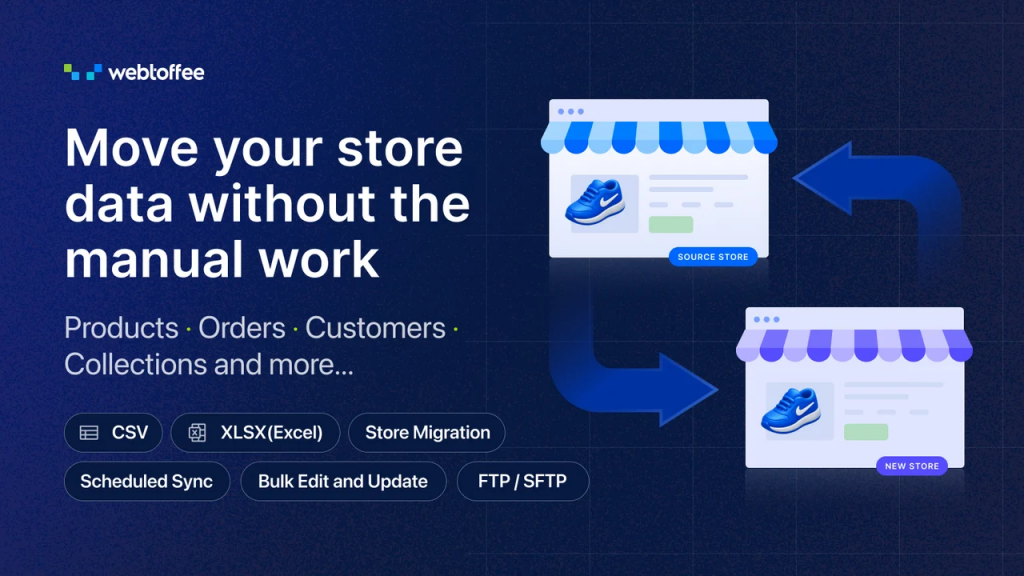
With the growth in size of the store’s catalog, the management of the data in it is becoming increasingly complicated. With StoreRobo Import Export, it is possible to import, export, migrate, and make bulk updates of data on a Shopify store without the need to edit the entries one by one.
StoreRobo can be used to do such tasks as products, collections, customers, orders, discounts, and others in Shopify stores. The useful feature offered by this tool is the ability to migrate from WooCommerce to Shopify using the WooCommerce API.
Key Features:
- Bulk import, export, and update products, customers, and orders.
- WooCommerce-to-Shopify migration support.
- Scheduled data transfers through FTP/SFTP.
- Inventory synchronization and CSV/XLSX file support.
Pricing: Free plan available; paid plans start at $15/month.
2. Vitals
Unlike adding new apps to implement each feature, Shopify store owners can use Vitals to handle multiple storefront optimizations in one platform. This application comprises over 40 different tools that are aimed at enhancing the purchasing experience, increasing customer engagement, and encouraging purchases through various functionalities, including product bundles, reviews, sticky add-to-cart buttons, etc.
Vitals is likely to benefit small and mid-sized companies because of its ability to consolidate multiple tools. Since these tools are complementary to each other, business owners will have an opportunity to try different approaches without switching between many apps. However, it is necessary to pay attention to existing solutions of similar kind if any are being used on the website.
Key Features:
- More than 40 conversion optimization tools.
- Sticky add-to-cart buttons and product bundles.
- Customer reviews and promotional widgets.
- Multilingual storefront and conversion features.
Pricing: Paid subscription plans are available; check the Shopify App Store for current pricing.
3. SF Product Recommendations
It is a great practice to provide customers with product recommendations while shopping in an online store. The SF Product Recommendations is an app created by WebToffee which enables retailers to show recommendations on their products according to various merchandising approaches such as ‘Frequently bought together’, ‘Related products’, ‘Bestsellers’, ‘Recently viewed products’ and ‘New arrivals’.
There are multiple recommendation widgets that the app can generate on several storefront pages such as product, collection, cart and thank-you pages. Merchants can personalize the way of displaying recommendations, make rules for recommendation widgets and monitor performance statistics.
Key Features:
- Frequently bought together and related product suggestions.
- Upselling and cross-selling recommendation widgets.
- Customizable recommendations across multiple store pages.
- Product recommendation performance analytics.
Pricing: Free version available for stores with up to 50 monthly orders; paid plans start at $10/month.
4. AfterShip
Delivery is not complete once the customers have gone through with the checkout process. Customers need to know whether their orders have been sent out, whereabouts of their packages, and when they should be expecting their deliveries. AfterShip assists merchants in providing this information via automation and branded shipment tracking.
The app integrates with a wide array of shipping providers and aggregates shipping information into one dashboard. The merchants are able to give their customers a branded tracking page and update them on the progress of delivery. This feature is very beneficial to those merchants who have a high frequency of sending out shipments since it helps in reducing order status inquiries.
Key Features:
- Branded shipment tracking pages.
- Automated shipping and delivery notifications.
- Integration with multiple shipping carriers.
- Centralized tracking and shipment management.
Pricing: Free entry tier available for up to 50 shipments/month; paid plans are available.
5. Klaviyo
Email marketing is still one of the vital sources for sustaining customer relations and creating loyalty among customers. Klaviyo is the software provider that offers Shopify users marketing tools such as email and SMS marketing based on their business data for creation of custom communications with customers. There are also available workflows for abandoned cart, welcome, recommendation and re-engagement emails.
It is a good choice for those merchants who require sophisticated customer segmentation and marketing campaigns. It is possible to develop customer-specific messages through the usage of such data as shopping behavior, purchase history and customer info. Therefore, Klaviyo is a good choice for stores with advanced lifecycle marketing.
Key Features:
- Automated email and SMS marketing campaigns.
- Customer segmentation based on purchase behavior.
- Abandoned-cart and post-purchase email workflows.
- Campaign performance and customer analytics.
Pricing: Free email tier for up to 250 contacts; paid email plans start at $20/month.
6. Omnisend
There is also the Omnisend app that can serve as an alternative to Klaviyo for Shopify users who need to control their email, SMS, and web push marketing using one tool. This application provides built-in automation flows and customizable email templates which may help ease the process of creating campaigns for companies that have limited marketing resources.
With Omnisend, users can set up welcome series, abandoned cart reminders, and promotions and gather subscribers using integrated forms and pop-ups. This app can offer customers a solution for multichannel marketing in a simple way.
Key Features:
- Email, SMS, and web push notification campaigns.
- Prebuilt marketing automation workflows.
- Customizable email templates and signup forms.
- Customer segmentation and campaign analytics.
Pricing: Free plan with up to 500 emails/month; paid plans start at $16/month.
7. Judge.me
Reviews by customers can affect decisions regarding purchase, especially if the shoppers have no idea about the shop or the item being sold. Judge.me assists sellers who use Shopify to get customer reviews and ratings, as well as user-generated content. The app enables the users to place the reviews on product pages and other areas of the online store.
Review request functionality is available in Judge.me as an automation, alongside the photo and video reviews. Also, the app allows adding custom review widgets for displaying the review info via integrations that work with a number of supported shopping channels. Having many useful features at no cost at all, Judge.me may be a good start for companies seeking customer trust through their products or services.
Key Features:
- Automated customer review requests.
- Photo, video, and written product reviews.
- Customizable star ratings and review widgets.
- Google-related review integrations.
Pricing: Free plan available; Awesome plan at $15/month.
8. Loox
Loox is yet another product review solution that places great importance on visual customer feedback. Rather than depending on text reviews alone, merchants have the ability to use Loox to gather customer photos and videos and then post them for customers to see. This feature can work wonders in categories such as fashion, beauty, home decor, and accessories, because of their dependence on product appearance.
The app provides a range of review displays which include carousels and galleries and which can be embedded in the pages of the merchant’s storefront. The different options offered by the app, depending on the plan selected by the merchant, include referral and syndication services for customer reviews.
Key Features:
- Photo and video customer review collection.
- Customizable visual review galleries.
- Automated post-purchase review requests.
- Customer referral and review-sharing features.
Pricing: Free entry plan available; paid plans start at $49.99/month.
9. ReConvert
An order may also provide the chance to promote other products related to what was already bought. ReConvert is an application that will allow you to set up offers after the purchasing process in your Shopify store. There is no need to use offers only before the customer makes an order.
ReConvert provides the ability to set up a funnel for the upsell strategy and analyze its performance. You can set up an offer for products often purchased together, related to one another, or other offers. This application can be really helpful for those who want to try different ways to increase the average order amount in their Shopify store.
Key Features:
- Post-purchase upsell and cross-sell offers.
- Customizable product recommendation funnels.
- One-click upselling where supported.
- Conversion and revenue performance tracking.
Pricing: Entry-level options are available, with paid tiers varying according to store requirements and order volume.
10. Discount Kit
Discounts can be effective at drawing customers and encouraging them to buy more products, yet sometimes more sophisticated marketing strategies would need to involve elements other than discount codes. The Discount Kit application is able to help Shopify store owners develop complicated discount schemes such as volume discounts, tier rewards, and free gifts.
Stores are able to announce their promotions using product page pricing tables and discount indicators, while Shopify Sidekick, a Shopify AI marketing tool, is able to assist in developing simple discount strategies, generating reports, and completing other mundane tasks.
Key Features:
- Tiered volume and quantity-based discounts.
- Free-gift and gift-with-purchase promotions.
- Customizable product-page savings displays.
- Advanced promotional campaign management.
Pricing: Paid subscription plans start at $99.99/month, with a free trial available.
11. EU Withdrawal Button
Legal compliance is yet another aspect of running a store, especially when dealing with customers from other nations. EU Withdrawal Button, created by Clevyre, enables the Shopify merchant to offer a system through which the customer can use his rights of withdrawal as per the EU regulations on consumer rights, including those set out through Directive (EU) 2023/2673.
It provides a withdrawal button and form, which can be used by the customer without being logged into the account. The system has a two-stage withdrawal process, automated email confirmations, and a dashboard for withdrawal request management. The multilingual feature and withdrawal tracking may also assist the merchant in maintaining a better process in handling such requests. However, since the requirements vary depending on the transaction and law, the merchant should verify the requirements separately.
Key Features:
- EU consumer withdrawal button and form.
- Two-step confirmation to prevent accidental submissions.
- Automated withdrawal confirmation emails.
- Withdrawal request management dashboard.
Pricing: Free plan for core functionality; Pro plan at $5/month.
12. Gorgias
As an eCommerce store expands, it receives customer support messages through various channels. Responding to such messages becomes challenging when each communication channel needs individual attention. Gorgias offers an integrated helpdesk solution specifically meant for eCommerce businesses where customers’ conversations are managed together with access to order information from Shopify.
This makes it easier for support agents to learn about their customers’ queries without having to keep toggling back and forth between applications. Team members can view orders, reply to queries, and use workflows to handle repetitive tasks related to customer support. Gorgias is ideal for those stores that get many support tickets.
Key Features:
- Centralized customer support inbox.
- Shopify order and customer information integration.
- Automated ticket management and responses.
- Multichannel customer communication support.
Pricing: Plans start at $10/month, with pricing scaling according to ticket volume and functionality.
13. PageFly
A store’s layout contributes significantly to the discovery of new products and navigation through the purchasing journey. Although Shopify themes include customization tools out of the box, there are cases where merchants require additional freedom in designing landing pages, product pages, or marketing campaigns. PageFly is one such tool which gives users a visual page builder which enables them to create custom page layouts without requiring advanced coding skills.
The page builder of this application comes with a drag and drop editor, controls to make the site responsive, and hundreds of templates and page sections. Using this page builder, merchants can create landing pages for campaigns and customize their product presentations. In case merchants consider a developer-led approach to creating customized headless storefronts other than using Shopify themes, then Shopify Hydrogen is another solution available to them.
Key Features:
- Drag-and-drop Shopify page builder.
- AI-assisted page generation and customizable templates.
- Responsive designs for mobile and desktop.
- Landing-page optimization and app integrations.
Pricing: Free plan available; paid plans start at $24/month.
14. Smile.io
Getting new customers is critical; however, having existing customers coming back will be more sustainable. Smile.io is a good app that assists merchants to implement loyalty programs that give rewards to clients for their purchases, referrals, and other actions. Customers can get incentives to come back and have extra reasons for shopping with one specific brand.
Store owners have many options to implement rewards in the form of points, discounts, and VIP bonuses with paid plans of Smile.io. Additionally, there are ways to customize the look of the loyalty program according to the branding of the store. Smile.io will be helpful especially for businesses dealing with products that people tend to buy regularly.
Key Features:
- Points-based customer loyalty programs.
- Referral rewards and promotional incentives.
- VIP membership tiers.
- Loyalty program performance tracking.
Pricing: Free plan available for stores with up to 200 monthly orders; additional paid plans are available.
15. ADA Accessibility Widget
Website accessibility is something that should be taken into account when building online stores for people with various disabilities and browsing requirements. ADA Accessibility Widget by Clevyre provides customers with access controls that they can customize based on their preferences. Such features are supposed to assist visitors with interacting with the website better.
The widget has several options including accessibility profiles, contrast adjustment, text to speech, and enhanced cursor among others. The widget can also be customized in terms of design and available languages to fit the merchant’s storefront. Although an accessibility widget can provide some assistance, it will not automatically make the whole website meet ADA, WCAG, EAA, and other accessibility standards requirements.
Key Features:
- More than 25 accessibility assistance tools.
- Text-to-speech and visual adjustment features.
- Customizable accessibility profiles.
- Multilingual accessibility widget support.
Pricing: Free plan for up to 5,000 widget impressions/month; paid plans available.
16. Privy
Not all visitors landing on the Shopify store will necessarily make a purchase right away; some may simply look at the products, do comparisons, or even just exit the site without making a purchase. Privy can help merchants connect with those potential customers by making use of sign-up forms, pop-ups, or other promotional offers. Through the use of Privy, merchants have the ability to provide incentives for newsletter signups, show special offers, and entice visitors to sign up for marketing communications. Through certain tools and plans, the merchant can also use audience targeting and messaging.
Key Features:
- Email signup forms and customizable popups.
- Exit-intent offers and promotional banners.
- Targeted campaigns based on visitor behavior.
- Email subscriber growth and engagement tools.
Pricing: Subscription plans and usage limits vary; check the Shopify listing for current pricing.
17. Tidio
Questions frequently arise while customers visit an online store. Some issues that may arise include product specification queries, cost of delivery charges, return policy details, and other questions regarding orders. Tidio offers merchants ways to answer such inquiries via live chat and customer support solutions provided automatically.
Tidio allows merchants to combine the interaction of customers with artificial intelligence assistance, which includes the Lyro AI agent. This is how merchants can employ automated answers to typical queries, but more complex questions will go to human agents for resolving. The ability to access Tidio through mobile devices makes it applicable for small businesses who cannot afford a big support team.
Key Features:
- Real-time customer live chat.
- Lyro AI customer support agent.
- Automated responses and chatbot workflows.
- Mobile support and multichannel integrations.
Pricing: Free plan available; customer service plans start at $29/month, with separate AI pricing.
18. Lucky Orange
Knowing the behavior of the visitor is important in increasing sales. The common tracking tool will be able to measure the number of visitors as well as their purchases. However, sometimes the tool will not provide insights about why certain customers leave. Lucky Orange offers some useful solutions to track and understand website behavior through session recording, heat maps, and conversion tools.
The application will give insight into the way visitors use the product pages and navigations among others. Merchants will see that customers keep clicking the unclear button or leaving the page without reading all the necessary information about the product.
Key Features:
- Visitor session recordings.
- Click, movement, and scroll heatmaps.
- Conversion funnel analysis.
- Website behavior and performance insights.
Pricing: Free plan for up to 100 sessions/month; paid plans start at $19/month.
How to Choose the Right Shopify Apps for Your Store
It is not always the Shopify application set with the maximum number of features that can be considered to be the right one. Each and every application must cater to any requirement for the organization. A brand new Shopify website might require an application which can take care of their product information management, customer reviews, and communicating with the buyer. An increasing number of orders might demand other applications like shipments, automation, and customer retention.
Final Thoughts
To build an efficient Shopify store, one needs to have reliable processes, good marketing practices, customers’ trust, and constant optimization. App usage can save one time and effort, create better shopping experience for customers, and help entrepreneurs cope with increasing complexity of business processes.
Not all apps are needed by all stores. Sometimes they act like substitutes, while other apps are simply too specific for a store to need it from the start. The best strategy would be to start with operational apps, discover places where you may use automation or optimization, and add more apps to your list as your business expands.