Open your phone, and you are bound to find a taxi booking app within two taps; so will the 1.3 billion people who used ride-hailing or taxi services at least once per month (in 2025). Millions of ride requests are processed daily.
The ride-hailing and taxi market size was valued at USD 199.14 billion in 2021 and is expected to reach USD 432.63 billion by 2028. But nowhere is the velocity of this transformation more viscerally visible than in Southeast Asia right now, and no story illustrates it better than the rise of Vietnam’s Green and Smart Mobility (GSM) and its Xanh SM electric taxi brand.
“The future belongs to those who see possibilities before they become obvious.”
— John Sculley, former CEO of Apple.
Hence, if your question as a taxi app development company is still: “Is it worth developing a taxi booking app in 2026?”, then you are asking the wrong question. Because the real question you should be asking is: “What does it take to build a professional, competitive taxi booking platform that can win?”
“You don’t have to be great to start, but you have to start to be great.”
— Zig Ziglar
This definitive strategic framework outlines how to reduce taxi app development costs while ensuring enterprise-grade software integrity, absolute security, and elite performance.
Where Taxi App Budgets Actually Vanish
Custom taxi app development can take over 15 months and cost your company dearly. The costs are not high because of the need for a fancy interface or complex features (although that does partially contribute).
The main reason it is so expensive is the research phase. Hours and hours are spent on the core research and development phase and on over-engineering. Issues like scope creep and technical debt also tend to add to the cost and time.
A custom taxi app might sound great and perform well, but businesses attempting to enter the highly competitive market in 2026 do not have the luxury of time. They need to look for quicker alternatives to launch their taxi business.
True engineering efficiency is not about spending less; it is about wasting less on reinventing wheels that have already been perfected.
Strategic Cost Reduction Without Compromising Code Integrity
A taxi app development company can reduce their initial cost without having to sacrifice on the quality of the code:
White-label Taxi App Clone:
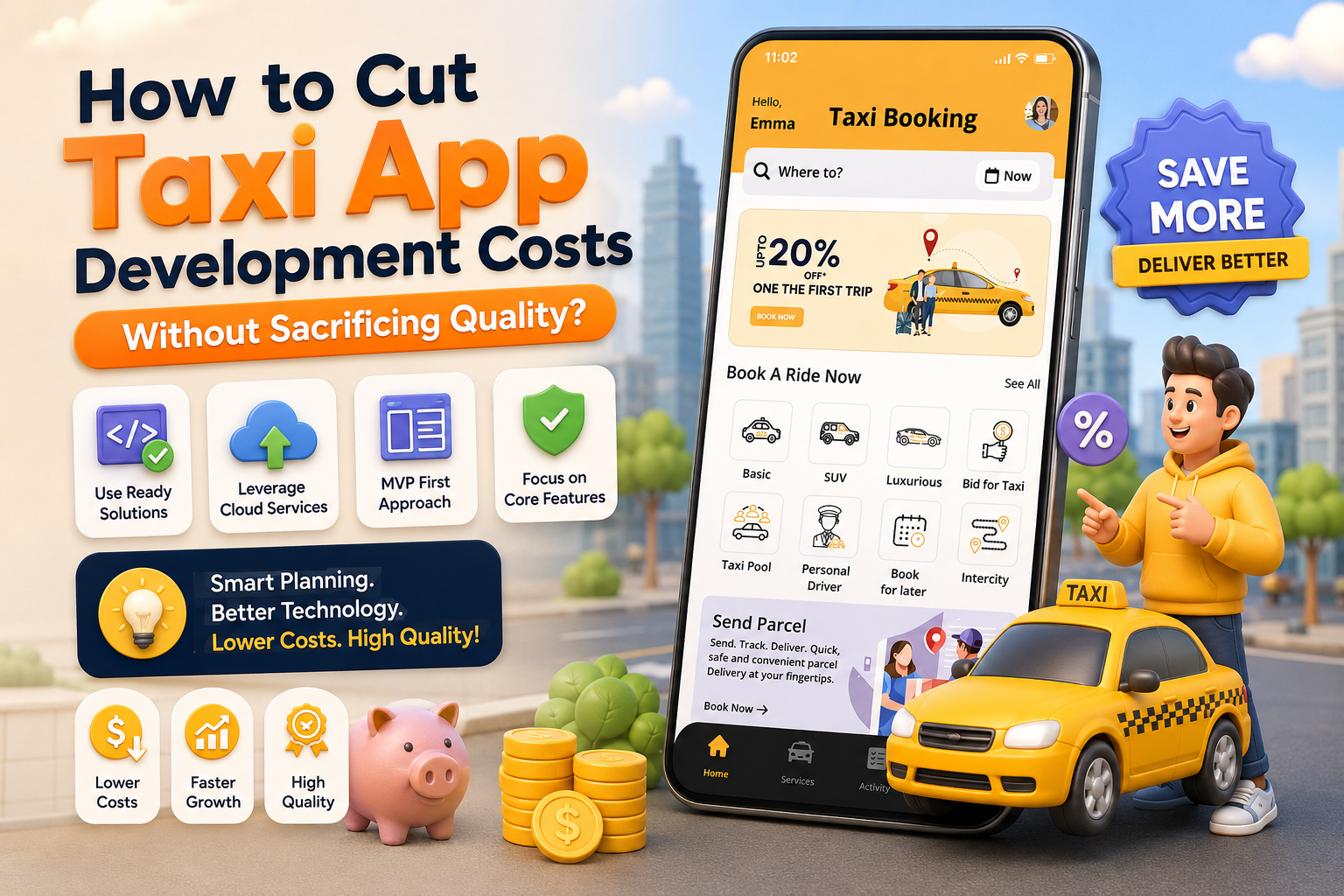
Avoid reinventing the wheel; instead, buy what is already available. Several taxi app clone development companies around the world offer ready-made solutions. Such solutions have been developed with years of research and are continuously updated. They can typically be customized and be available to launch within 2 weeks. White-label solutions tend to provide multiple languages, currencies, and payment gateways. For example, the Uber Clone.
The MVP Approach:
Opting for a phased rollout of features can reduce the impact of a high initial cost. Developing a minimum viable product allows you to launch with the core features and gradually build towards the final release in a multi-phased release. This will reduce the initial cost but not the overall cost of developing the app.
Cloud Computing:
By shifting simple computing tasks to the user’s local device (Edge computing) and utilizing pre-built, scalable cloud components for heavy real-time data needs, you can dramatically lower your ongoing server costs. This way, your platform handles high-volume requests smoothly without driving up infrastructure bills.
The table below compares custom development vs. low code Saas vs. white-label clones to build the perfect taxi app platform for your taxi app development company:
| Evaluation Metric | Custom Scratch-Build Agency | Low-Code SaaS Subscriptions | Enterprise White-Label Framework |
|---|---|---|---|
| Average Initial Capital Outlay | Very High | Low Initial | Moderate One-Time Purchase |
| Time-to-Market Window | 9 to 14 Months | 1 to 3 Weeks | 1 to 2 Weeks |
| Source Code Ownership & Control | Full IP Ownership | Zero Ownership (Vendor Lock-in) | Full Source Code Handover |
| Long-Term Scaling Costs (TCO) | High (Constant retainer fees) | Exponentially High (Per-transaction fees) | Minimal (In-house maintenance) |
| AI Integration Extensibility | Custom engineered at high cost | Highly restricted by platform APIs | Native, open architecture |
How Founders Should Evaluate Cost Efficiency
To achieve true cost efficiency, look for solutions that combine affordable upfront costs with complete ownership of your code. This is where partnering with an experienced global provider makes all the difference.
Here is what founders and product managers should be asking:
- What percentage of features will users actually use?
- How easily can the backend scale for 10x growth?
- Does the vendor provide modular, reusable code or a one-off product?
Businesses should ideally be looking for options that are easy and quick to scale and do not involve a developer overhead. There couldn’t be a better description for the white-label Uber Clone app.
As the name suggests, it is a taxi booking app like Uber and comes with all the bells and whistles. Besides all the core features, it also consists of a wide range of advanced features, including AI-powered ones.
For example, V3Cube provides white-label Uber Clone apps at a highly affordable rate for businesses to launch in 1-2 weeks. It also allows them to scale quickly and offers the best features.
At the same time, for entrepreneurs targeting broader service ecosystems, leveraging a fully integrated Gojek Clone will allow you to deploy a mature multi-service super-app with proven architecture. However, this will cost more than the Uber Clone app.
Hence, for businesses looking for an affordable taxi app solution, the best option would be to buy a white-label Uber Clone app from V3Cube.
Building Lean, Scalable, and Future-Ready Taxi Platforms
Reducing taxi app development costs isn’t about cutting corners on security or performance or searching for the best taxi app development company. It’s about choosing a smarter architectural starting point.
By using modular, pre-engineered enterprise foundations, founders can bypass predictable development hurdles and focus capital directly on growth and driver acquisition. Choose wisely, opt for the best taxi app development solution like a white-label Uber Clone app.
FAQs
1. Does utilizing a white-label app compromise platform security or data isolation?
White-label apps are equally secure. However, you must buy a white-label taxi app from a verified vendor. For example, if you opt for a white-label Uber clone from V3Cube, you can be sure you are getting a highly secure solution.
2. Why is source code ownership crucial for long-term cost reduction?
If you do not own the source code, you are bound to have monthly software licensing fees, and it also means a vendor lock-in. Businesses are not free to modify the code either. On the other hand, if you own the source code, you have complete freedom to scale and modify it.
3. How long does it take to deploy a ready-made taxi booking app solution?
A ready-made taxi app or white-label taxi app can be launched quickly. Once you buy it, the development firm can customize it as per your requirements. They will also localize as per the local language and currency and make it available to launch within 2 weeks.
4. Can a taxi app remain scalable if built using a low-cost approach?
Yes. A white-label taxi clone will cost a lot less, but at the same time, it is feature-rich and easy to scale. White-label and MVP-based apps can scale by adding features, expanding regions, and upgrading infrastructure as demand grows.