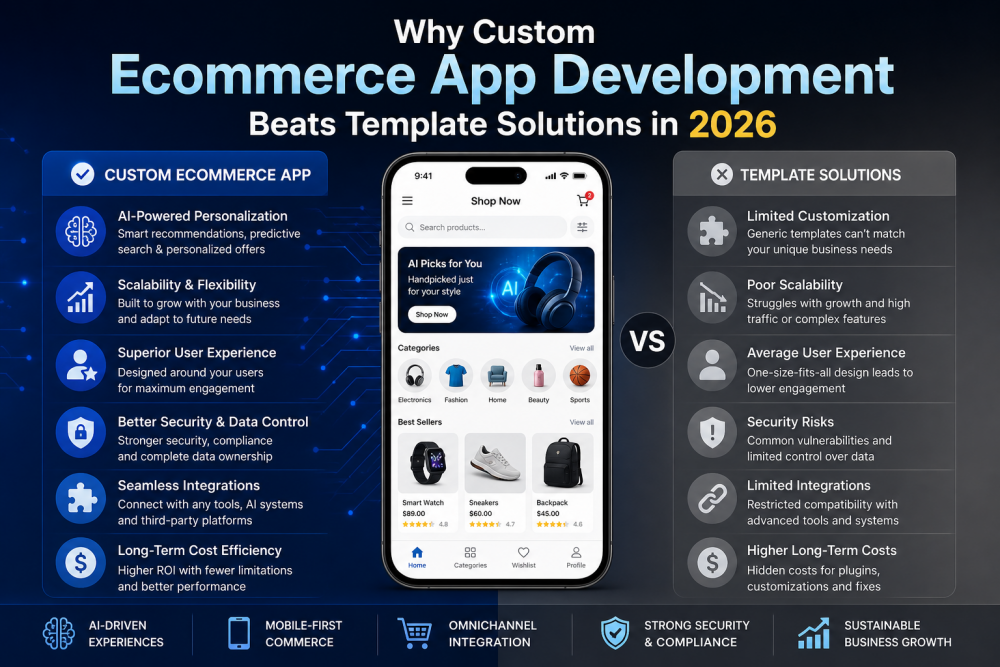
Ecommerce sector is faster than it’s ever been in 2026. Customer habits is moveing toward mobile-first shopping, AI powered recommendations, voice search shopping. Companies that use their basic website templates for there business are now facing issues of growth, traffic drop, user and data security issue and losing there customer loyalty.
But as more and more competition is increasing, many brands are finding that template based systems website can be a limiting factor for there business long term growth. That’s why custom app development have become necessary to today ecommerce business growth strategies. Businesses have more control and flexibility over there customer apps thanks to customized solutions, including AI automation and advanced personalization.
From generic templates to personalized commerce
Everyone was mad about template solutions. They were cheap and quick to implement. Little technical knowledge would be needed for small businesses to sell on the web. But in 2026 consumer expectations are a million miles from where they were just a few years ago.
Users nowadays want:
- Load speed is faster
- Ideas for Custom Products
- AI-based search experiences
- One-click check out systems
- Real-time stock visibility
- Shopping journey across devices
These sophisticated needs are unlikely to be met by template platforms without considerable modification. That’s why so many companies are shifting their focus to custom ecommerce architectures based on their audience and their processes.
As per the talks in the industry, the work of an ecommerce app development company is less about working on pre-built frameworks and more about developing scalable infrastructures that respond to the changes in trends of digital commerce.
Why Scalability Will Be Even More Important in 2026
Scalability is no longer about “more traffic”. Today’s ecommerce systems need to scale across multiple dimensions – user personalization, AI processing, product management, payment integrations, omni-channel experiences, etc.
“A template solution might work for a small inventory startup. Yet companies entering international markets often face limitations such as:
- less backend customizations
- API integrations are limited
- Heavy traffic performance is poor.
- Problems with large catalogs
- Challenges in the Implementation of Artificial Intelligence Systems
Custom apps let developers customize the architecture to the business as they need it. This flexibility is particularly necessary during peak periods like holiday sales, flash campaigns and seasonal shopping rushes.
Ecommerce App Development is changing with AI.
Artificial intelligence (Ai) is one of the most powerful tool in eCommerce technology. AI will be a central part of the shopping experience in, between 2029 -to 2030, but not now in 2026 but we can not be able to ignore this coz its currently is not a central part of ecommaeace
Smart Product Recommendations
Machine learning algorithms (ai) study web browsing patterns, purchase history, and customeror user behavior to make more accurate data about products like which product is got how may impressiona and how many click like that or more advance. Individualized advice may lead to increased session duration and higher user engagement.
Voice Shopping & Search Predictions
More and more customer’s are using voice search assistants and conversational search for shopping. AI powered search tools like ChatGpt, gemini. understand questions that are posed in natural language, and help users discover products faster.
Dynamic Pricing System
AI tools assist in optimising the pricing of products based on demand, competitor trends, customer behaviour and inventory availability. This enables companies to respond to market conditions as they occur.
Fraud & Security Detection
AI-powered security solutions look for suspicious transaction activity and help to reduce the threat of payment fraud. This has become more and more important as the volume of online payments continues to grow worldwide.
AI integration will be a big focus for many modern ecommerce app development services as intelligent automation will be the heart of digital retail performance.
Mobile commerce is becoming increasingly important.
Mobile still accounts for the bulk of e-commerce traffic worldwide. Smartphones, tablets, smart TVs, wearables – consumers want a seamless shopping experience across them all today.
This has resulted in the demand for advanced eCommerce mobile app development strategies that are fast, usable and consistent across platforms.
The benefits of a custom mobile ecosystem are numerous:
- Better user interface optimisation
- Personalised push notifications
- Offline browsing function
- Quicker checkouts
- Better app performance
- Improved Customer Retention
In many template systems, default layouts do not reflect user behavior patterns or brand-specific workflow.
User experience is a differentiator
In 2026, user experience directly impacts conversion rates. If the app is slow or difficult to navigate, users will quickly abandon it.
Custom applications allow companies to design user journeys that mirror how real customers actually behave, rather than being limited to the constraints of a template.
For example, AI enhanced heatmap analysis can help to identify:
- Where the users go astray.
- Featured Product
- What checkout steps are causing friction?
- The different types of device movement.
In the case of online store app development services such data-driven optimization is even more valuable since customer expectations are now shaped by highly personalized digital ecosystems.
Multi-Vendor & Marketplace Expansion
The marketplace model is catching on in a broad spectrum of industries, from fashion and electronics to grocery delivery and digital goods. Infrastructure of marketplace platforms is often very specific to the running business.
A typical multi-vendor eCommerce app is:
- Dashboards for suppliers
- Board of Directors
- product certification procedures
- Individual inventory control
- Multiple stores analysis
- Tracking of seller performance
Template platforms may offer marketplace plugins, but these are often not customizable and scalable enough to support larger ecosystems.
A custom marketplace can also have advanced AI moderation, automated vendor verification and inventory forecasting tools to make operational efficiency better.
Flexibility: The Key to Omnichannel Commerce
Consumers today are shopping across many channels before they buy. They can search for products on social media, compare prices on mobile apps and shop through desktop websites.
And more and more companies are looking for connected ecosystems that sync up:
- Mobile apps Websites
- Social commerce websites
- physical stores
- Customer Relationship Management (CRM) systems
- Inventory Management System
That’s why custom mobile commerce app solutions beat rigid template frameworks. “The flexible architecture gives businesses the ability to take advantage of the latest technologies without having to build out the entire infrastructure from scratch.
Data Ownership, Security
The ecommerce industry faces enormous challenges on the cybersecurity front. Template systems are a common target, as so many businesses run on the same frameworks and plugins.
Custom applications can help to mitigate some common vulnerabilities and enable the business to:
- Management of backend architecture
- Authentication Methods Custom
- Use AI to detect frauds
- Less dependency on third-party plug-ins
- Follow industry specific compliance steps
Another problem that is growing is data ownership. Businesses are demanding more systems that allow them to fully access and customize customer data, analytics and transaction insights.
Custom ecosystems are now the industry leaders’ number one priority.
A number of global tech companies have publicly called for the need of personalized commerce infrastructure. Companies innovating ecommerce with AI integrations, cloud scalability and advanced personalization systems include RichestSoft, Shopify, Adobe Commerce, Salesforce Commerce Cloud, SAP Commerce, BigCommerce, Oracle Commerce and commercetools.
These platforms are just a few examples of how the ecommerce industry is moving from rigid templates to flexible, modular ecosystems.
Future of B2C E-Commerce Applications
Future of B2C eCommerce App Development: Predictive Personalization and AI Shopping Experience
Emerging trends are:
- AI Shopping Aides
- Today, virtual assistants can help users find products,
- answer questions and recommend relevant items in real time.
- Visual Search Technologies
- Consumers are increasingly uploading images for similar products rather than typing in keywords.
- Interfaces built to your specifications
Apps are starting to change layouts dynamically based on user behavior, shopping history and demographic data.
Shopping with Augmented Reality
AR features let users view products in real-world environments before buying.
The technologies require flexible architectures that are not necessarily efficiently supported by templating systems over time.
The Importance of Flexible Platforms in E-commerce Success
2026 will be a year of ecommerce growth adaptability. Companies need to be able to react quickly to changing customer expectations, new tech and market trends.
A custom shopping app for iOS and Android gives you the flexibility to integrate future technologies like generative AI, predictive analytics, conversational commerce and automated logistics systems.
Template platforms still for small operations, early stage stores. However, as ecommerce ecosystems become more data-driven and AI-centric, companies are looking for infrastructure around their operational goals and customer journeys.
Summary
The ecommerce environment in 2026 is much more advanced than the classic online retail space . “AI-led personalization, omnichannel commerce, predictive analytics and intelligent automation are transforming how digital stores interact with consumers.
Template solutions will still work for basic ecommerce requirements but custom ecosystems give more scalability, flexibility, security and potential for innovation. A lot of businesses are choosing custom commerce infrastructures to get advanced AI features, complex integrations and personalized user experiences.
With the advancement of technology in generic templates and intelligent custom commerce platforms, the global ecommerce business is poised to further fragment.